In an effort to open up the conversation about mental health, Singapore Mental Health Film Festival (SMHFF) is collecting anonymous stories to share on social media
to encourage empathy, provide comfort for those who feel alone, and empower those who are afraid to ask for help.
As stigma and discrimination usually arise from a lack of understanding of mental illness (ignorance and misinformation), it is important to build up a community courageous enough to speak of the unspoken; to support each other through their individual journeys so that they can celebrate and grieve collectively.
Here are some real voices of people who struggle with mental health issues.
*The stories below have been edited slightly for clarity. *
Story 1: You are worthy of love
I had a rocky childhood. My father was abusive and unfaithful, and my parents divorced when I was 9. My mother never fully recovered from that trauma. I grew up believing I was a burden to my mother, and had my first major depressive episode in my teens.
10 years and countless episodes of depression later, I finally ended up at IMH after coming close to committing suicide. Now, after over a year of therapy and trying three different antidepressants, I can finally say that I’m stable.
There are still awful days when I feel utterly hopeless and the suicidal thoughts return, but I am now better equipped to handle them. My only regret was not seeking help earlier because I was convinced that how I was feeling was my fault and that nothing would help me feel better.
To anyone else struggling as I did: you are worthy of help, you are worthy of love! Don’t hesitate to seek help!
Story 2: Breaking the generational curse by seeking help
I’ve always had a pessimistic outlook in life ever since I was a teen due to my family circumstances. My father was plagued by various addictions and depression and that affected him and my mother badly.
Last year, the negative thoughts and feelings I had worsened when I experienced anxiety attacks for a week and thereafter, I had regular meltdowns that comprised of screaming, crying and punching my fists into the wall.
I was shaken but not surprised since mental illness is a part of my family history. My grandparents, my parents and my sibling have been trapped in the cycle of depression, never able to escape it.
It seems inevitable that I myself will never be able to break the cycle of depression but there is something that has set me apart from my family. While they have been in constant denial of the mental issues they face and have refused to seek help, I’ve chosen to acknowledge my anxiety, my fears, my anger. I’ve taken the step to share it with my husband and my closest friends. And I promised them that I will seek help from a counsellor.
This decision to seek help will help me overcome my challenges and I will lead a better life.
Story 3: “Asking for help is completely okay”
I’ve been dealing with depression and anxiety for over 5 years now. I wasn’t diagnosed until I was 13 because my parents didn’t believe in going to see someone for mental illnesses, they thought it was for ‘crazy people’.
At that time, I was going through a really, really dark period of my life. I seemed to be stuck in this black hole where I couldn’t get out and I was suffocating. I was dealing with panic attacks almost every day, some with reason but other times they just came out of the blue. No one knew what I was going through because I’ve never been one to express how I felt. So I just painfully went through the motions and attempted to get through school, dealing with family issues and my own mental health deteriorating. I was struggling to cope with everything and it all seemed too much for me. I didn’t want to be in this kind of pain every single day and I started to lose passion in the things I once loved.
Until one day, one of my teachers noticed. As she knew that I wasn’t telling anyone about my issues so she insisted that we talked. She told me, “You can tell me as much as you’re comfortable with and if you’re okay with talking to me, then that’s great. I’ll be here to help. But if not, then you need to find at least one person you can talk to because you can’t keep bottling this up.”
It suddenly felt like I could finally see the light at the end of the tunnel. For once in my life, I felt like I was being seen and heard. Someone was actually listening and someone cared. She helped me through my mental health struggles. She even went out of her way to research ways to help me. My teacher got me to finally muster up the courage to tell my parents and so that I could get professional help.
I learnt a few tools to cope. I used my passion, Drama, to help me get through the hard times. Somehow with Drama, I was able to push through until I was 16. However, I started to lose my way again after a traumatic experience and even more family problems that involved the law.
There were occasions when I tried to give subtle hints to friends and teachers about what I was struggling with but it didn’t work. I knew that if I didn’t speak up to say anything, there’s nothing they can do.
I’m not going to lie, I’ve fallen into a lot of relapses after having psychiatric help. However, now I fight much harder to overcome and live because I’ve overcome these challenges before. Plus, I have the resources to help me. I still have a lot to learn and I know this is going be a long journey but I beginning to finally understand that asking for help is completely okay and it doesn’t make you weak in fact, it makes you stronger because it takes courage.
Having a healthy mind
There are many occasions when people are simply told to ‘get themselves together’ and to go through their daily lives by fulfilling their roles and responsibilities. In the process, they might have neglected taking care of their mental health. People can look ‘put together’ but they are broken inside. What does it take to have a healthy mind?
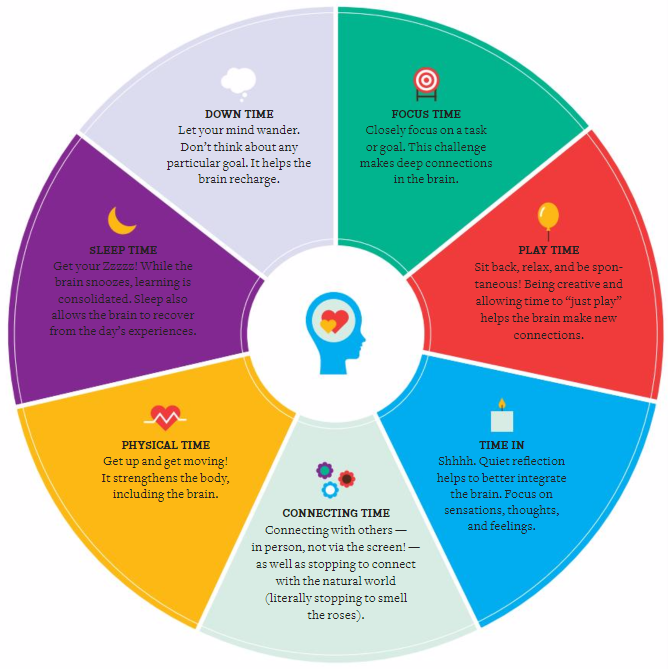
According to Dr Dan Siegel, the healthy mind platter below shows you the 7 daily activities, or the ‘nutrients’ that your brain need so as to function optimally. These seven daily activities make up the full set of “mental nutrients” that your brain and relationships need to function at their best.
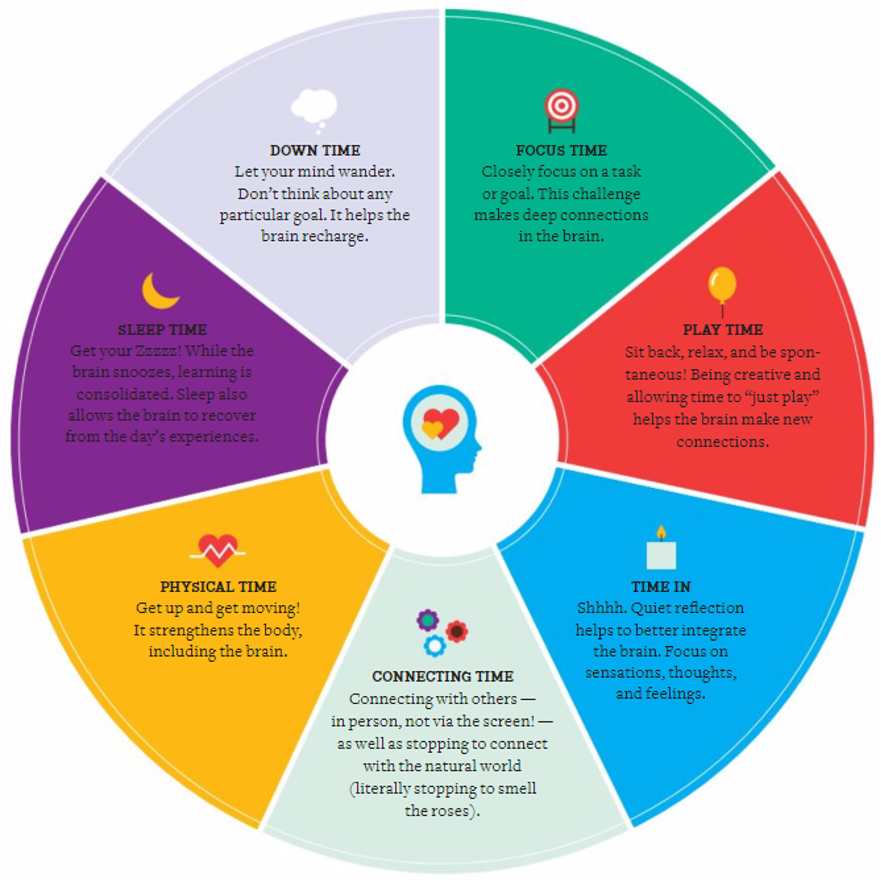
Image credits: https://static.wixstatic.com/media/45a0b5_e1123e581a50424fb4895478afcc9abd~mv2.png
Definition and suggestions for each category:
- Physical time:
When we move our bodies, aerobically if your health situation permits, we strengthen the brain in many ways.
Suggestion: Physical exercise, anything involving moving your body. Examples include: working out at the school gym, fitness corners, walking & running at the park/stadium, dancing to your favourite song, stretching and playing sports.
- Connecting time:
When we connect with other people, ideally in person, and when we take time to appreciate our connection to the natural world around us, we activate and reinforce the brain’s relational circuitry.
Suggestion: Spending time with friends during school breaks or going for a run or walk in the park with a family member
- Sleep time:
When we give the brain the rest it needs, we consolidate learning and recover from the experiences of the day.
Suggestion: Create a comfortable and peaceful environment for good and quality sleep.
- Down time:
When we are non-focused, without any specific goal, and let our mind wander or simply relax, we help the brain recharge.
Suggestion: Just let your mind wander. You may be walking, lying down with your favourite pillow or watching TV.
- Focus time:
When we closely focus on tasks in a goal-oriented way, we take on challenges that make deep connections in the brain.
Suggestion: Revision, reading complex material, or focusing on learning a new skill, such as playing an instrument or chess, or learning an activity such as riding a bike.
- Play time:
When we allow ourselves to be spontaneous or creative and playfully enjoying novel experiences, we help make new connections in the brain.
Suggestion: Laughing with your friends and not doing anything in particular, or it may include singing in a choir, or painting, or playing a board game. Play games that you enjoyed when you were younger.
- Time in:
When we quietly reflect internally, focusing on sensations, images, feelings and thoughts, we help to better integrate the brain.
Suggestion: Be mindful of your feelings. You can either let your mind wander and observe your thoughts, feelings or sensations, or you follow a script or recording and mentally walk through an activity.
Some people like to use a journal to reflect on their thoughts. Some express themselves creatively using art or music, some like to take a bath or shower, some like to take a walk or talk it through with someone. Some like to do yoga to really tune into their body sensations.
After becoming aware of the full spectrum of essential mental activities, make sure that at least every day you are bringing the right ingredients into your mental diet, even if for just a bit of time. Just as you wouldn’t eat only pizza every day for days on end, we shouldn’t just live on focus time alone with little time for sleep.
The key is balancing the day with each of these essential mental activities. Mental wellness is all about reinforcing our connections with others and the world around us; and it is also about strengthening the connections within the brain itself. When we vary the focus of attention with this spectrum of mental activities, we give the brain lots of opportunities to develop in different ways.
Seek help
Mental health is just as important as physical health. If you caught a flu, you would visit the doctor or take medication. Likewise, if you are not feeling well mentally, you will have to seek help. There are occasions when we realise that we cannot overcome the problems on our own and therefore it is important to seek help. Sharing your feelings and experiences with someone who will listen is important.
Share any stories about mental health struggles anonymously here: https://mentalhealthfilmfest.sg/shareyourstory. The story may be your own personal journey with a mental health/dementia issue or the story of someone close to you.
Here are some resources and articles that can provide more information on mental health-related issues:
- Mental Health Film Festival Singapore Helplines:
- https://mentalhealthfilmfest.sg/helplines
- Depression:
- https://www.healthhub.sg/live-healthy/509/mythsandmisconceptionsaboutdepression
- https://www.healthhub.sg/live-healthy/231/dont_mope_cope
- Stress Management:
- https://www.healthhub.sg/live-healthy/1182/be-a-master-of-stress
Reflect on the questions below with close reference to The Healthy Mind Platter and hopefully you will know how to nourish your mental well-being each day with the ‘right ingredients’.
Reflection Questions:
- Rate on a scale of 1-10 how well you think you keep up with each of these activities in the platter? (Considering you should be doing every part every day)
- Provide a reason to explain why each of the seven parts of the platter is important to you. Don’t write why you think someone else would think it’s important but why is it important to you. (For example, I might write that I need eight hours of sleep each day to function to the best of my abilities. It’s important to me to be a kind and easy-going person and to be able to focus on what I need to throughout the day and not sleeping enough gets in the way of this.)
- Pick one area you’d like to work on and decide a clear and specific way that you’d like to change it.
Sources: