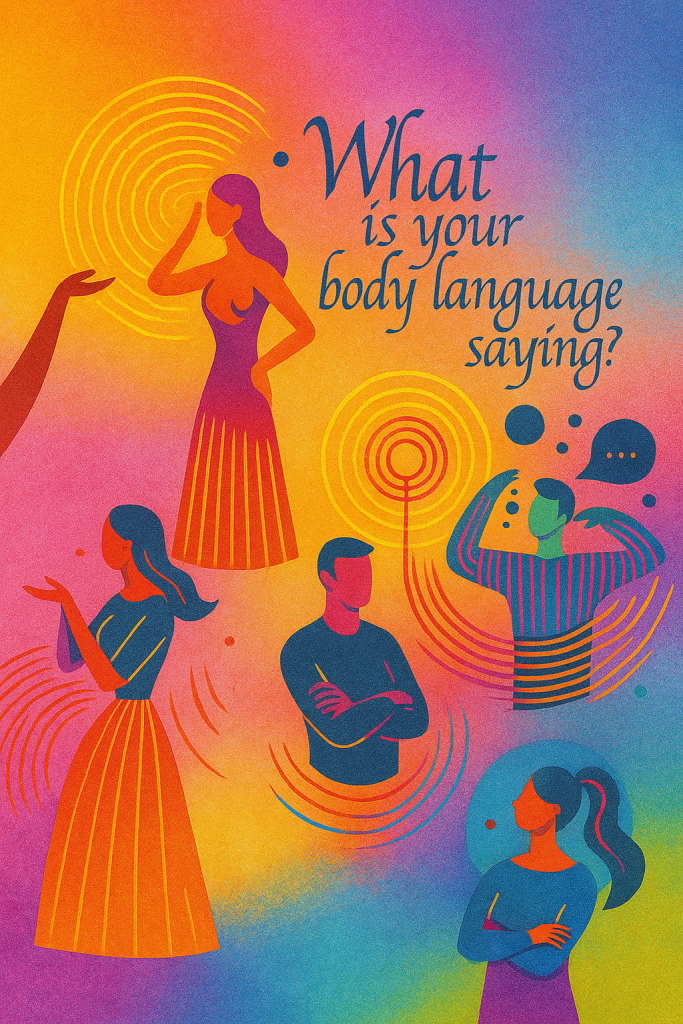
What is your body language saying?
Non-verbal communication is a rapidly flowing back-and-forth process that requires your full focus on the moment-to-moment experience. If you’re planning what you’re going to say next, checking your phone, or thinking about something else, you’re almost certain to miss nonverbal cues and not fully understand the subtleties of what’s being communicated. As well as being fully present, you can improve how you communicate nonverbally by learning to manage stress and developing your emotional awareness.
Types of Non-Verbal Communication
There are many different types of non-verbal communication. They include:
- Body movements (kinesics),for example, hand gestures or nodding or shaking the head, which are often the easiest element of non-verbal communication to control;
- Posture, or how you stand or sit, whether your arms are crossed, and so on;
- Eye contact, where the amount of eye contact often determines the level of trust and trustworthiness;
- Para-language, or aspects of the voice apart from speech, such as pitch, tone, and speed of speaking;
- Closeness or personal space (proxemics), which determines the level of intimacy, and which varies very much by culture;
- Facial expressions, including smiling, frowning and blinking, which are very hard to control consciously. Interestingly, the broad facial expressions that show strong emotions, such as fear, anger, and happiness, are the same throughout the world; and
- Physiological changes, for example, you may sweat or blink more when you are nervous, and your heart rate is also likely to increase. These are almost impossible to control consciously and are therefore a very important indicator of mental state.
Body language is an outward reflection of a person’s emotional condition. Here are some tips by Joe Navarro on how to speed-read it:
- Squinted eyes
What it can mean:
“I don’t like what’s going on.”
“Something doesn’t feel right.”
“I disagree with what you’re saying.”
We often squint our eyes when we’re trying to focus our vision on something that’s far away. But squinted eyes and a furrowed “glabella” (the part of the forehead above and between the eyebrows) can also be a sign of disagreement or confusion.
- Touching the neck
What it can mean:
“I’m struggling with something.”
“I’m stressed by what you’re saying.”
“I’m concerned about this situation.”
If someone is touching their “neck dimple” (the visible indentation at the middle-front of their neck), it could mean they’re distressed or insecure. If you notice someone doing this, try communicating with more empathy to help comfort or ease their anxiety.
- Rubbing the chest
What it can mean:
- “I don’t feel confident.”
- “I’m troubled by something.”
- “I’m very worried.”
This is another sign of stress and anxiety. If someone is rubbing the upper part of their chest with a palm of a hand (or even just the fingers), it can indicate discomfort or concern. I recently found myself doing this when discussing a family member’s health.
- Arched eyebrows
What it can mean:
- “I’m happy to see you!”
- “I’m pleasantly surprised.”
- “That’s a very intriguing point.”
If someone greets you with arched eyebrows (also called an “eyebrow flash”), it typically means they’re pleased to see you. This expression can also be used to show recognition when someone makes a good point in a conversation.
- Tilted head
What it can mean:
- “I’m interested in what’s going on.”
- “I’m listening and fully present.”
- “I agree with what you’re saying.”
Head movements can go a long way in showing whether or not someone is fully engaged, especially during video conference calls. A slightly tilted head displays awareness and attentiveness. And, when combined with a few nods, it can show approval of what’s being said or heard.
Important things to note about non-verbal communication:
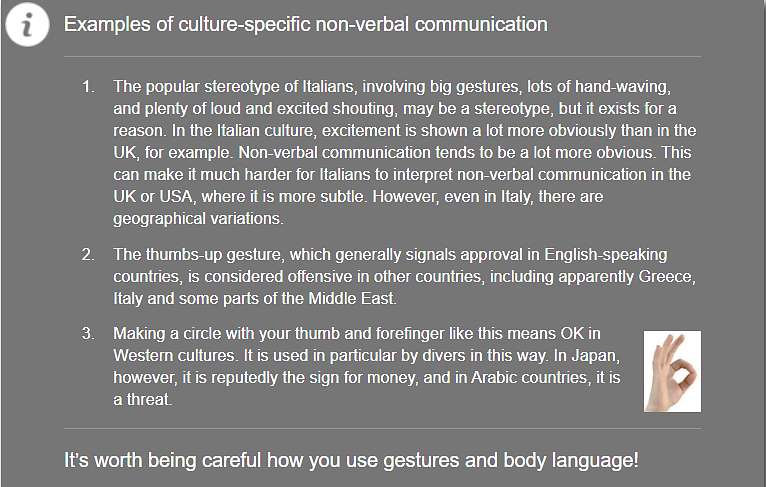
Non-verbal communication is influenced and driven by the context in which it occurs.
- It is important to note that non-verbal communication is not a language with a fixed meaning. This includes both the place and the people concerned, as well as the culture.
- For example, a nod of the head between colleagues in a committee meeting may mean something very different from when the same action is used to acknowledge someone across a crowded room, and again when two people are having a social conversation.
-
Non-verbal communication may also be both conscious and unconscious.
- Facial expressions are particularly hard to control, because we cannot see ourselves to know what we are doing. We may, therefore complicate communication by trying to convey one message consciously, while in fact conveying quite another unconsciously.
Interpersonal communication is further complicated because it is usually not possible to interpret a gesture or expression accurately on its own.
- Non-verbal communication consists of a complete package of expressions, hand and eye movements, postures, and gestures which should be interpreted along with speech (verbal communication).
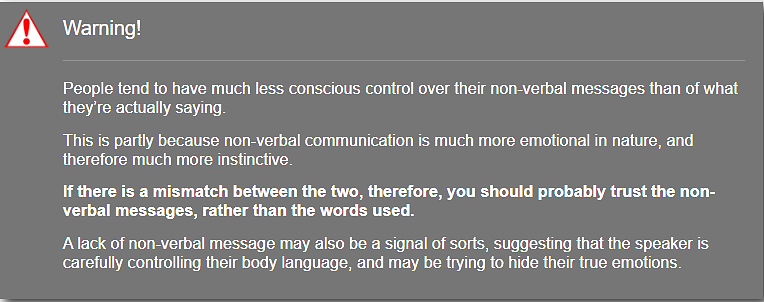
In conclusion, non-verbal communication is an extremely complex yet integral part of overall communication skills. However, people are often totally unaware of their non-verbal behaviour.
A basic awareness of non-verbal communication strategies, over and above what is actually said, can help to improve interaction with others. Knowledge of these signs can be used to encourage people to talk about their concerns and can lead to a greater shared understanding, which is, after all, the purpose of communication.
How can you improve your communication skills with others to forge deeper relationships?
Sources:
- https://www.skillsyouneed.com/ips/nonverbal-communication.html
- https://www.cnbc.com/2020/04/16/retired-fbi-agent-how-to-read-body-language-during-coronavirus-when-wearing-face-masks.html
Suggested Videos:
1. Former FBI Agent Explains How to Read Body Language | Tradecraft | WIRED
https://www.youtube.com/watch?feature=youtu.be&v=4jwUXV4QaTw&app=desktop (14.43mins)
2. Reading minds through body language
https://www.youtube.com/watch?v=W3P3rT0j2gQ (11.58mins)