
What is empathetic listening and how can it prevent suicide?
Suicide is preventable. To play a role, we need to start by becoming better EMPATHETIC LISTENERS. Empathy does not come naturally; it is a learned skill. While it is difficult to master, it starts from something basic – listening.
Often, when others come to us with their troubles, it is common that we start providing advice and responding with our own stories from our own experiences. Perhaps when your friend shared that he or she failed an examination, you responded with your personal struggles of coping with academics. Or when your family shared with you about their stressful day, you responded with an ever-ready phrase ‘me too’.
Unfortunately, we are hardwired to talk more about ourselves, which will not help a struggling friend.
Here is what we can do instead:
Listen and validate people’s feelings
We often share our own stories with good intentions – to motivate them and to show them that we understand how it feels like to be in their shoes. However, these responses may not achieve what we intend it to be. By not acknowledging that everyone’s experience is special in its own way, you may have unintentionally regarded their feelings as irrational and downplay the severity of the problem.
Personal anecdotes and phrases such as, ’things will get better’ and ’if I can do it, you can too’ may seem like harmless encouragements, but they actually disregard the feelings of the individual in crisis. And when one repeatedly gets their emotions undermined, they may inevitably experience an overwhelming feeling of isolation, loneliness and worthlessness. What your loved ones need is for someone to listen and to acknowledge what they are going through – not your experiences.
Listen to connect, not to provide solutions.
Often, we listen not to understand but to reply, and this stems from a lack of empathy towards our friends and families in crisis. As emotional human beings, we all need empathy; to have someone to understand, listen and validate– not negotiate – our own feelings.
Active, empathetic listening requires making an effort to listen more and to talk less, and to ask questions that encourages the other party to share and allows you to gain a deeper and clearer understanding of what they are experiencing. While listening, we may feel compelled to give advice. However, the goal of empathetic listening is to connect with – not changing – them. Acknowledge their feelings and what they are going through with an open mind without ‘preaching’ or judgement. Without having to say a lot, you will be surprised at the help you have provided by simply allowing them a safe space to express themselves.
It makes people feel important when you show them that they matter simply by listening.
If you are contemplating suicide, you need to:
- Postpone any urge to end your life. You may find your mood changing if you wait for these feelings to lessen.
- Remove anything in your surroundings which may be used to harm yourself on an impulse. Alternatively, move out of reach of these items.
- Stay around other people and let them know how you’re coping.
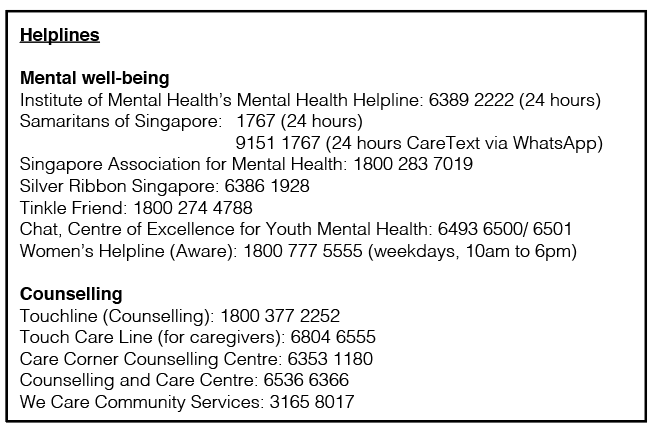
- Keep the contact numbers of hotlines and people you’re close with on speed dial. Call them just to hear a voice.
- Avoid drugs and alcohol. They intensify low moods and impair decision-making.
- If you feel you may be at immediate risk of harming yourself, call 995 or approach the A&E department of your nearest hospital.
- Approach an adult you trust and one whom you are close to. It may be a family member, friend, community leader, teacher, etc. Tell them what you are thinking of, or at least how you are feeling. Let them know you are struggling and at a loss.
- Be prepared for their reaction. They will want to help but may be startled or react emotionally. Let them know you want to work things out but can’t do it alone.
- Ask them to help you find additional support in person, online or on the phone.
You can write to pat@sos.org.sg, or call the organisation’s 24-hour toll-free hotline at 1800-221 4444. You can be anonymous and any information given will remain confidential.
Things can change for the better.
Most importantly, seek support from mental health or counselling professionals if you feel suicidal or anticipate recurring suicidal thoughts. They can work together with you in creating a long-term safety plan or finding ways to cope with difficult experiences, situations, or emotions.
Sources:
- https://www.sos.org.sg/blog/what-it-means-to-listen
- https://www.suicideispreventable.org/
- https://www.sos.org.sg/blog/suicide-warning-sign-here-where-to-start
- https://www.sos.org.sg/get-help/if-i-am-feeling-suicidal