Plight of migrant workers in Singapore
Dr Mohan Dutta states that migrant workers are an invisible community in Singapore. Advocacy group Transient Workers Count Too (TWC2) calls them the “hidden backbone” of Singapore society. Singapore’s 1.4 million foreign workers make up about one-third of the country’s total workforce, according to government figures. Most of the low-wage workers are from India, Bangladesh, Myanmar, China and other countries and they normally work in industries like manufacturing or construction.
TWC2’s vision statement states that, “All labour is dignified and should be treated with respect and consideration. Ethnicity, colour, gender, language, religion or class are irrelevant – no worker should be subjected to inhumane or degrading treatment.”
In 2020, Covid-19 clusters detected in the overcrowded dormitories and industrial worksites highlighted the poor living conditions of vulnerable migrant workers. With no legal maximum occupancy rules, in pre-Covid times it was normal for up to 20 men to share a room in a dorm.
The pandemic has brought about added stress to the migrant workers due to the almost impossible feat of adhering to social distancing rules in the tiny spaces which they were living in. Their right to live in Singapore is tied to their job and their employer must provide accommodation, at a cost. Therefore, due to fear of losing their jobs, many do not complain about their living and working conditions. “Not only are they unseen, but their voices are also unheard,” says Dr Dutta, a professor who studies the intersection of poverty and health at Massey University in New Zealand.
Zakir Hossain Khokan, a migrant worker from Bangladesh shares that his room which measures around 6m by 7m, is shared by up to 12 men. In a usual dormitory, each floor is home to 15 such rooms – or up to 180 men assuming each room is fully filled. They share one toilet facility, with six basins, shower cubicles, toilets and urinals.
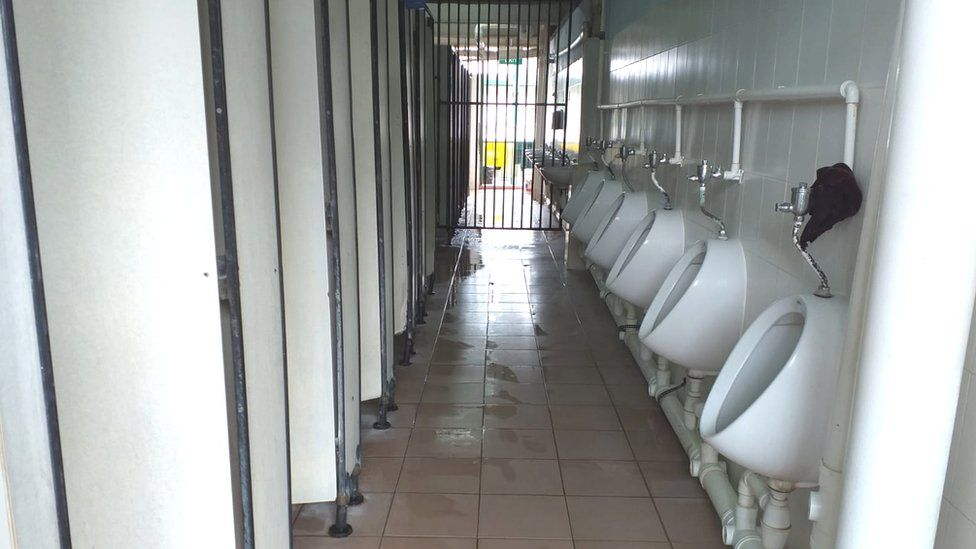
Image credits: https://www.bbc.com/news/world-asia-54082861
Government guidelines state that there should be 15 beds to one toilet, shower and sink. On a daily basis, they commute from their dorms in packed vans to building sites where they work and take breaks alongside men from other crowded dorms – perfect conditions for the virus to spread.
Non-governmental organisations (NGOs) in Singapore such as Migrant Worker’s Centre (MWC) and Transient Workers Count Too (TWC2) promotes fair treatment for migrant workers and provide opportunities for social acceptance and integration through outreach activities, community engagement, advocacy and public education. They also extend assistance to workers in need to ensure that they have fair resolution of their cases, dignity in work and living conditions, access to medical care, and protection of their rightful autonomy. By engaging in public education, they also strive to promote the social conditions in which exploitation, abuse and injustice become history.
What else can we do to help migrant workers?
- Be their voice and advocate
Voice out concerns and push for changes to improve their safety and well-being. News of the tragic deaths of migrant workers in road accidents and pictures of migrant workers travelling on the roads in unsafe conditions highlighted the need for things to change. Bridget Chen started a petition to “appeal to Land Transport Authority (LTA) to review outdated practices, and make it mandatory for employers to transport workers by safe and humane standards, such as hiring vans, buses or even using old SBS buses or installing collapsible seats with seat belts like in SUVs.
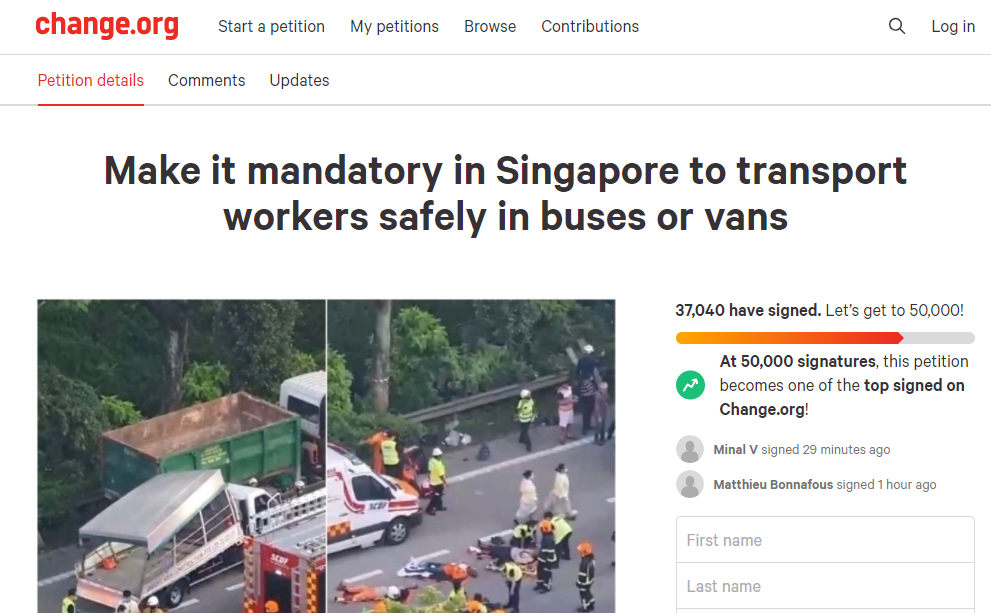
Image credits: https://www.change.org/p/land-transport-authority-make-it-mandatory-to-transport-workers-in-buses-or-vans?redirect=false
- Get involved with organisations who actively seek to meet the needs of the migrant workers
Non-profit organisation group ItsRainingRaincoat aims to improve the lives of migrant workers in Singapore, and build bridges to strengthen their integration into our broader community. They do this by using imaginative, innovative, authentic and nimble strategies.
Watch this video to find out how an encounter with migrant workers led Ms. Dipa Swaminathan to start ItsRainingRaincoat:
You may not be a lawyer like Ms. Dipa (for now), or have plenty of resources at hand, but a word of appreciation or small act of kind gesture to the migrant workers for their contributions, can light up their day.
Do visit: https://www.facebook.com/itsrainingraincoats to find out more on how you can contribute to the cause.
What are the other vulnerable and ‘overlooked’ groups of people in Singapore? What can you do to help improve their circumstances?
Sources:
- https://lkyspp.nus.edu.sg/gia/article/meritocracy-in-singapore-solution-or-problem
- https://www.bbc.com/news/world-asia-54082861
- https://time.com/5825261/singapore-coronavirus-migrant-workers-inequality/
- https://www.straitstimes.com/singapore/stepping-up-in-a-crisis-how-migrant-workers-took-on-leadership-roles-during-covid-19
- https://twc2.org.sg/