There’s nothing like listening to your favourite song on blast. But while jamming through a workout or bopping along to your playlist as you go about your daily tasks, you are putting yourself at greater risk of losing your hearing prematurely.
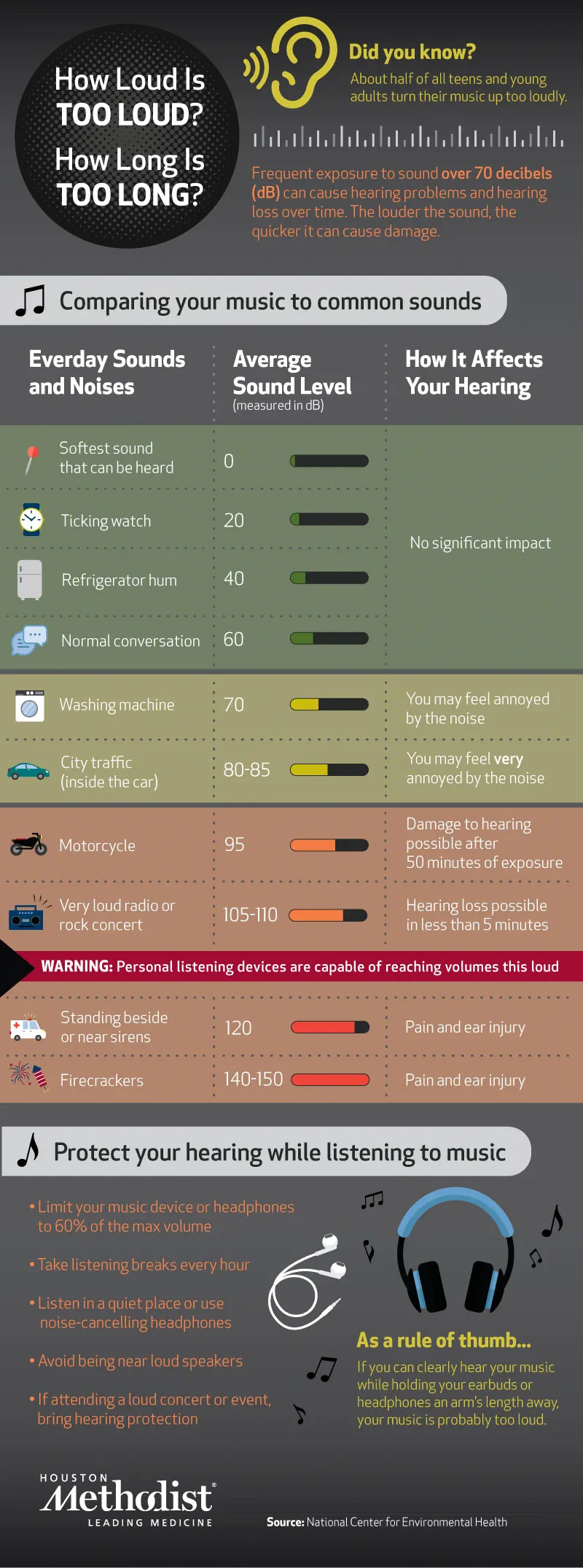
The World Health Organization estimates that 1.1 million teenagers and young adults are at risk for developing hearing loss from exposure to noise through headphones, at loud concerts, or at sporting events. Sounds are everywhere, and the volume of a sound is described in decibels (dB). Sounds less than around 70 dB are safe and won’t typically affect your hearing. Overtime, exposure to sound over 85 decibels can impair hearing. It’s not uncommon for headphone volume to reach 100 decibels – and rock concerts can register a whopping 120 decibels. As sounds get louder and/or the amount of time you listen to loud sounds gets longer, damage to your hearing becomes more and more likely.
A study by Johns Hopkins University showed that only 8 percent of adolescents and young adults are aware of the potentially damaging and sometimes permanent effects of noise-induced hearing loss. Young people are especially susceptible since many teens frequently wear headphones to listen to music, watch movies, or play video games.
“What many people may not realize is that the maximum volume of personal listening devices is well above 70 dB, and when you’re using earbuds or headphones to listen to your music the sound is going directly into to your ear,” explains Dr. Wang. “Listening to your music too loudly, as well as loudly for extended periods of time, can indeed cause damage to your hearing over time.”
“Our ears are incredibly complex and sensitive. There are thousands of cells with millions of tiny hair-like structures in our inner ear that facilitate hearing, but these cells and structures can be damaged by loud sound,” warns Dr. Brian Wang, ear nose and throat doctor specializing in hearing loss at Houston Methodist.
“If damage accumulates over time and causes you to lose hearing, you can’t get it back. Similarly, if you’re exposed acutely to a very loud noise like a firecracker, it’s very hard to recover from that trauma.”
If the noise around you is so loud that you have to shout to be heard, there may be a chance that you have some trouble hearing. Loud noise can damage the parts of your inner ear that detect sound and send signals to the brain. Temporary hearing loss can happen when you are around loud noises. If you have temporary hearing loss, you won’t be able to hear as well as you normally do for a while.
It is time to learn and practise healthy hearing habits.
Experts recommend the 60/60 rule: Listen through your headphones for no more than 60 minutes at a time at no more than 60 percent of your device’s maximum volume
- Turn down the volume
- Is loud always more fun? Today’s maxed out volume is tomorrow’s inability to enjoy dinner conversations or university lectures. Most smartphones have a volume limit that allows you to limit the volume automatically. It is recommended to set the volume control at no more than 60 percent of the maximum volume.
- At home, lower the TV volume, turn down the radio and take other steps to keep excessive noise to a minimum in your home.
- Make family dinners a time for easy conversation, without the background noise of music or kitchen appliances.
- Keep track of time
Limit listening time on headphones and take regular breaks to give your ears a rest. The damage from exposure to noise is cumulative. The louder the noise, the less time it takes for damage to occur. Give your ears a rest by not wearing headphones or ear buds all the time. Listen to the peaceful sound of silence or the music of nature.
- Protect your ears
- Bring ear protection along on family outings to sporting events, concerts and movie theaters where sound can be especially loud.
- A ticket to a concert or sporting event may be costly, but protecting your hearing is a fraction of the price. A pair of inexpensive foam earplugs or earmuffs can prevent exposure to excessive noise.
- Avoid standing near loudspeakers.
- Use your smartphone to help you keep track of decibel levels. Download a volume monitor app and use it when in doubt of noise levels.
- Caught unaware as a siren or loud explosion occurs? In an emergency, cover your ears with your hands to block the sound.
- Buy quieter appliances, especially frequent-use items like hair dryers, and insist all family members use hearing protection when mowing the lawn or using power tools.
- Schedule a hearing test
A regular hearing checkup is an easy and simple yet important step to take to protect your family’s hearing health. Schedule hearing evaluations as part of annual health check-ups.
5. signs it is time to see an audiologist
Sign 1: You’re not hearing well in certain environments or situations. Whether you’re turning the TV volume up louder and louder or dreading social situations because you don’t always hear well enough to keep up with conversations, don’t ignore changes you notice in your hearing.
Sign 2: Someone else has noticed a change in your hearing. Dr. Martin notes that it’s not uncommon for hearing changes to first be noticed by a spouse, child, loved one or friend — not the person with hearing loss.
Sign 3: You have pain, pressure or drainage in your ears. These symptoms aren’t just themselves uncomfortable — they reduce hearing. They’re also typically a sign of an underlying ear problem that needs to be treated.
Sign 4: You’ve noticed a ringing in your ears. More formally called tinnitus, this early sign of hearing loss can also sound like static, buzzing, humming or cricket-like sounds.
Sign 5: You have a family history of hearing loss. Even if you’re not having trouble hearing yet, having a family history of hearing loss is a good reason to establish a relationship with an audiologist and get an early baseline.
It’s never too soon to be educated about the importance of healthy hearing habits. The smart listening behaviours will benefit you in years to come.
What healthy hearing habits will you start practising today?
Sources:
- https://www.houstonmethodist.org/blog/articles/2021/feb/headphones-and-your-health-can-loud-music-cause-hearing-loss/
- https://kidshealth.org/en/kids/rock-music.html
Take the High-Frequency Hearing Test | Brain Games
https://www.youtube.com/watch?v=sZHWY1KBHwc (2.50 mins)
How Old is Your Hearing? – Interactive Test for Your Ears
https://www.youtube.com/watch?v=iN3PBpInNJM (3.16 mins)
Can You Trust Your Ears? (Audio Illusions)
https://www.youtube.com/watch?v=kzo45hWXRWU (3.29 mins)