Archives For Uncategorized

Striving for growth

January 3, 2026 — Leave a comment

Competition is an unavoidable aspect of life. During competitions, there are winners and losers. It is bound to make some nervous, but it shouldn’t be something that makes people quake in fear either. Almost anything can be made into a competition. Whether it’s sports, dancing, getting a job, or top grades, it is natural for people to compete, especially in skills they are confident with.

Some argue that competition encourages a child to excel in today’s fiercely competitive world where we compete for everything; in academics performance, CCAs and even friendships. Others say it can destroy self-esteem and lead to disappointment and resentment.

However, a healthy level of competition is always welcome, if not, necessary. Healthy competition involves teamwork and positive participation of all team members. Competitions that are non-academic in nature can provide opportunities for students who have other talents, gifts and creativity to shine, helping them to gain confidence. Healthy competition in schools can also give students opportunities to compete without suffering severe repercussions that they might face in the adult world. This will make them better prepared for the competition of the real world and help them learn from failures.

However, in highly competitive environments such as schools, competition can become unhealthy.

Having a greater awareness of the unhealthy competition in your external environment can help you manage better when you feel that you are not performing up to standards.

Here are some statements to determine if you are in an environment where there is unhealthy competition. Put a tick in the boxes that most reflect your experience.

Statements

Yes, all the time!

Yes, most of the time

Yes, sometimes

No,  what are you talking about?

1

You feel like a failure if you are not in first place; you will be looked down upon for not being first.


2

You are devastated by failure.


3

You are overwhelmed by fear and nervousness during a competitive event. There is no sense of achievement or joy in the competition.


4

You do extracurriculars activities even if you don’t enjoy them because you feel judged depending on what activities you do or do not do.


5

There is more focus on the end result, not on the progress.


6

When put in a team, people focus on proving themselves than displaying teamwork in order to achieve a common goal.


7

People will scheme and tear others down in order to win.


8

There are people who put more emphasis on what someone didn’t do well than on what they did well. There are mainly criticisms and minimal encouraging words.


9

People don’t show appreciation for other’s accomplishments.


10

People focus more on how others are performing than on their own performance.


If you have answered ‘Yes, all the time!’ and ‘Yes, most of the time’, it shows that you are often in an unhealthy environment that limits your growth. The impact of being in unhealthy competition with others in the long-term can be harmful to your self-esteem.

Many of us tend to blame only ourselves for not being able to perform well in school or progress fast enough. We may tell ourselves that we are “weak” for being overwhelmed by the competitive environment since competition is normal. While our mental strength and mindset affects our growth, so does the external environment. For example, no matter how strong a flower is, if it is repeatedly trampled, cut, neglected, and surrounded by a rocky environment, it’s going to have a hard time growing. It is best to be in an environment where there is healthy competition, allowing the plant to grow and thrive.  

If you find that your school has an unhealthy competition culture, unfortunately, there might not be much you can do to change it. However, you can relieve some of the pressure you have probably put on yourself.

Recall and reflect on the video that discusses fixed and growth mindset. How can you change to have a growth mindset?  

Realize that it’s ok not to be number one all the time. You are a human; it is okay to make mistakes and then try again. You are not defined by what grades you get or what extracurricular activities you are involved in. If you want to actually grow, try not to focus on what other people are doing. Focus on improving yourself through activities that you enjoy. You can succeed without tearing others down. Be around peers who challenge, encourage and work with you to improve.
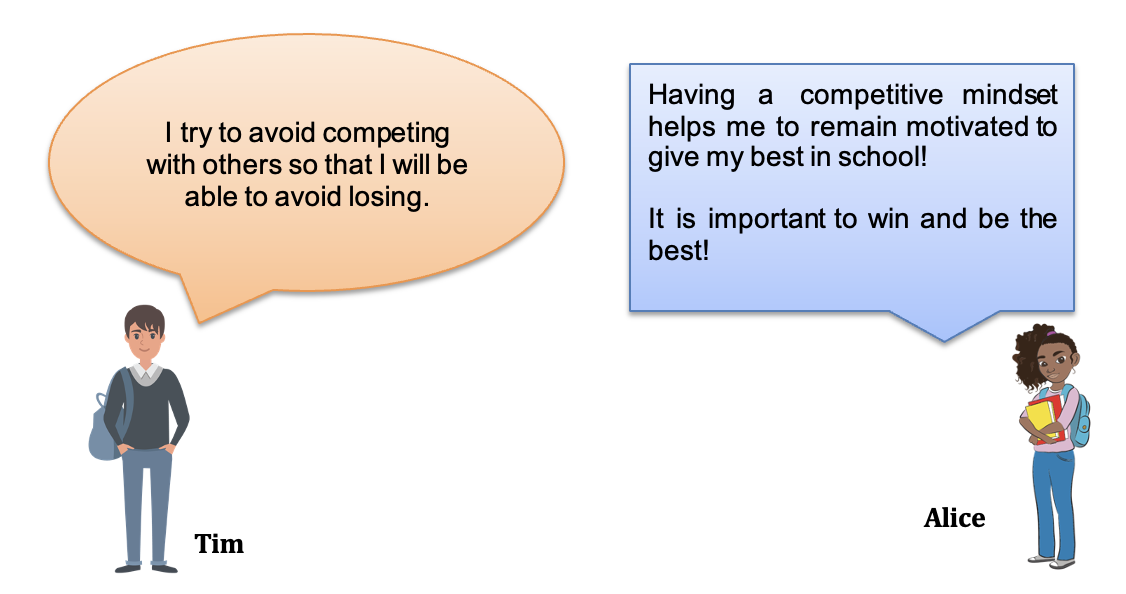
  1. Do you relate more to what Tim or Alice is saying? Support your answer.
  2. Why do you think Tim wants to “avoid losing”? How can Tim change his mindset?
  3. What can you learn from Alice? Do you agree that it is “important to win and be the

    best”?   

Sources:

  1. https://mindsagewriting.medium.com/competition-culture-in-schools-68478f147601
  2. https://www.ineos.com/inch-magazine/articles/issue-5/debate/

3. https://www.schooliseasy.com/tutor/tutor-blog/is-competition-healthy-in-schools-the-pros-and-cons/

You might have heard that some people survive on less than 4 hours of sleep. There are also some who feel that they are nocturnal creatures; people who are more alert and active at night and therefore decide to only study at night (hmm… or is that merely procrastination?). However, this decision can lead to them feel extremely fatigued in the day, and they will mostly likely find themselves nodding off unwittingly in the day or desiring more caffeine-fix to stay awake.

Can I ‘borrow’ one hour of sleep on the weekday as I need to study for an exam, and then ‘pay it back’ during the weekend? How does ‘sleep debt’ work?

Here is how science explains sleep. Losing even an hour puts you in sleep debt. Many people think of sleep like a bank account: Withdraw an hour on Monday, then deposit an extra one on Saturday to break even. But the equation is more complicated than that, says Dr. Cathy Goldstein, an associate professor of neurology at the University of Michigan Sleep Disorders Center. “You might be getting some alertness benefits by sleeping longer on the weekends, but as far as truly making up for the lost sleep during the week, you really can’t make up for it hour by hour,” she says.

Research has suggested that a person would actually need four days of adequate rest to make up for even one hour of sleep debt. Since many people get less sleep than they need just about every weeknight, Dr. Goldstein says it’s almost mathematically impossible to close that gap over only two weekend nights. “The sleep debt is just accumulating over time,” she says.

Your circadian clock is more sensitive than you think

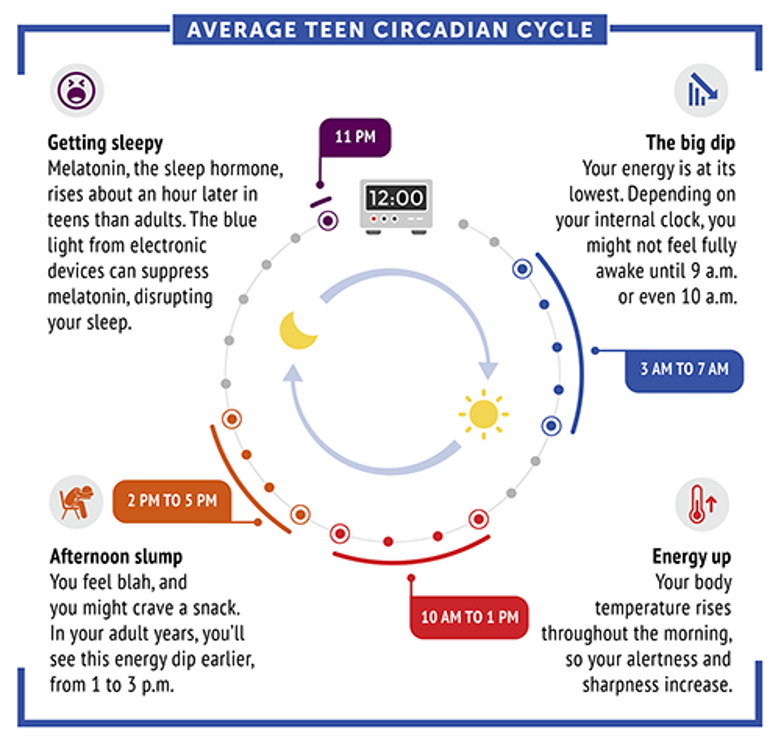
Pulling an occasional all-nighter or extra-early morning may not seem like a big deal. But Dr Goldstein says fatigue isn’t the only consequence of an erratic sleep schedule; it also disrupts your circadian clock, an internal system that regulates hormone levels to promote sleep at night and alertness during the day.

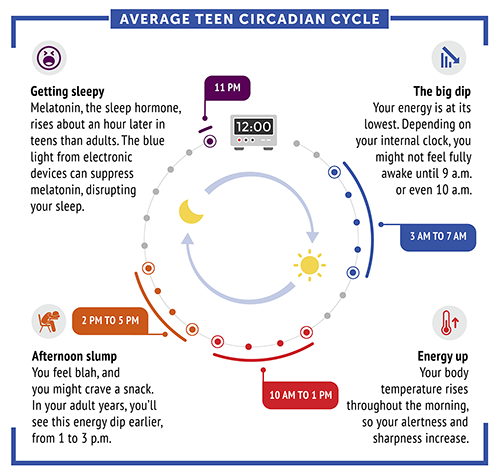
Your circadian clock naturally starts secreting sleep-promoting melatonin around 9 p.m., and levels stay elevated throughout the night before dropping off in the morning, according to the National Sleep Foundation. Light exposure influences circadian rhythms somewhat — which is why you may have trouble sleeping after using screens at night — but if you maintain stable sleep and wake times, your internal clock should be similarly reliable.

  Image credits: https://www.nigms.nih.gov/education/fact-sheets/PublishingImages/circadian-rhythms/circadian-cycle.png

Here, Dr Goldstein explains the consequences to circadian disruption (of any degree):

  1. Higher chances of suffering cancer, cognitive decline and early death
  2. Obesity issues. Research linked losing just an hour of sleep to eating about 200 extra calories the next day. The new Current Biology study found that sleep-deprived people snacked more after dinner and experienced negative metabolic changes compared to people who got enough sleep for 10 days in a row, and those changes could not be fully corrected through weekend sleep. 
  3. Worsens productivity

There is lower efficiency displayed at school and workouts the next day, creating a ripple effect that can’t be easily corrected by sleeping more during the weekend.


Therefore, it is important to maintain your body’s natural circadian cycle/rhythm. So, what are the recommended activities that you can be involved in throughout the day?

Our experience in life is predominantly shaped by our senses – what we see, smell, hear, taste, touch, and our awareness of body and balance.

More often than not, we tend to take our senses for granted. We only realise the importance of our senses when we lose them. For example, it feels terrible when we have a blocked nose and our food tastes bland because we lost our sense of smell or taste temporarily.

The impact of COVID-19 has affected the senses of COVID survivor. On the morning after Christmas in 2020, Carolyn Hinds woke up and realized she couldn’t smell or taste anything. Other signs of COVID-19, like fever, cough and muscle aches, came in the following days. Those symptoms subsided with time, but her lack of smell and taste did not. Close to two years later, Hinds who is 38 years old, can barely smell anything, and her sense of taste remains warped—sweet things leave a strange aftertaste, salty foods upset her stomach and spice makes her lips and tongue burn but tastes like nothing. “These things will mess with you mentally and physically because it changes the way you experience the world,” she says. Almost two years into the COVID-19 pandemic, there are a lot of people who have similar experience with Hinds.

The inability to fully experience and feel everything around us can cause us to feel detached and withdrawn. Dr Zara Patel, a head and neck surgeon and smell-loss expert at Stanford University explains that “the inability to partake in the simple pleasure of life really starts to weigh on people and detracts from their overall quality of life and even leads to depression and anxiety and social withdrawal.” 

What happens if you are ‘feeling nothing’?

The feeling of ‘not feeling’ anything might be called emotional numbness. It’s hard to describe what feeling numb is like, but you’ll intuitively know it if you’ve felt it. Know that you’re not alone.

Many people report feeling disconnected from the world around them sometimes, feeling “flat,” or feeling like life is on autopilot. Perhaps events and people seem muted, or less colorful somehow. It can also be described as chronically running on empty, feeling ungrounded, having a hard time focusing, or losing track of time throughout the day. Feeling numb can make it hard to connect with others, which creates loneliness or a sense of isolation in your experience.

Emotional numbness, also called “affective blunting,” is most commonly associated with depression. It can also occur with other mental health conditions and medications. It can be linked with states like dissociation or depersonalization — feelings of being disconnected from yourself, your emotions, or your surroundings.

The good news is, emotional numbness is usually temporary and treatable. This article will walk you through causes, treatment, self-help strategies, and additional resources.

“Why do I feel nothing?

There’s no one answer to this question, but experts have a pretty good theory. Emotional numbness can occur when the limbic system is flooded with stress hormones. This is the area of the brain that deals with emotional regulation and memory.

There’s an emotional component as well. High-stress situations can tax our emotions and exhaust the physical body. The combination of the two can lead to a feeling of being drained and, consequently, numb. Numbness may also be a coping mechanism to prevent more pain from entering the psyche. This is especially true for those in high-stress environments and those who have experienced trauma.

The mental health conditions most often associated with emotional numbness are depression, anxiety, and post-traumatic stress disorder (PTSD).

Emotional numbness can also come up in some dissociative disorders, which are connected with a personal history of trauma. Depersonalization is the sense of being disconnected from yourself, as if you’re having an out-of-body experience.

Anyone can experience this disconnect. Sometimes, it’s linked with an anxiety disorder or depersonalization-derealization disorder. It’s also one of the less talked about symptoms of a panic attack.

In some cases, antidepressants may be the cause of emotional numbness. A 2017 study showed that 46% of research participants experienced emotional numbness as a side effect of medication, most commonly with a classification of antidepressants called selective norepinephrine reuptake inhibitors (SNRIs).

What to do when you feel numb

In the moment, you probably don’t feel like doing much at all. Sometimes, just curling up in a blanket and making yourself comfortable can feel soothing. Other times, it can help to move around, talk with a friend, or release some pent-up emotion. We talk more about these methods below.

  • Move your body

Emotional numbness may feel like being “frozen” for some people. If this is the case for you, exercise might be the last thing on your mind. However, doing any form of physical movement is a great way to get out of your head and into your body. Try just walking around your room and shaking your arms out to connect with your body, or put on a lively song and move to the music in a way that feels good.

If you want to crank it up a gear, try working up a sweat with a bike ride, a brisk walk outdoors, swimming, or some yoga.

If none of these options sound appealing, remember what physical activities you used to love as a child — the hobbies that brought you pure, unbridled joy. Maybe that’s roller-skating, horseback riding, or boogie boarding. Do more of these activities to see if you can tap into that youthful exuberance.

For optimal health, the Centers for Disease Control and Prevention (CDC)Trusted Source recommends getting at least 30 minutes of moderate physical exercise at least 5 days a week. Moderate exercise means you’re breaking a sweat and your heart is working hard. Regular exercise will get the endorphins flowing and perhaps help you feel more alive, yet grounded in your body.

  • Talk it out

Sometimes, when we feel like we have no one to talk to, we shove our uncomfortable emotions down because we feel safer that way. Do this for long enough, though, and you might find it easier to feel nothing at all — as in, emotional numbness.

While it’s hard to be vulnerable, it’s also hard to keep everything bottled up inside. It can help to open up to someone you trust about what you’re going through. You might say something like, “I notice that lately I don’t feel much of anything at all. Has this ever happened to you?”

The bonding experience will release a neurotransmitter called oxytocin, also known as the cuddle hormone. This feeling of connection may be a welcome relief from the sense of “nothingness” you may be used to.

If you don’t feel like opening up to a friend or family member, you might consider reaching out through an online forum, a support group, or a session with a therapist to talk about what you’re experiencing.

  • Try grounding exercises

If you feel numb and disconnected, it might help to gently bring your awareness to your body and your surroundings using grounding techniques. These techniques are often recommended for coping with PTSD and anxiety because they help reconnect you and remind you of the present and help you to emerge from feelings of distress.

Grounding can be physical or mental. Here are some ideas to try:

  • Breathe deeply and notice your breath moving in and out of your body.
  • Touch a familiar object and notice how it feels in your hands. Is it heavy or light? What texture does it have? Does it feel warm or cool?
  • Notice the colors of objects around you. Try to find and name five blue, green, or red objects in the room.
  • Hold a piece of ice in your hand. How does it feel as it melts? Challenge yourself to name the sensations.
  • Put on a favorite song and really listen to it. How does it make you feel? Record your feelings in a journal.

Here is a link on other grounding techniques: https://www.healthline.com/health/grounding-techniques#physical-techniques

  • Release pent-up anger

If you suspect that the emotional numbness has to do with repressed frustration, consider going to a beach or a lake and throwing stones into the water. Or you might consider taking kickboxing classes or booking a day at a batting cage.

You can also look up a local Rage Room. Once there, you’ll be given safety gear and weapons to smash things, like plates and old TVs, in a safe environment.

  • Learn about emotions

Self-study can be an effective tool to become familiar with what you’re feeling. Sometimes, your feelings are too complex to be expressed or verbalized.

Create a mood diary, set a daily alarm, and jot down your emotions every day at the same time. Assign what you’re feeling a number between 1 and 10. If digital note-taking is more your style, try mood tracker apps.

There’s way more to the world of emotions than just happy, sad, and angry. If you’re trying to figure out what you’re feeling, refer to this list of emotions — 54 of them, to be exact.

We hope that after trying some of the tips and advice, you will emerge more confident in expressing your emotions in a healthier and more effective way.

Most emotions researchers agree on these five Universal Emotions: sadness, anger, disgust, fear and enjoyment, are the emotions that all humans, no matter where or how we were raised, have in common. To help you understand your emotional world and improve your emotional awareness and responses, take some time to explore this website: http://atlasofemotions.org/#introduction//

Which of the emotion(s) do you experience most frequently? How can you manage your emotions positively?

Sources:

  1. https://time.com/6113909/covid-19-smell-taste-loss/
  2. https://sciencing.com/do-parts-brain-control-5754118.html
  3. https://psychcentral.com/depression/i-feel-nothing-emotional-numbness#long-term-methods

Self-esteem matters

January 2, 2026 — Leave a comment

Self-esteem is the confidence in one’s own worth or abilities; self-respect.

“Oh, I wish I could have bigger eyes, a sharper nose, a slimmer build … I just want to look like…!” Does this sound familiar? Do you ever wish you could change something about your body or appearance? Do you tend to criticise yourself as you filter your pictures? If so, you’re not alone. More often than not, people become unsatisfied with their looks and seek ways to improve their appearance so that they can feel more confident about themselves. Their low self-esteem and sense of inferiority might be due to comparisons with others, negative comments from loved ones, or the inability to meet ideal and unrealistic expectations set by society and themselves.

An important question is: Who should have the power to define our worth? Do we let society define what attractiveness or beauty means?

Imagine a high-achieving student who takes a difficult exam and earns a failing grade. If she has high self-esteem, she will likely attribute her failure to factors like not studying hard enough, or it was just a particularly difficult examination. What she doesn’t do is conclude that she must be stupid and that she will probably fail all future tests too. She knows that by putting more effort or reviewing studying techniques may help her perform better academically. Having a healthy sense of self-esteem guides her towards accepting reality, thinking critically about why she failed, and problem-solving instead of wallowing in self-pity or giving up. She believes that there is always a chance for improvement.

Another scenario goes like this: Think about a young man out on a first date. He really likes the young woman he is going out with, so he is eager to make a good impression and connect with her. Over the course of their discussion on the date, he learns that she is motivated and driven by completely different values and has very different taste in almost everything. Instead of going along with her expressed opinions on things, he offers up his own views and isn’t afraid to disagree with her. His high self-esteem makes him stay true to his values and allows him to easily communicate with others, even when they don’t agree. To him, it is more important to behave authentically than to focus on getting his date to like him.

After reading these examples, do you feel that having high self-esteem is important?

People with healthy self-esteem:

  1. Are less critical of themselves and others.
  2. Are better able to handle stress and avoid the unhealthy side effects of stress.
  3. Are less likely to develop an eating disorder.
  4. Are less likely to feel worthless, guilty, and ashamed.
  5. Are more likely to be assertive about expressing and getting what they want.
  6. Are able to build strong, honest relationships and are more likely to leave unhealthy ones.
  7. Are more confident in their ability to make good decisions.
  8. Are more resilient and able to bounce back when faced with disappointment, failure, and obstacles

You likely have high self-esteem if you:

  • Act assertively without experiencing any guilt, and feel at ease communicating with others
  • Avoid dwelling on the past and focus on the present moment
  • Believe you are equal to everyone else, no better and no worse
  • Reject the attempts of others to manipulate you
  • Recognize and accept a wide range of feelings, both positive and negative, and share them within your healthy relationships
  • Enjoy a healthy balance of work, play, and relaxation
  • Accept challenges and take risks in order to grow, and learn from your mistakes when you fail
  • Handle criticism without taking it personally, with the knowledge that you are learning and growing and that your worth is not dependent on the opinions of others
  • Value yourself and communicate well with others, without fear of expressing your likes, dislikes, and feelings
  • Value others and accept them as they are without trying to change them

Given the positive outcomes associated with high self-esteem, it is definitely a worthwhile endeavor to look into how self-esteem can be developed.

Here are some practical tips on how to increase self-esteem:

1.    Stop comparing yourself with others

Comparing ourselves to others is a trap that is extremely easy to fall into, especially today with social media and the ability to project a polished, perfected appearance. It’s all too easy to get jealous of others on social media. Let us not forget that people usually choose their best moments to be displayed on social media. According to a study carried out at the University of Copenhagen, we start to feel envious when we compare our everyday lives with other people’s highlight reel – which is all social media really is. When you fall into the trap of comparing your private self with other people’s public personas, you are bound to feel inferior!

So here are some tips to combat social media envy:

·      Use social media to connect, not compare

Social networks are designed for positive interactions, not pointless and unhealthy comparisons. Keep your focus where it belongs. Take a genuine interest in other people’s activities, lives, and opinions rather than running yourself down by making it into a competition. You don’t have to give up Instagram, Facebook, or other social media platforms entirely. They are great tools for staying in touch with others. However, in order to combat jealousy, you need to keep a balanced perspective and be willing to take a step back when necessary. The only person you should compare yourself to is you. Strive to be a better ‘you’ than the ‘you’ from yesterday. 

·      Record your own achievements

If you have some good news to share, spread the positivity! There is nothing wrong in acknowledging your achievements and life highlights on your profile truthfully. Genuine and true friends will support and celebrate milestones with you. Record steps of progress that you have made. For example, “I finally managed to finish my homework!”, “I ran 1km today!”, “I tidied up my room!”. These accomplishments might be small or insignificant to others, but remember don’t compare yourself to the others. Be proud of yourself because you overcame your mental barriers, displayed discipline and determination, allowing you to achieve your goals! Your authentic posts may even encourage others to work harder at achieving their goals!

·      Limit social media time

The simplest way to avoid succumbing to envy is to limit the amount of time you spend reading other people’s posts. Never allow yourself to waste hours looking longingly through a feed or photo album. Set yourself a reasonable time limit per day to catch up with friends and with news. Spend your time wisely by learning something new or doing something that is positive to your body and mind.

  1. Develop a positive self-image

For some people, appearances have a huge impact on their self-esteem. Some people think, “When I get in better shape, I’ll like my body”. But it’s best to start the other way. First, accept your body. Embrace that we are all made differently. When you like and accept your body, it’s easier to treat it right.

Take care of your body by doing the following:

  • Select healthier food choices.Learn what foods are good for you, and how much is the right amount. Take your time when you eat and enjoy your food. Eating right helps provides you with the energy you need. When you treat your body right, you feel good about yourself. Go to: https://www.healthhub.sg/live-healthy/10/build_healthy_food_foundation to find out types of food you need to eat.
  • Get good sleep.Learn how much sleep you need for your age. Get to bed on time. Turn off screens hours before bedtime so you can sleep well. Teenagers need about 8-10 hours of sleep daily. You might think that you can function with just 3 or 4 hours of sleep but insufficient sleep can cause many negative consequences. Many studies show students who sleep less suffer academically, as chronic sleep loss impairs the ability to remember, concentrate, think abstractly and solve problems.
  • Be active every day.Your body needs to move to be strong, fit, and healthy. You can be active by playing a sport. You can run, walk, work out, do yoga, swim, or dance. Pick any activities that you like. Exercise can help relieve symptoms of depression too! Your brain experiences the release of endorphins when you exert yourself physically. Endorphins are a type of neurotransmitter, or chemical messenger. They help relieve pain and stress. For example, regular exercise can also positively impact serotonin levels in your brain. Raising your levels of serotonin boosts your mood and overall sense of well-being. It can also help improve your appetite and sleep cycles, which are often negatively affected by depression. Regular exercise also helps balance your body’s level of stress hormones, such as adrenaline. Adrenaline plays a crucial role in your fight-or-flight response, but too much of it can damage your health. What are you waiting for then? Get off the chair and start doing some push-ups and burpees!
  • Keep to a healthy weight.Calculate your Body Mass Index (BMI) here: https://www.healthhub.sg/programmes/93/bmi-calculator. Avoid trying fad diets or eating weight-loss pills to lose weight. When it comes to weight, the lower it is does not mean the healthier you are. If you have to lose weight to be healthy, exercise and eat well-balanced meals. Consult a qualified professional like a doctor, nurse or nutritionist, who can give useful and reliable advice. 

What will you do (or not do) to improve your self-esteem?

 Adapted from:

  1. https://kidshealth.org/en/teens/body-image.html
  2. https://positivepsychology.com/self-esteem/
  3. https://med.stanford.edu/news/all-news/2015/10/among-teens-sleep-deprivation-an-epidemic.html
  4. https://www.lifehack.org/600150/how-social-media-fuels-jealousy
  5. https://www.healthline.com/health/depression/exercise


How do we define ‘winning’? Does the term ‘winner’ then suggest that there must be ‘losers’?

In sporting competitions, the winners are the ones who complete the race in the shortest time or the team that scores the most goals. They are then awarded with trophies, medals and cash prizes as ways to acknowledge their victorious achievements.

In schools, those who perform well academically or those who display outstanding performance in their CCAs are publicly commended and rewarded with merit certificates or scholarships.  

As people enter the work force, the ones who are in the highest position, the ones who deem the most authority are regarded as the ‘winners’ because they have secured the highest position one can get and they receive a comfortable amount of pay every month.

In the above scenarios, these are how most people define ‘winners’. Their efforts are always rewarded and acknowledged.

Admittedly, the process of ‘winning’ is not easy because there is definitely a lot of effort and sacrifices to be made. Professional athletes have to be disciplined during their rigorous trainings and be selective in what they eat.  Students who perform well academically have to put in consistent effort and even have to sacrifice leisure time to focus on their revision. People who have reached the pinnacle of their careers have proven their abilities and would have sacrificed personal and family time to be the position they are in.

However, unlike in sports, there is no real scoreboard for life. We can’t look up at any one moment and know, objectively, how well we are doing. Many times you may wonder how your life stacks up by comparing yourself to others. However, studies have shown that making these social comparisons may lead to negative emotions. The platform of social media has especially been linked to depressive symptoms because the context is primed for people to compare their accomplishments to that of their friends.

In fact, the only real metric by which most people compare is financial success. Think about it for a second, what’s the sign of a successful book, movie, or sports contract? Books are defined by the number of copies sold, a movie by its box office revenue, and a sports contract by the salary. This is also true in day-to-day life. We often evaluate an opportunity based on its financial reward and we evaluate ourselves on our ability to earn money and spend that money on material things. To quote the film Jerry Maguire, we define success simply by asking the universe to “show me the money.” Ironicalluy, he later realised that love and friendship were more important than money alone.

Does money or financial success help us to feel like we are winning? No.

Consider this study conducted by Daniel Kahneman and Angus Deaton where they looked for indicators of psychological well-being in nearly half a million randomly selected American citizens. Their findings were profound as the research indicated once our basic needs are met, our happiness tends to plateau.

We tend to define success by money, yet money does not equate to happiness. It seems we have driven our lives into a crossroads: is success defined by money or by happiness? I say, it’s time to walk the off-road and make your own path.

You are likely to be winning at life if you incorporate three important practices into your daily routine. Without further delay, here they are:

  1. Gratitude

Gratitude as a life orientation goes beyond the appreciation that arises after help from others. Research has found that gratitude is strongly associated with psychological well-being when it is practiced as a habitual focusing on and appreciating the positive in the world. When you make the decision to emphasize gratitude, there is little room left for feelings of jealousy or envy. As quoted by the Zen Shin practice of meditation, “A flower does not think of comparing itself to the flower next to it. It just blooms.” Start a gratitude journal to give thanks to simple things in life. Remember to also be kind to yourself.

  1. Relationships

The quality of our relationships does not just impact our daily lives but also our long-term well-being. Dr. Robert Waldinger, Director of the Harvard Study of Adult Development, supported this notion with findings from research that began in 1938 with 268 Harvard sophomores but has now expanded to include their offspring and has amassed data from over 1,300 participants. One critical finding was how the role of relationships played in our overall health. The people who were happiest in their relationships at age 50 were the healthiest at age 80. Furthermore, Dr. Waldinger went as far as to emphasise that, “Loneliness kills. It’s as powerful as smoking or alcoholism.”

  1. Pursuit of Meaning

The Journal of Positive Psychology recently published two studies that tracked 400 Americans who fell into two groups: high happiness/low meaning levels and low happiness/high meaning levels. Characteristics of the “happy” group included avoidance of being constantly in conflicts with self or/and others. On the other hand, the “meaning” group spent more time helping others and focused on family or relationships. The study explains that the pursuit of meaning lends to a belief that one’s life matters. That purpose can foster life satisfaction. These studies reinforce the important roles that gratitude and quality relationships play in a “winning” life.

So when you’re looking for a scorecard on your life, don’t look at your salary, the size of your house, or the brand of your car. Instead, look inward towards your ability to enjoy your relationships and activities. That way, you’ll always win.

Discussion:

Below are some similes and metaphors about life.

(A)

“My mama always said life is like a box of chocolates. You never know what you’re gonna get!” – by the main character Forrest Gump in the movie Forrest Gump (1994)

  1. In the quote above, what is life compared to?
  2. What is the comparison trying to say about life?
  3. Do you agree or disagree with the simile? Why?
  4. In such a case, is there a purpose of ‘winning’ at life?

(B)

“The truth is you don’t know what is going to happen tomorrow. Life is a crazy ride, and nothing is guaranteed.”- by American rapper Eminem

  1. What is the metaphor in this quote?
  2. In your own words, rephrase the two sentences.
  3. Referring to your explanation in (2), what attitude should you take when being on this ‘crazy ride’ called life?
  4. How can you ‘win’ in this life? What preparations should you make?

(C)

“Your life is a blank page. You write on it.” – by Donald Miller, American author

  1. Is the above quote a simile or metaphor?
  2. Do you agree or disagree with this comparison?
  3. Does the comparison make you feel hopeful or discouraged about life? Why do you say so?
  4. How can you ‘win’ in this case?

(D)

“Imagine life is a game in which you are juggling five balls. The balls are called work, family, health, friends, and integrity. And you’re keeping all of them in the air. But one day you finally come to understand that work is a rubber ball. If you drop it, it will bounce back. The other four balls…are made of glass. If you drop one of these, it will be irrevocably scuffed, nicked, perhaps even shattered.” – By James Patterson from the book Suzanne’s Diary for Nicholas

  1. What is the metaphor in these sentences?
  2. What do you agree or disagree with in this quote?
  3. How does it change your perspective on what is important in life?
  4. What should you do in order to win ‘this game’?

Which of the above quotes inspires you? Why? 

Sources:

  1. https://www.psychologytoday.com/au/blog/the-new-you/201711/three-signs-you-are-winning-life
  2. https://symbolismandmetaphor.com/metaphors-for-life/
  3. https://blog.hubspot.com/sales/famous-quotes
  4. https://www.brainyquote.com/quotes/eminem_387440?img=2
  5. https://www.azquotes.com/quote/869514