Archives For Uncategorized

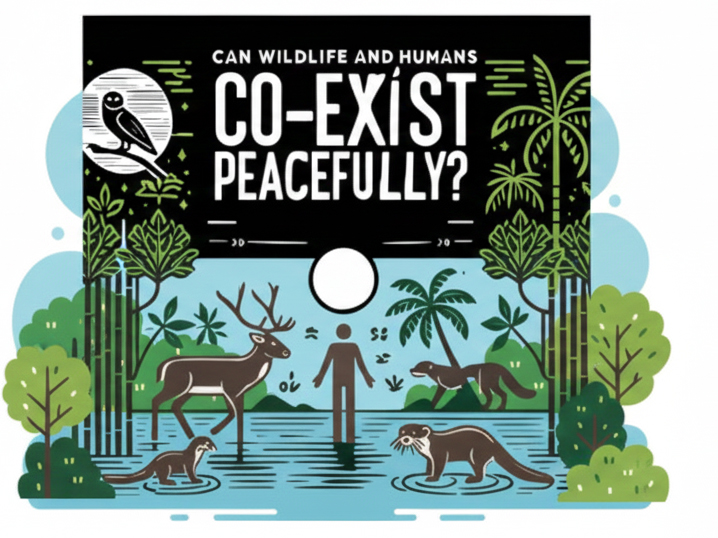
“City In Nature” is one of the key pillars in the Singapore Green Plan 2030. One of the main objectives under this pillar is the safeguarding of nature reserves and providing more habitats for Singapore’s flora and fauna.

While this plan is ideal, however, at the moment, residents in Singapore find it hard to live harmoniously with wildlife when they unexpectedly show up in public urban spaces. With more development projects in the works, the greater the chances of conflicts between human and wildlife as our urban spaces expand and encroach into the natural habitats of the wildlife.

Dr Andie Ang, a research scientist with Mandai Nature, said: “We need to live in harmony with these wild neighbours, and co-exist with them because we are sharing so much of the habitat and there’s so much overlap in the space.” We need to strive for peaceful coexistence between humans and wildlife as Singapore’s natural spaces have “brought people closer to nature”.

Wildlife experts said that instead of trying to draw a line between natural and urban areas, the encroachment of residential areas into nature means that people will have to look to a future when living alongside wildlife is the new

However, keeping a distance from wildlife and not feeding them is crucial to co-existence.  Wild animals can come to rely on humans for food and can become aggressive when they’re not fed. This can be very dangerous and unpleasant.

So how should you behave in wildlife habitats? Here are some wildlife etiquette that will be helpful for you.  
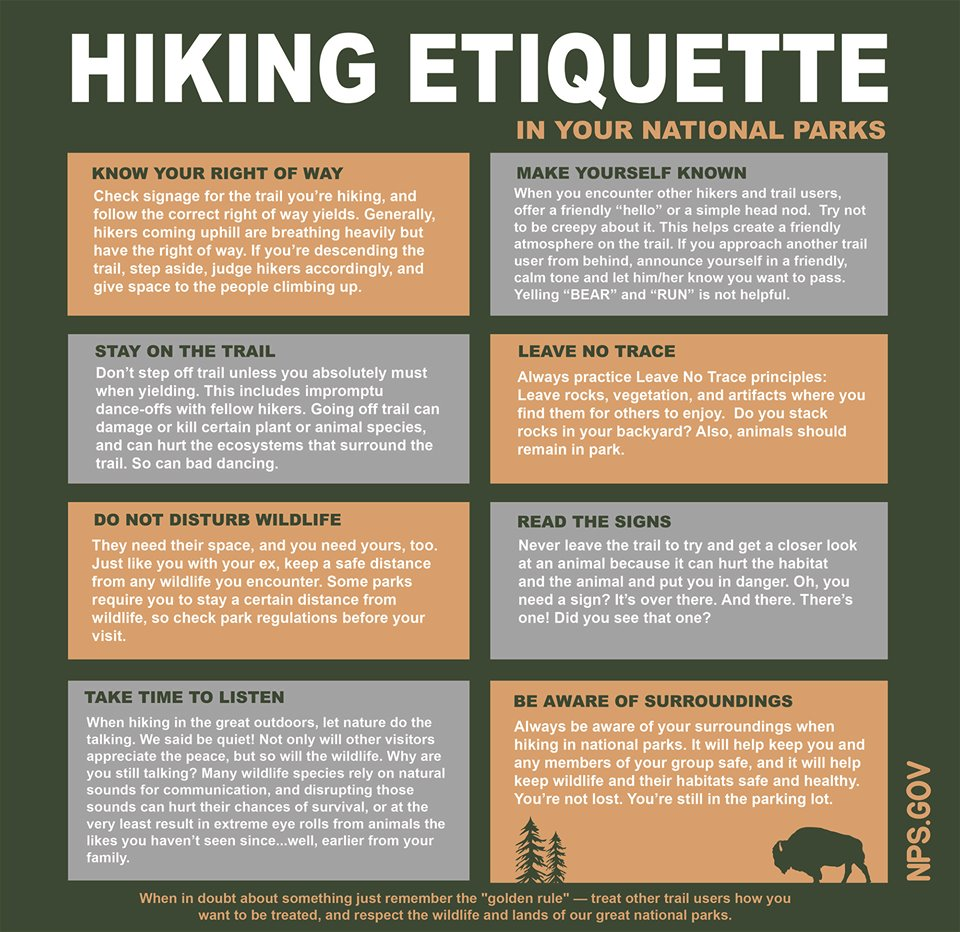
Image credits: https://www.nps.gov/articles/hikingetiquette.htm?fbclid=IwAR2CQxcL-h5koet21FkPF1yLwHcOlmMO7_kMLq_VQ78ygeP971LFtVO2kHs


Frequently Asked Questions

What to do when I encounter wild boars?

First, please try to keep calm and don’t scream.

Like many other wild animals, wild boars will only attack if they are cornered or if they feel threatened. Female wild boars are very protective of their young and can easily be provoked. Wild boars are strong animals that can run relatively fast. The canines in adult males can inflict serious injuries in case of an attack. Due to their solid body build wild boars are considered to be particularly dangerous when involved in car accidents.

  1. Be calm and move slowly away from the animal. Do not approach or attempt to feed the animal.
  2. Keep a safe distance and do not corner or provoke the animal i.e. by using a flash while taking pictures of it.
  3. If you see adults with young piglets, leave them alone. These are potentially more dangerous because they may attempt to defend their young.

What should I do if I see a pangolin?

In Singapore, it is illegal under the Wildlife Act to remove wild animals, including pangolins, from the wild. Those found in nature reserves and other areas managed by NParks are also protected by the Parks and Trees Act 2005. Furthermore, a total trade ban has been placed on wild pangolins under the Endangered Species (Import and Export; CITES) Act.

If you see them, do not be alarmed. These animals are shy and will not attack humans. Do not touch, chase or corner them, as they will be frightened from your approach. You are advised to leave them alone. In fact, the slow-moving pangolins are often injured or killed by vehicles when they stray off too far from the forested areas onto roads.

Globally, pangolins are greatly poached for its meat and scales, the latter in which is believed to have medicinal value. If you witness any illegal trading or poaching:

  • Collect information. Take photos or video evidences of the traps, snares, nets, trapped animals, poachers, and/or their vehicle license plate number.
  • Call us at 1800-471-7300. Alternatively, you can contact the local police. 
  • Do not buy any pangolin products, such as meat, scales and medicinal products.
  • Raise awareness by sharing with your friends and family about the threats to pangolins, and what can they do to help.
  • Report your sightings, and contribute resources or media you have to various animal research and welfare groups to assist in research and conservation efforts.

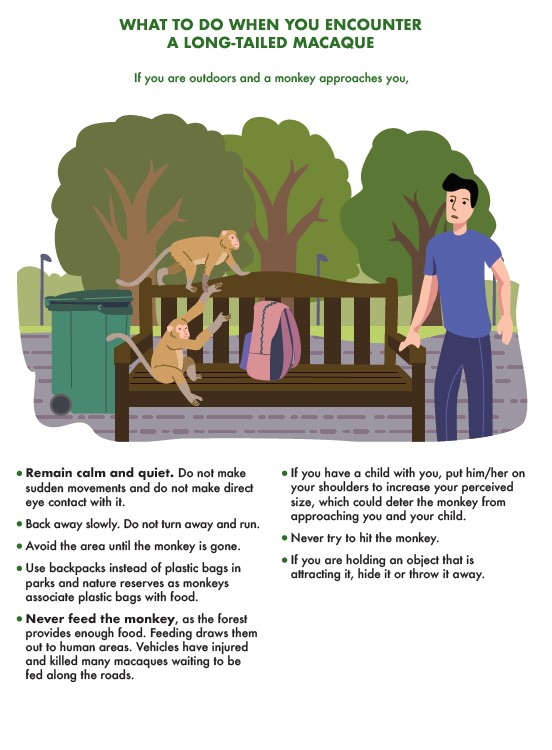
And finally, let us find out how we should respond to the cheeky monkeys…

The Long-tailed Macaque (Macaca fascicularis) is one of our native primate species and a fundamental part of Singapore’s biodiversity. It naturally inhabits forested areas and can also be found in mangroves. However, being a forest fringe animal, it also frequents its immediate surroundings to explore and forage for food. Being innately curious, these monkeys may visit our homes to explore or to seek food.

When you encounter monkeys, please do not feed them. When the monkeys get used to being fed, they reduce their natural inclination to forage in the forest. This will incur long-term impacts as they also help in seed dispersal through the consumption of fruits naturally found in the forest and defecate as they move around the forest.  Furthermore, with the nutrients contained in the excrement matter, the seeds will stand a higher chance of germinating and subsequent survival.

Having been conditioned to recognise plastic bags and other containers as food sources, they may instinctively grab these items when they see them. One way to help monkeys return to the forest is to minimise contact with them.
How would you describe your experiences with wildlife animals? Are they mainly positive, negative or neutral? Explain your answer.

Sources:

  1. https://www.nparks.gov.sg/gardens-parks-and-nature/dos-and-donts/animal-advisories/macaques
  2. https://www.nparks.gov.sg/gardens-parks-and-nature/dos-and-donts/animal-advisories/pangolins
  3. https://www.nparks.gov.sg/gardens-parks-and-nature/dos-and-donts/animal-advisories/wild-boars
  4. https://www.straitstimes.com/singapore/environment/ntu-undertaking-measures-to-reduce-human-wildlife-conflict
  5. https://www.nps.gov/articles/hikingetiquette.htm?fbclid=IwAR2CQxcL-h5koet21FkPF1yLwHcOlmMO7_kMLq_VQ78ygeP971LFtVO2kHs

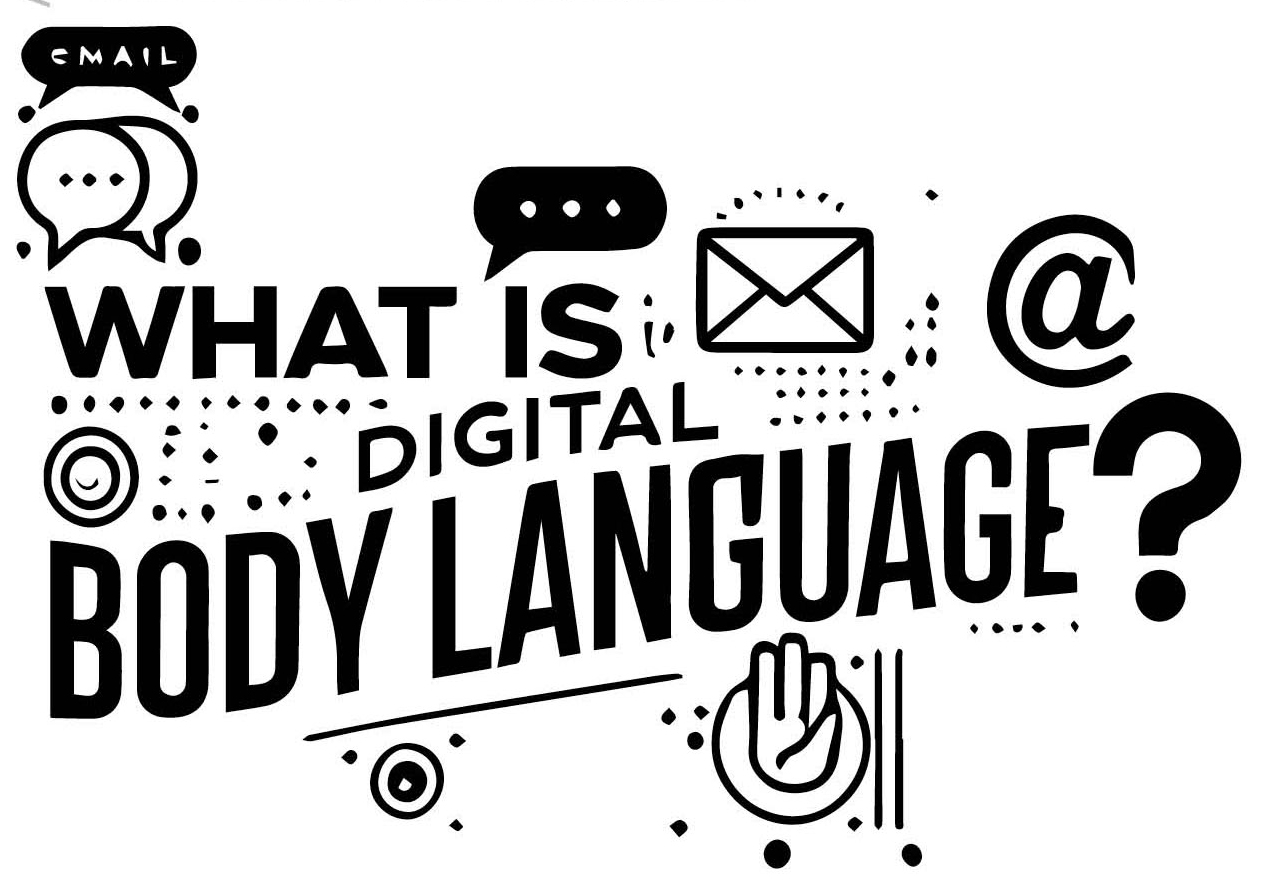
We love our emojis. It adds extra ‘colour’ to the messages we send out. It is a part of what is called, ‘digital body language’.

Like our in-person physical body language, digital body language concerns the subtle cues that implicitly convey our mood or level of engagement, which affect the meaning of the words we say and how the receiver interprets the message– be it in text, on the phone or in a video call. 

“Research shows that roughly 60% to 80% of our face-to-face communication is non-verbal language, such as the pacing, pauses, gestures and tone. All of these cues bring energy and emotional nuance to our message,” leadership expert Erica Dhawan says. “In many ways, punctuation and the use of symbols and emojis in a digital world are the new means of conveying that emotion.” 

Emoji are more than meets the eye 👀

We often use emoji to express things we’re used to doing in person in speech or signing, but emoji is evolving as its own system, too!

  • To stand in for gestures.In person there are times when we want to let our pals know that we’re listening or give a reaction without interrupting, and emoji give us a way to do this in writing! Emoji let us agree (), shrug (🤷‍♂️), and do all sorts of things we might do with our hands and body language in person!
  • To replace facial expressions.The right emoji can help the person you are writing to know whether you’re being sarcastic (😏) or skeptical (🤔) – all the information we want to convey in person but may not want to explicitly say in words when writing.
  • To replace rhythm and intonation.In spoken language, we use the rhythm of our voice to give emphasis to certain words and phrases. In sign languages, we use visual rhythm. Emojis serve the same purposes in written language! For example, you might use the 😬 emoji to indicate reluctance (the way that, if you were speaking, you might slow your speech and change your intonation and voice to show you’re not thrilled about something).
  • To clarify meaning.We also use emoji to add information to help the recipient understand our intended meaning. For example, “thank you” on its own might seem incomplete without a ❤️ if you want to express deeper gratitude.

Broadly, your use of punctuation and emojis are part of a bigger set of cues that will establish the tone of your exchanges – whether they feel formal or informal, enthusiastic or bored. Other signals will include your greetings (whether you include a friendly “Hello” at the start of the message or simply dive straight in), and your sign off (an emotionally distant “Regards” versus an enthusiastic “Thanks!”). The tone of your texts depends on who the receiver of the messages is. If you are sending a message to a teacher, it is best to remain formal and polite.

Ultimately, simply proof-reading your messages to ensure that the meaning and the emotional subtexts are as clear and appropriate as possible, could facilitate open and clear communication.

How good are you at understanding emoji? Take a fun quiz to find out!

1. What does this emoji 🙌mean?

  • Praying
  • Surrender
  • Celebration
  • A sign of rejection

2. What do you think this emoji 😶‍🌫️ refers to?

  • A foggy or confused state of mind
  • A person who is daydreaming
  • A person who is unrealistic
  • Santa Claus

3. When is this emoji 👉👈 usually used?

  • When a person wants people to meet face to face
  • When a person is really bad at directions
  • When a person is nervous or embarrassed about what he/she going to ask/talk about
  • When the person is portraying a gun fight between two parties

Deciphering 3 Commonly Misinterpreted Texts
https://www.youtube.com/watch?v=JGM2cb24Obk (2.31 mins)


This article was first published on https://www.skh.com.sg/about-skh/news/skoop/skoop-issue-14/the-dark-side-of-vaping.newsdetails.

Using e-vaporisers, or vaping, may seem harmless but it can give rise to a serious condition known as ‘popcorn lung’, among other health issues.

You may have seen the videos of people doing vape tricks on TikTok or Instagram. They seem on trend and look like harmless fun, so naturally they pique your interest. Electronic cigarettes or vaporisers, commonly known as vapes, even look like cool gadgets and come in different colours with enticing flavours like strawberry and vanilla custard. So how dangerous can vaping be?

Vaping entails inhaling an aerosol mist from a vaporiser. Vaporisers were created by cigarette company manufacturers to target youth. Unfortunately, alarming evidence soon surfaced that some vaping devices deliver higher nicotine levels than traditional cigarettes, and all e-cigarettes contain other harmful chemicals.

It is estimated that the number of people vaping has been on the rise worldwide – from 2.6 million in 2013 to 55 million in 2021[1]. Vaping is illegal in Singapore but illicit vaping is still rampant, especially among youths. In 2022, 4,916 people were caught for the offence compared with 1,266 in 2020, according to figures from the Health Sciences Authority (HSA)[2]. And these are only those who got caught.

What Vaping Does to Your Lungs

It is a worrying trend because most vaping devices do not just contain nicotine, the drug that causes addiction, but also have hundreds of other harmful chemicals and irritants.

According to Dr Liu Jiaxuan, Associate Consultant, Department of Respiratory Medicine at Sengkang General Hospital, most vaping liquids contain propylene glycol and glycerol, which are known airway irritants. She also singled out a chemical known as diacetyl found in vaping liquids with flavouring, which when inhaled has been linked to bronchiolitis obliterans, or ‘popcorn lung’. Inhaling diacetyl causes inflammation and may lead to permanent scarring and damage of the small airways in the lungs, causing breathing difficulties. The disease is incurable.

What about the claim that vaping is less harmful than cigarette smoking? According to Dr Liu, although vaping is purported to be less harmful than smoking because it does not involve combustion and the inhalation of tar and other chemicals found in tobacco smoke, vaping can lead to several detrimental health effects.

“One of the more well-known lung-related adverse health effects is E-cigarette and Vaping Lung Related Injury (EVALI). There was an outbreak in the US in 2019, which raised the alarm about the harmful effects of vaping as many patients died from it,” observes Dr Liu, emphasising that the health implications from vaping can be life-threatening.

“Vaping also causes pneumonia, pneumonitis and worsens pre-existing lung conditions such as asthma. It is also linked to cancer, fits and stroke, cardiovascular diseases such as hypertension and elevated heart rate, and increases risk of periodontal and gingival diseases,” she adds.


Marketing Hype

“There was a study conducted in rats that had proven that certain vaping devices deliver higher levels of nicotine compared to traditional cigarettes, hence concluding that vaping can be more harmful than smoking,” warns Dr Liu, debunking the marketing hype that e-cigarettes are less harmful than smoking or that they help smokers quit.

In fact, it is more likely that vaping is the gateway to cigarette smoking. A US systematic review of nine studies involving more than 17,000 youths found that youths who vape were three times more likely to pick up cigarette smoking compared to non-vapers[3]. And nicotine’s impact on youths can be extra harmful.

“There is mounting evidence that nicotine can affect adolescent brain development and cognition, and is linked to attention deficit, poor academic performance and risk of mental health issues later on in life,” cautions Dr Liu.

Dr Liu believes that quitting smoking effectively requires a user to overcome both psychological and behavioural (habitual) dependence on tobacco, as well as adopt other forms of coping strategies through cognitive behavioural therapy. “It takes courage to quit vaping, but quitting is easier if you prepare and have a plan. If you do fail, seek professional help and try again. The journey to quit is not easy but it is achievable,” encourages Dr Liu.

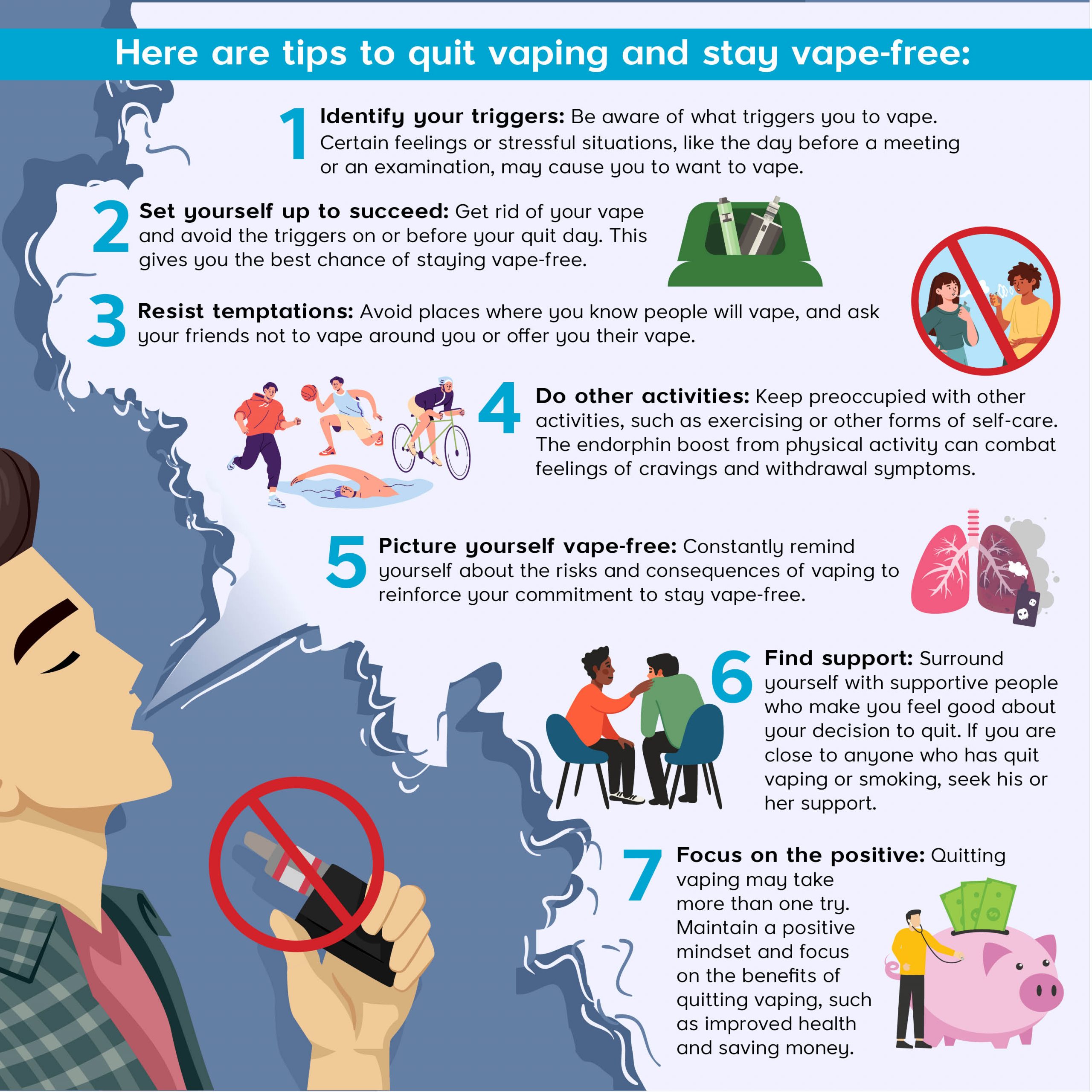
Here are tips to quit vaping and stay vape-free:

  1. Identify your triggers: Be aware of what triggers you to vape. Certain feelings or stressful situations, like the day before a meeting or an examination, may cause you to want to vape.
  2. Set yourself up to succeed: Get rid of your vape and avoid the triggers on or before your quit day. This gives you the best chance of staying vape-free.
  3. Resist temptations: Avoid places where you know people will vape, and ask your friends not to vape around you or offer you their vape.
  4. Do other activities: Keep preoccupied with other activities, such as exercising or other forms of self-care. The endorphin boost from physical activity can combat feelings of cravings and withdrawal symptoms.
  5. Picture yourself vape-free: Constantly remind yourself about the risks and consequences of vaping to reinforce your commitment to stay vape-free.
  6. Find support: Surround yourself with supportive people who make you feel good about your decision to quit. If you are close to anyone who has quit vaping or smoking, seek his or her support.
  7. Focus on the positive: Quitting vaping may take more than one try. Maintain a positive mindset and focus on the benefits of quitting vaping, such as improved health and saving money.

reference:

The idea of autonomous sensory meridian response (ASMR) has been around a long time, though it was not always described as such.

History of ASMR

Even before the term ASMR was coined, people were already experiencing “weird sensations” from observing people carry out simple tasks like filling out a form, reading a story etc. People in an online forum began discussing their experiences and tried hard to explain the sensation.

It wasn’t until 2010 when YouTuber Jennifer Allen coined the term ASMR, and the whole thing really took off. In 2011, a subreddit forum called “ASMR: Sounds that feel good” was created that continued to draw more fans of the genre.

Fast forward to 2016, WhisperingLife, the first whisper YouTube channel had well over half a million subscribers and 15 million video views. More channels had popped up during this time and moved well beyond whispering to whole buffets of audiovisual stimuli intended to give people the tingles. ASMR has continued to build in popularity ever since.

Health benefits of ASMR

Image source: https://www.healthline.com/health/autonomous-sensory-meridian-response#benefits

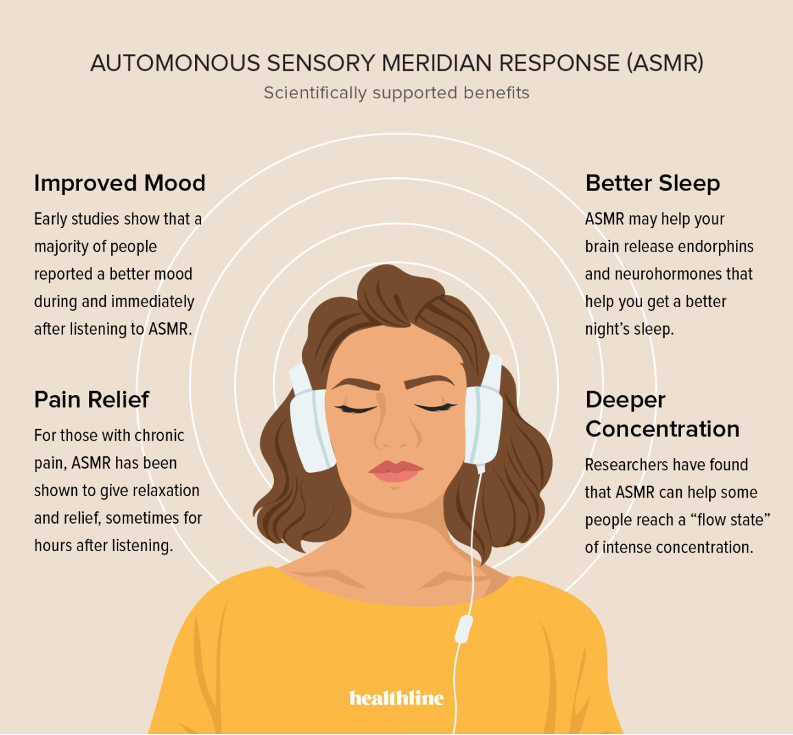
  • ASMR has reportedly helped in Immediate pleasure. For people who experience the ASMR shivers and tingles, it can be a very pleasurable and relaxing feeling that happens almost immediately with exposure to the stimuli.
  • Improved mood. An early study revealed that 80 percent of participants had improved mood after exposure to ASMR. The benefits declined faster in people with higher levels of depression.
  • Pain relief. The same study showed that a portion of people who deal with chronic pain found relief that lasted for up to 3 hours after exposure.
  • Deeper concentration. A “flow state” refers to when you lose yourself or your sense of time because you are so deeply concentrated on something. Researchers have found similarities between ASMR and the type of focus you would experience in flow.
  • Better sleep. Early research has shown that ASMR may help get you and your brain into the right state for deep, healthy sleep by promoting relaxation and theta brainwaves.
  • Other benefits. People who enjoy ASMR often report reduced anxiety, fewer headaches, lower blood pressure, and more.

While these are in line with what has been proven, more research is needed to back up these claims. ASMR is accessible to almost anyone. So, if these benefits sound promising to you, you can try it for free online and without a prescription.

Question and Answer about ASMR

  1. Can you be addicted to ASMR?

You can get too much of a good thing, but watching too many ASMR videos won’t necessarily harm you. If it starts to interfere with your everyday life or you feel dependent on ASMR to function, you may want to contact your doctor or therapist to see if there are other issues at play. It is worth mentioning again that people who watch too much ASMR or who have developed a problem with their relationship to ASMR may be more likely to become desensitized and develop “ASMR immunity.”

  1. How can I start my own ASMR channel?

Visit this website for more information: https://asmruniversity.com/be-asmr-artist/

  1. Why do some people cringe at ASMR?

Some people may cringe at ASMR because they have misophonia, which means “hatred of sound” and can be triggered by the same sounds that elicit pleasure in others. Whereas ASMR makes some people feel warm and fuzzy, misophonia may produce an unsettling fight, flight, or freeze response in others. 

Experiencing ASMR for yourself

Now that you know about the unique benefits of what is termed as ‘stimulating relaxation’, ASMR can seem like something you may want to experience for yourself. Unfortunately, it is not the kind of thing you can teach, practice, or learn. It is an involuntary physical reaction and it’s not as common as you might expect despite the popularity of ASMR videos. It’s difficult to say just how many people have the ASMR response, but an article in The Guardian from 2018 indicated that anywhere between 20% and 70% of adults might experience it.

In the end, if you experience ASMR, it might be good for you, in that you can probably use it to help you relax at bedtime… but if you don’t, it’s probably nothing to lose sleep over. Overall, in your everyday life it is still important to be mindful of using your senses to be present in the moment.

What are your responses and feelings as you watch ASMR content videos?

Sources:

  1. https://www.healthline.com/health/autonomous-sensory-meridian-response#benefits
  2. https://www.healthline.com/health/autonomous-sensory-meridian-response#asmr-uses
  3. https://asmruniversity.com/about-asmr/what-is-asmr/
  4. https://www.psychologytoday.com/sg/blog/i-hear-you/202201/what-is-asmr-all-about

[ASMR]: Everything Science Knows So Far
https://www.youtube.com/watch?v=-WpAphhsBgs (4.23 mins)


Meet The ASMR Creators Behind The Spine-Tingling Videos Taking Over YouTube
https://www.youtube.com/watch?v=nyQ56-GxM5k (5.37 mins)


You are not alone.

January 5, 2026 — Leave a comment

In an effort to open up the conversation about mental health, Singapore Mental Health Film Festival (SMHFF) is collecting anonymous stories to share on social media
to encourage empathy, provide comfort for those who feel alone, and empower those who are afraid to ask for help.

As stigma and discrimination usually arise from a lack of understanding of mental illness (ignorance and misinformation), it is important to build up a community courageous enough to speak of the unspoken; to support each other through their individual journeys so that they can celebrate and grieve collectively.

Here are some real voices of people who struggle with mental health issues.

*The stories below have been edited slightly for clarity. *

Story 1: You are worthy of love

I had a rocky childhood. My father was abusive and unfaithful, and my parents divorced when I was 9. My mother never fully recovered from that trauma. I grew up believing I was a burden to my mother, and had my first major depressive episode in my teens.

10 years and countless episodes of depression later, I finally ended up at IMH after coming close to committing suicide. Now, after over a year of therapy and trying three different antidepressants, I can finally say that I’m stable.  

There are still awful days when I feel utterly hopeless and the suicidal thoughts return, but I am now better equipped to handle them. My only regret was not seeking help earlier because I was convinced that how I was feeling was my fault and that nothing would help me feel better.

To anyone else struggling as I did: you are worthy of help, you are worthy of love! Don’t hesitate to seek help!

Story 2: Breaking the generational curse by seeking help

I’ve always had a pessimistic outlook in life ever since I was a teen due to my family circumstances. My father was plagued by various addictions and depression and that affected him and my mother badly.  

Last year, the negative thoughts and feelings I had worsened when I experienced anxiety attacks for a week and thereafter, I had regular meltdowns that comprised of screaming, crying and punching my fists into the wall.

I was shaken but not surprised since mental illness is a part of my family history. My grandparents, my parents and my sibling have been trapped in the cycle of depression, never able to escape it.

It seems inevitable that I myself will never be able to break the cycle of depression but there is something that has set me apart from my family. While they have been in constant denial of the mental issues they face and have refused to seek help, I’ve chosen to acknowledge my anxiety, my fears, my anger. I’ve taken the step to share it with my husband and my closest friends. And I promised them that I will seek help from a counsellor.

This decision to seek help will help me overcome my challenges and I will lead a better life.

Story 3: “Asking for help is completely okay”

I’ve been dealing with depression and anxiety for over 5 years now. I wasn’t diagnosed until I was 13 because my parents didn’t believe in going to see someone for mental illnesses, they thought it was for ‘crazy people’.

At that time, I was going through a really, really dark period of my life. I seemed to be stuck in this black hole where I couldn’t get out and I was suffocating. I was dealing with panic attacks almost every day, some with reason but other times they just came out of the blue. No one knew what I was going through because I’ve never been one to express how I felt. So I just painfully went through the motions and attempted to get through school, dealing with family issues and my own mental health deteriorating. I was struggling to cope with everything and it all seemed too much for me. I didn’t want to be in this kind of pain every single day and I started to lose passion in the things I once loved.

Until one day, one of my teachers noticed. As she knew that I wasn’t telling anyone about my issues so she insisted that we talked. She told me, “You can tell me as much as you’re comfortable with and if you’re okay with talking to me, then that’s great. I’ll be here to help. But if not, then you need to find at least one person you can talk to because you can’t keep bottling this up.”

It suddenly felt like I could finally see the light at the end of the tunnel. For once in my life, I felt like I was being seen and heard. Someone was actually listening and someone cared. She helped me through my mental health struggles. She even went out of her way to research ways to help me. My teacher got me to finally muster up the courage to tell my parents and so that I could get professional help. 

I learnt a few tools to cope. I used my passion, Drama, to help me get through the hard times. Somehow with Drama, I was able to push through until I was 16. However, I started to lose my way again after a traumatic experience and even more family problems that involved the law.

There were occasions when I tried to give subtle hints to friends and teachers about what I was struggling with but it didn’t work. I knew that if I didn’t speak up to say anything, there’s nothing they can do.

I’m not going to lie, I’ve fallen into a lot of relapses after having psychiatric help. However, now I fight much harder to overcome and live because I’ve overcome these challenges before. Plus, I have the resources to help me. I still have a lot to learn and I know this is going be a long journey but I beginning to finally understand that asking for help is completely okay and it doesn’t make you weak in fact, it makes you stronger because it takes courage.

Having a healthy mind

 There are many occasions when people are simply told to ‘get themselves together’ and to go through their daily lives by fulfilling their roles and responsibilities. In the process, they might have neglected taking care of their mental health. People can look ‘put together’ but they are broken inside. What does it take to have a healthy mind?

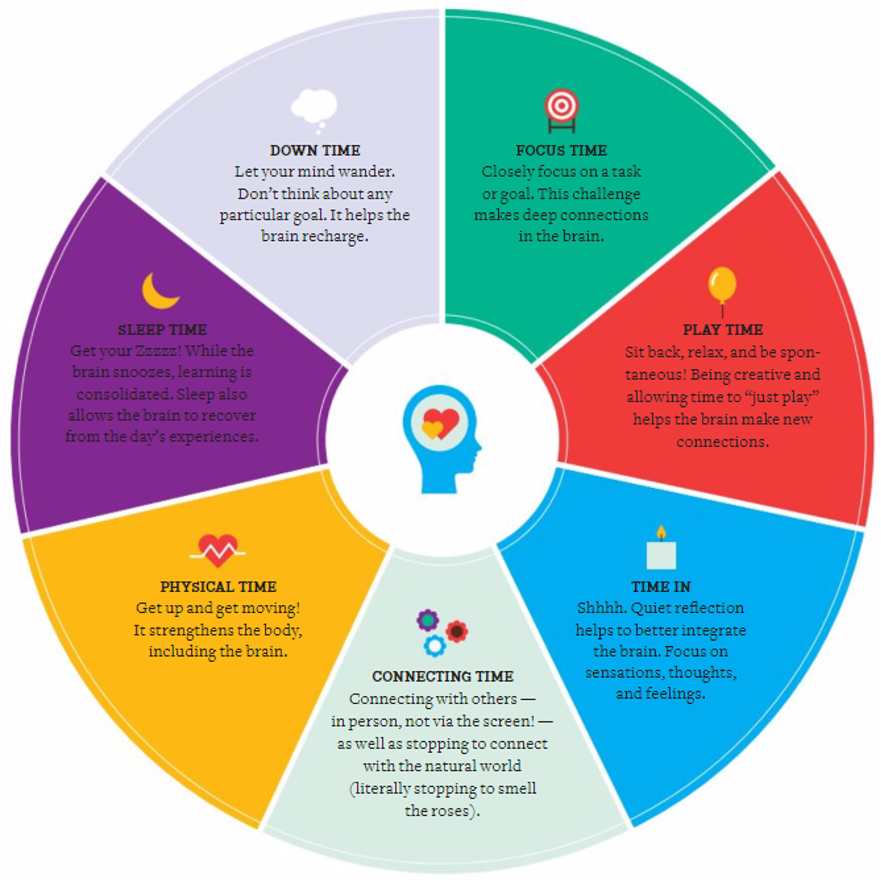
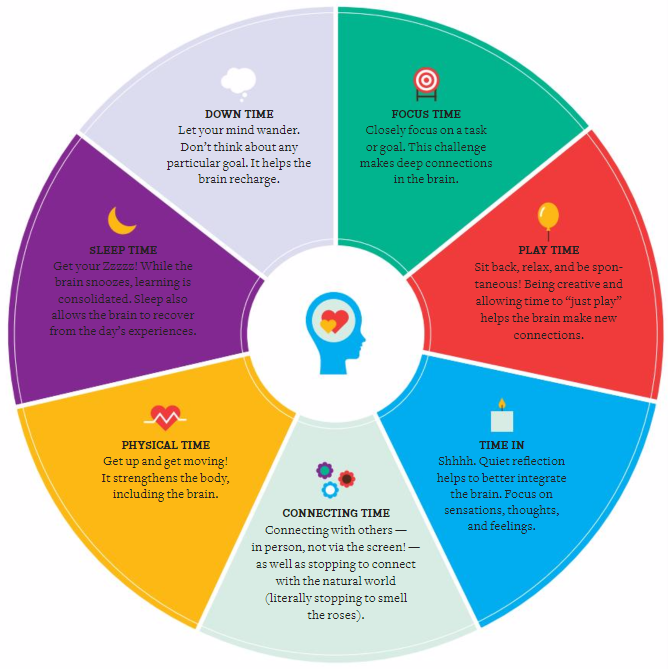
According to Dr Dan Siegel, the healthy mind platter below shows you the 7 daily activities, or the ‘nutrients’ that your brain need so as to function optimally.  These seven daily activities make up the full set of “mental nutrients” that your brain and relationships need to function at their best.

Image credits: https://static.wixstatic.com/media/45a0b5_e1123e581a50424fb4895478afcc9abd~mv2.png

Definition and suggestions for each category:

  1. Physical time:

When we move our bodies, aerobically if your health situation permits, we strengthen the brain in many ways.

Suggestion: Physical exercise, anything involving moving your body. Examples include: working out at the school gym, fitness corners, walking & running at the park/stadium, dancing to your favourite song, stretching and playing sports.

  1. Connecting time:

When we connect with other people, ideally in person, and when we take time to appreciate our connection to the natural world around us, we activate and reinforce the brain’s relational circuitry.

Suggestion: Spending time with friends during school breaks or going for a run or walk in the park with a family member

  1. Sleep time:

When we give the brain the rest it needs, we consolidate learning and recover from the experiences of the day.

Suggestion: Create a comfortable and peaceful environment for good and quality sleep.

  1. Down time:

When we are non-focused, without any specific goal, and let our mind wander or simply relax, we help the brain recharge.

Suggestion: Just let your mind wander. You may be walking, lying down with your favourite pillow or watching TV.

  1. Focus time:

When we closely focus on tasks in a goal-oriented way, we take on challenges that make deep connections in the brain.

Suggestion: Revision, reading complex material, or focusing on learning a new skill, such as playing an instrument or chess, or learning an activity such as riding a bike.

  1. Play time:

When we allow ourselves to be spontaneous or creative and playfully enjoying novel experiences, we help make new connections in the brain.

Suggestion: Laughing with your friends and not doing anything in particular, or it may include singing in a choir, or painting, or playing a board game. Play games that you enjoyed when you were younger.

  1. Time in:

When we quietly reflect internally, focusing on sensations, images, feelings and thoughts, we help to better integrate the brain.

Suggestion: Be mindful of your feelings. You can either let your mind wander and observe your thoughts, feelings or sensations, or you follow a script or recording and mentally walk through an activity.

Some people like to use a journal to reflect on their thoughts. Some express themselves creatively using art or music, some like to take a bath or shower, some like to take a walk or talk it through with someone. Some like to do yoga to really tune into their body sensations.

After becoming aware of the full spectrum of essential mental activities, make sure that at least every day you are bringing the right ingredients into your mental diet, even if for just a bit of time. Just as you wouldn’t eat only pizza every day for days on end, we shouldn’t just live on focus time alone with little time for sleep.

The key is balancing the day with each of these essential mental activities. Mental wellness is all about reinforcing our connections with others and the world around us; and it is also about strengthening the connections within the brain itself.  When we vary the focus of attention with this spectrum of mental activities, we give the brain lots of opportunities to develop in different ways.

Seek help

Mental health is just as important as physical health. If you caught a flu, you would visit the doctor or take medication. Likewise, if you are not feeling well mentally, you will have to seek help. There are occasions when we realise that we cannot overcome the problems on our own and therefore it is important to seek help. Sharing your feelings and experiences with someone who will listen is important.

Share any stories about mental health struggles anonymously here: https://mentalhealthfilmfest.sg/shareyourstory. The story may be your own personal journey with a mental health/dementia issue or the story of someone close to you.

Here are some resources and articles that can provide more information on mental health-related issues:

Reflect on the questions below with close reference to The Healthy Mind Platter and hopefully you will know how to nourish your mental well-being each day with the ‘right ingredients’.

Reflection Questions:

  1. Rate on a scale of 1-10 how well you think you keep up with each of these activities in the platter? (Considering you should be doing every part every day)
  2. Provide a reason to explain why each of the seven parts of the platter is important to you. Don’t write why you think someone else would think it’s important but why is it important to you. (For example, I might write that I need eight hours of sleep each day to function to the best of my abilities. It’s important to me to be a kind and easy-going person and to be able to focus on what I need to throughout the day and not sleeping enough gets in the way of this.)
  3. Pick one area you’d like to work on and decide a clear and specific way that you’d like to change it.

Sources:

  1. https://mentalhealthfilmfest.sg/personalstories
  2. https://drdansiegel.com/healthy-mind-platter/
  3. https://www.michaelayoung.org/post/healthy-mind-platter-how-to-keep-your-brain-healthy-and-functioning-to-it-s-full-potential