Archives For Uncategorized

The importance of developing your critical thinking skills

There are all sorts of information flooding our social media, and amongst the sea of information, fake news lurks within. The full spectrum of fake news can range from truly absurd and unbelievable stories, which are clearly fake, to more subtle types of misinformation, which are more difficult to detect. There are also websites that perpetuate fake news and hoaxes without first verifying the veracity of the news.

Bearing in mind how much information we are consuming daily from the Internet and social media in this digital age we live in, all the more we must learn to discern truth from false information using critical skills and navigate the murky waters of social media carefully.

Here are some examples of fake news and ways we can ensure that we do not fall into the trap of circulating misinformation and generate unnecessary panic and alarm.

  • Deceptive news can be made to look convincing and real.
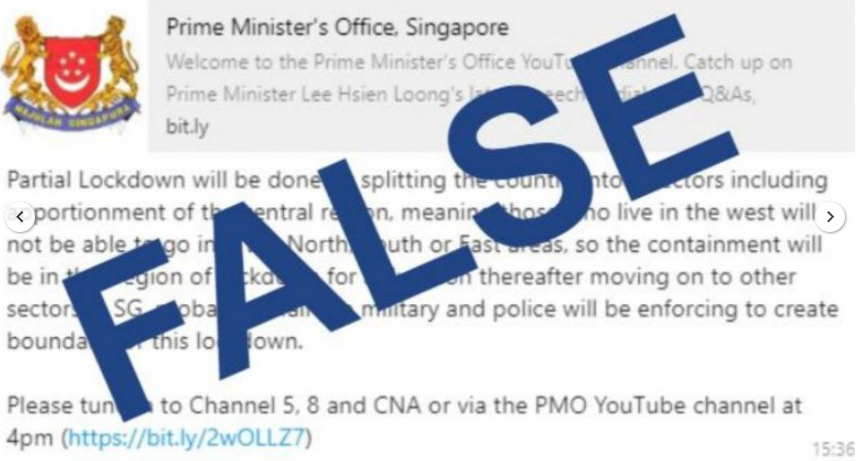
Image credits: https://www.straitstimes.com/singapore/coronavirus-pm-lee-announcement-that-sporeans-cant-travel-beyond-the-area-they-live-in-is

A message being circulated recently is similar to an old WhatsApp chain message that refers to a “partial lockdown” of Singapore, where the country is alleged to be split into four sectors – north, south, east and west. According to the fake message, boundaries of the sectors will be enforced by soldiers and the police to make sure that residents of one sector do not enter another. 

In a message sent through Gov.sg’s messaging app channels, the Government said that people should refer to government sources or PM Lee’s official social media platforms for information on whether he was going to make a national address. There were no indications from official sources that he was going to make a national address on that day. The Gov.sg message urged people not to spread unverified information.

The Government invokes the Protection from Online Falsehoods and Manipulation Act (POFMA) to correct false statements. POFMA’s primary tools to counter online falsehoods are the correction directions – these directions do not require the online falsehood to be removed. In more serious cases, a stop communication or disabling direction may be used. However, there are concerns about the impact on freedom of expression in Singapore with the implementation of POFMA.


  • Fake news and misinformation contradict facts

There are certain groups of people that challenge historical facts that have undoubtedly happened due to malicious intents and self-serving purposes.


One such example is the holocaust denial. The Holocaust was the genocide of the Jewish people that tragically happened under the totalitarian Adolf Hitler during World War II in Europe from the 1941 – 1945.

Read about the Holocaust here: https://www.britannica.com/summary/Holocaust

Despite reliable evidence that Holocaust has happened, there are people who deny that there was such an event. Holocaust deniers argue that Nazi Germany was the victim of a conspiracy, contrived by the Allies to brand Nazi Germany the villain of World War II. They maintain that the U.S. and Great Britain concocted wild atrocity stories about the Nazis to cover up their own war crimes. Jews, they claim, joined the conspiracy in order to prey upon the sympathies of the world and extort money from post-war Germany in order to establish the State of Israel. (Arab leaders have sometimes resorted to Holocaust denial in an attempt to delegitimize the existence of the State of Israel). To one degree or another, Holocaust revisionists claim the Holocaust is an exaggeration, if not an outright hoax.

Facebook is banning all content that “denies or distorts the Holocaust,” in a policy reversal that comes after increased pressure from critics.

Read why Mark Zuckerberg decided to remove Holocaust-denying posts after initially refusing to: https://www.npr.org/2020/10/12/923002012/facebook-bans-holocaust-denial-reversing-earlier-policy

How can we be more discerning and critical when reading from various sources? 

A. Be careful of confirmation bias

Image credits: https://onlinejournalismblog.files.wordpress.com/2020/04/lf16-confirmation-bias.png

A confirmation bias is a type of cognitive bias that involves favouring information that confirms your previously existing beliefs or biases.

For example, imagine that a person holds a belief that left-handed people are more creative than right-handed people. Whenever this person encounters a person that is both left-handed and creative, they place greater importance on this “evidence” that supports what they already believe. This individual might even seek proof that further backs up this belief while discounting examples that don’t support the idea.

Confirmation biases impact how we gather information, but they also influence how we interpret and recall information. For example, people who support or oppose a particular issue will not only seek information to support it, they will also interpret news stories in a way that upholds their existing ideas. They will also remember details in a way that reinforces these attitudes.

Unfortunately, we all have confirmation bias. Even if you believe you are very open-minded and only observe the facts before coming to conclusions, it’s very likely that some bias will shape your opinion in the end. It’s very difficult to combat this natural tendency.

That said, if we know about confirmation bias and accept the fact that it does exist, we can make an effort to recognize it by working to be curious about opposing views and really listening to what others have to say and why. This can help us better see issues and beliefs from another perspective, though we still need to be very conscious of wading past our confirmation bias.

B. Evaluate the sources using critical skills

This is the time to put all the skills that you have learnt from your history lessons to use! Test the reliability of the source by asking yourself questions:

  • Who created the source? Whose perspective is presented?
  • Look at the author. To check if they are real, reliable and “trustworthy”, look for other pieces they have written and what outlets they have written for. If they haven’t written anything else, or if they write for websites that look unreliable, think twice about believing what they say.
  • Find out more about the source. Look at the website where the story comes from to see if the story is well-presented, if the images are clear, and if the text is written well and without any spelling errors or exaggerated language. If you’re not sure, try clicking on the “about us” section, and check that there’s a clear outline explaining the work of the organisation and its history.
  • What is the purpose of the source?
  • Who is the target audience of the source?
  • What is the intended impact of the source?
  • Is this a form of propaganda to influence certain ideologies and actions of some groups of people? Check that the article contains references and links to other news stories, articles and authors. Click on the links and check if they seem reliable and trustworthy.

    C. Do a Google Reverse Image Search

This is an excellent tool, which allows you to search Google by images, rather than words. It’s simple; all you have to do is upload a picture onto the Google Reverse Image Search site and you will see all the other web pages that have similar images. This then tells you the other sites where the images have been used – and if they’ve been used out of context.
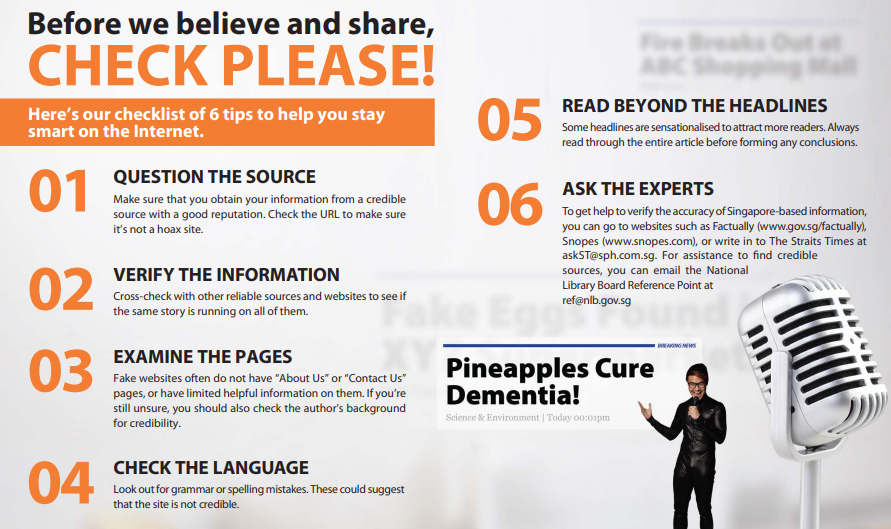
Image credits: https://www.betterinternet.sg/-/media/MLC/Files/SID-2018/Quick-Tips/1_How-to-spot-Fake News_Tipsheet.pdf

Do remember that trending news or news that is widely shared may not be accurate or true! It’s really important to avoid sharing stories that you are unsure about. If you are in any doubt about whether the news is real or fake, discuss it with a knowledgeable friend or a family member to find out what they think about the story.

How confident are you in identifying fake news?

Have you been duped by fake news that you first believed to be real?

Sources:

  1. https://www.pofmaoffice.gov.sg/regulations/protection-from-online-falsehoods-and-manipulation-act/
  2. https://www.straitstimes.com/singapore/coronavirus-pm-lee-announcement-that-sporeans-cant-travel-beyond-the-area-they-live-in-is
  3. https://www.museumoftolerance.com/education/teacher-resources/holocaust-resources/what-is-holocaust-denial.html#2
  4. https://www.npr.org/2020/10/12/923002012/facebook-bans-holocaust-denial-reversing-earlier-policy
  5. https://www.verywellmind.com/what-is-a-confirmation-bias-2795024
  6. https://www.betterinternet.sg/SID-Campaign-2018/Tipsheets/Online-Discernment
  7. https://theconversation.com/how-to-spot-fake-news-an-experts-guide-for-young-people-88887

During times of emergency, situations can be chaotic and people may be in great shock and panic. Therefore, it is important for people to have the essential skills and knowledge to respond swiftly and appropriately during life-threatening and dangerous circumstances.  

Emergencies in schools

According to the Ministry of Education, all schools have a School Emergency Structure to deal with emergencies to respond, recover and restore the situation back to normalcy. School staff are trained to assume specific roles and responsibilities during emergencies, from first-aid, search, trauma management, evacuation, and handling of casualties. Therefore, when there is an emergency, listen to your teachers’ instructions and try to keep calm.

Here are some emergencies that might happen unexpectedly and how you can respond to these emergencies.

A. Fire

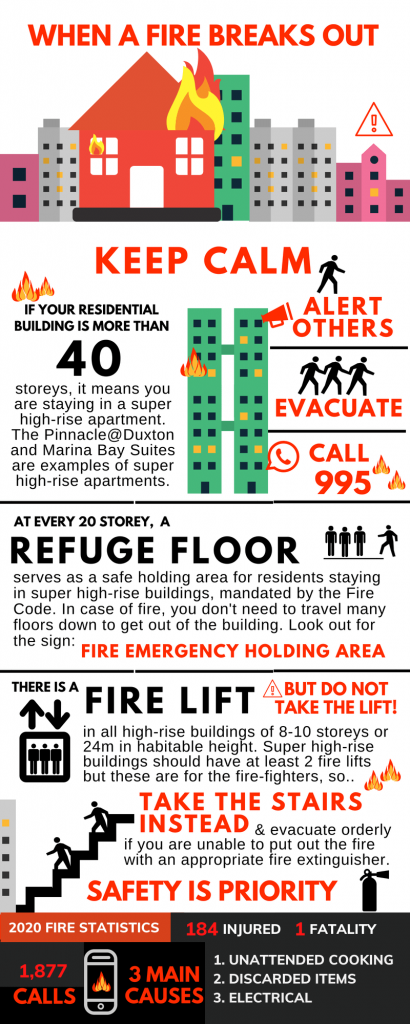
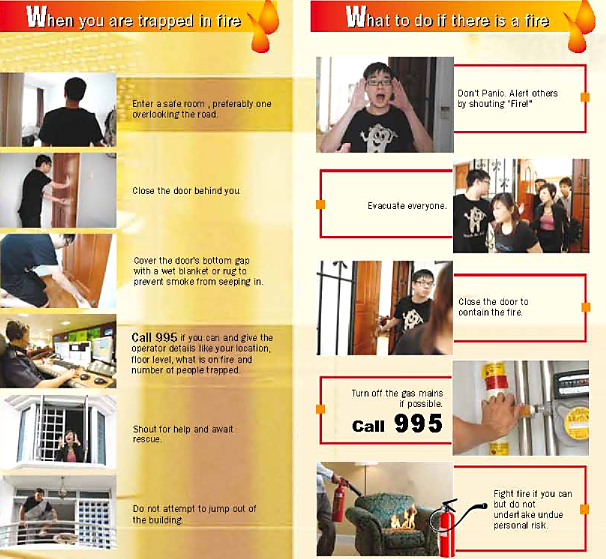
In the event of a fire, here is what you should do:

Image credits: tiq.com.sg/blog/fire-safety-infographic-what-to-do/

Image credits: https://www.scdf.gov.sg/images/default-source/publications/fire-safety-at-home-(eng).jpg

Fire is best prevented by eliminating fire hazards. Read here to find out how to do so:

https://www.scdf.gov.sg/home/community-volunteers/community-preparedness/fire-safety-guidelines-for-hdb-estates

B. Drowning 

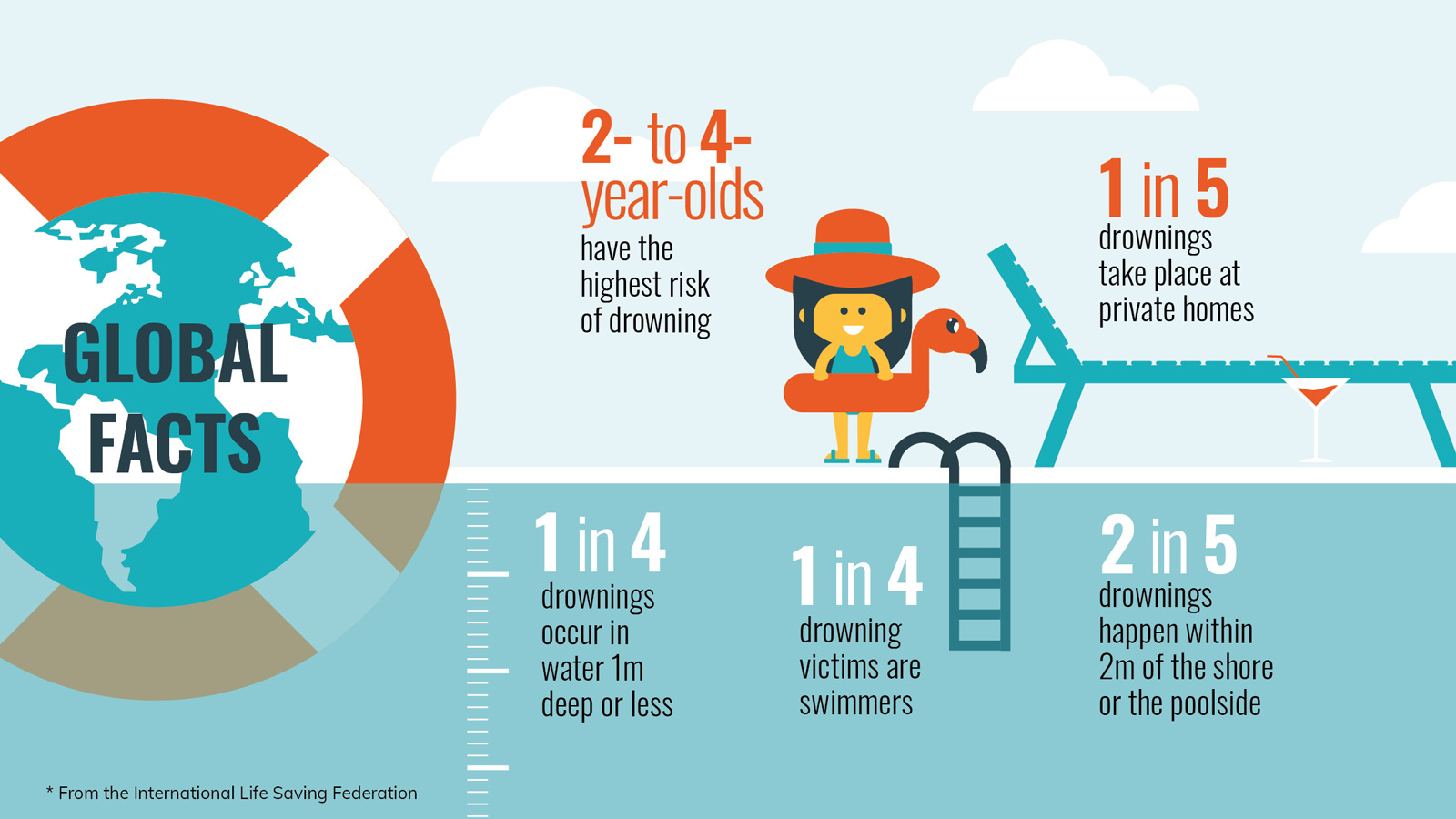
With the year-round tropical heat, swimming pools are irresistible weekend draws for families with children, especially young energetic ones with extra energy to spare from being indoors all week. Although there are lifeguards in public swimming pools, there are no lifeguards in private swimming pools. Hence, it is crucial for everyone to be alert at the beaches and pools. Keep an eye out for any signs of drownings and seek for help.

Image credits: https://www.todayonline.com/brandstudio/emergency/drowning

“Drowning risks for Singaporeans include not supervising children, not knowing the pool depth before swimming, swimmers pushing themselves to the limit when swimming, and swimming despite having a known medical condition,” said Ms Delphine Fong, Safety Management Director at Sport Singapore.

Drowning can happen outdoors as well as indoors. Young children can drown in 2.5cm of water, in where you least expect it.

How does a person look like when he or she is drowning?

“Drowning is not the violent, splashing call for help that most people expect,” noted Coast Guard retiree and trained rescue swimmer, Mario Vittone. Dramatic, loud drowning is part of our cultural expectation. It’s what we’ve seen on television and in movies. In contrast, real life drowning involves what psychologist Dr. Francesco A. Pia dubbed the Instinctive Drowning Response

Myth 1: Drowning people will yell for you. “Except in rare circumstances, drowning people are physiologically unable to call out for help,” Dr. Pia noted. “The respiratory system was designed for breathing. Breathing must be fulfilled before speech occurs. The mouths of drowning people are not above the surface of the water long enough for them to exhale, inhale and call out for help.”

Myth 2: Drowning people will wave wildly. They can’t, Vittone said. “Nature instinctively forces them to extend their arms laterally and press down on the water’s surface. Pressing down on the surface of the water permits drowning people to leverage their bodies so they can lift their mouths out of the water to breathe.”

Myth 3: Someone drowning might be able to assist in the rescue. “Physiologically, drowning people who are struggling on the surface of the water cannot stop drowning and perform voluntary movements such as waving for help, moving toward a rescuer or reaching out for a piece of rescue equipment,” Vittone warned. He added an important distinction: “This doesn’t mean that a person that is yelling for help and thrashing isn’t in real trouble, [only that] they are experiencing aquatic distress,” he said. “Aquatic distress doesn’t last long, but unlike true drowning these victims can still assist in their own rescue. They can grab lifelines, throw rings, etc.”

Myth 4: Drowning takes a while. Unless someone who’s drowning in the water is rescued by a trained lifeguard, they’ll only be able to struggle on the surface of the water for 20 to 60 seconds before submersion occurs.

Myth 5: Kids who are drowning will make noise. Bystanders and parents should actually be more alert to the kids who seem to be playing quietly, Vittone advised. “Children playing in the water make noise,” he reminded. “When they get quiet, you get to them and find out why.”

According to Sport Singapore, look out for any of the following signs of the Instinctive Drowning Response:

  • Head is low in the water, mouth is at water level
  • Head is tilted back with mouth open
  • Eyes look glassy and empty, unable to focus or eyes are closed
  • Hair over forehead or eyes
  • Legs are vertical
  • Hyperventilating or gasping
  • Attempts to swim in a particular direction but no headway
  • Trying to roll over on the back
  • Appears to be climbing an invisible ladder

If you identify it as a drowning emergency, Dr Chong advises the following to be done immediately:

  • Seek help to get the victim out of the water without delay. However, do not put your own life at risk if you have not been trained on water rescue.
  • Call for help. If someone else is present, have the person call for emergency medical help at 995.
  • Check to see if victim is breathing on his own. If not, promptly begin Cardiopulmonary resuscitation (CPR).
  • Concentrate on rescue breathing and CPR until victim is breathing without assistance.
  • Expect water in the lungs to be expelled during CPR


C. Terrorist attack

SG Secure is Singapore’s community response to the threat of terrorism. It is a movement to build the resilience of our community and a call to action to everyone in our multi-racial, multi-religious society to come together to safeguard Singapore and our way of life.

Terrorist attacks can have a crippling effect on societies that extends beyond the physical devastation. Even the threat of terrorism can foment distrust among communities. In today’s heightened security climate, it is even more urgent that we continue to strengthen the bonds among our various communities and prevent racial and religious conflict in the aftermath of a terrorist attack.

SGSecure focuses on three core actions that every one of us can do in the fight against terrorism:

  • Staying Alert to prevent a terrorist attack and to keep yourself safe in the event of an attack
  • Staying United to help one another, especially after an attack
  • Staying Strong to safeguard our social fabric and bounce back as one people

Alternatively, you can also report the incident with clear description via:

a call to Police at 999; SMS 71999 if you can’t talk; or submit the information via the SGSecure app

Those with information on a person who may be radicalised can also contact the ISD Counter-Terrorism Centre hotline on 1800-2626-473.

If you or anyone you know, are willing to help out during an emergency, proceed to https://www.sgsecure.gov.sg/what-can-i-do/be-an-sgsecure-responders to find out how to be a SGSecure Responder.

It is crucial that in times of crisis and disaster, Singaporeans remain calm, united and resilient to overcome any challenges.

How can you play a part in creating a safe environment in your school, community and nation?

Sources:

  1. https://www.scdf.gov.sg/home/community-volunteers/publications/emergency-handbook
  2. https://www.todayonline.com/brandstudio/emergency/drowning
  3. https://www.moe.gov.sg/about-us/emergency-preparedness
  4. https://www.sgsecure.gov.sg/
  5. https://www.ajc.com/lifestyles/health/drowning-doesn-look-like-what-you-think-how-recognize-the-signs/d1xQYZMVmgfHI1nBWOVK0J/

Why do you spend?

January 7, 2026 — Leave a comment

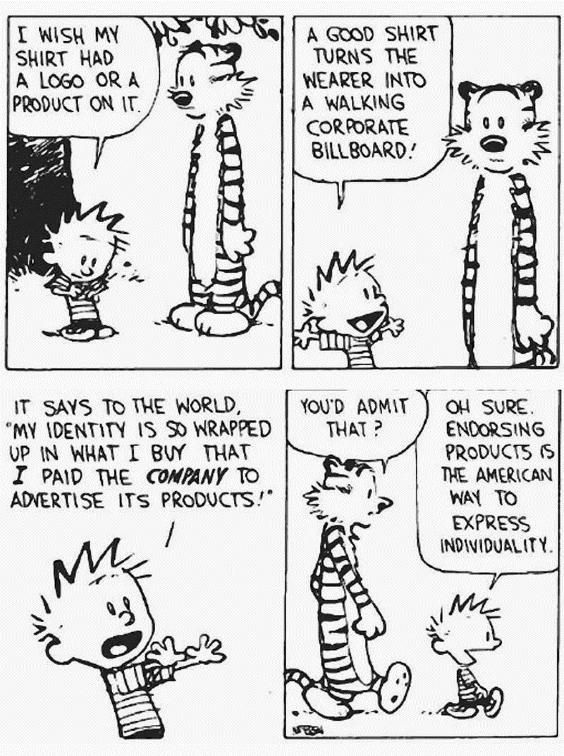
Image credits: https://1.bp.blogspot.com/-vjsIFGqrQec/VHLlrF7BEHI/AAAAAAAAAKI/9SIesapUPeo/s1600/calvin-and-hobbes-comic-logo-branding-consumerism.jpg

We may chuckle at Calvin for his understanding of corporate branding and its effects on consumers. However, isn’t there some truth in what he said that is worth pondering over?

Brand advertisements carefully shape brand image through advertisements, popular spokespeople, memorable taglines and a well-designed brand logo. Consumers usually show support to brands when they agree with the message that the brands want to convey. In addition, through brand association, consumers’ identity becomes tied to the brands that they support. For example, an athlete wants to be decked out with Nike products because the “Just do it” slogan encourages the athlete to be bold and fearless and hence he or she purchases the products in order to embody confidence.

Studies have shown that when we’re down on ourselves we’re more likely to buy luxury goods. In Martin Lindstrom’s book Brandwashed, he referenced how kids with lower self-esteem tend to rely more on brand names than kids with a higher self-esteem. Lindstrom summed it up in the book with: “the larger the logo on the clothing, the lower the self-esteem”.  Should you ever feel insignificant or like a nobody, remember that you define who you are, not by the brands that you wear or the people that you hang out with.

Social media has given a false idea that extravagant lifestyles are superior and that it could easily achieved overnight. Hence, we have to be aware that on social media, people share selectively and curate their feed carefully to shape how others view them. With the increased use of social media and the internet being an essential part of life,

‘flex culture’ will intensify.

Here’s a quick arbitrary test to check if you are sucked into this ‘flex culture’…

Read the following statements and choose ‘Yes’ if you agree with the statement or ‘No’ if you disagree with the statement.

Statements

Yes

No

When it comes to relationships, you tend to focus on the monetary gains and material gifts that you can gain from the relationships.


As you scroll through your social media platforms or watch videos online, you feel envious of others because they seem to be able to afford anything and everything.


You often blame your parents or caregivers for not being able to provide you with enough money to purchase material items or luxury goods.


You feel a sense of shame and inferiority when you are unable to afford what your peers can buy.  


You feel the pressure to keep up with the latest trends in order to feel accepted by your peers.


You have considered dishonest or illegal means (borrowing from others, gambling, stealing etc..) to obtain more money to fulfill your wants.


If you have answered mostly ‘Yes’, it could be a warning sign of being sucked into ‘flex culture’.

Let us bust some myths that the’ flex culture’ tells you.  

MYTHS

TRUTHS

Being wealthy brings me more friends.


Being wealthy may bring fans but not true friends. The truth is genuine friends will always be by your side whether you’re rich or poor. Authentic and genuine friendships that stay are not based on how rich or popular you are.

There are all kinds of people around us. There are insecure people who want to feel better about themselves and reflect their worth and ‘value’ through their material possessions. There are also people who may harbour ulterior motives when they befriend you, hoping to reap some monetary benefits from your friendship with them.


Being wealthy is the true definition of success.


Everyone’s life goals are different and hence their definitions of success will differ. Someone who seems to have it all might not have it all. A common saying that ‘wealth can’t buy health’ is the truth and there are certainly many other things in life that is worth our attention.

Self-discovery is knowing who you are and what you want in life is important because it can help you break free from societal expectations and the pressure to conform, thereby helping you to feel purposeful in life.


I will use whatever means to become wealthy first and then work on becoming a better person.


Many times, greed can cause people to become self-centered, selfish, competitive and dismissive of others People are brainwashed into thinking that doing disrespectful, outrageous or obscene things on the internet can easily help them become rich. These insensitive actions can cause harm to yourself and to others.

Walking in righteous paths will also prevent a life full of regrets in the future. People who fulfill their goals put in hours of hard work and persevere through their failures. Enduring the journey will develop your resilience and character. Perseverance, honesty and humility are some of the values that will help you achieve your goals in the long-run. Remember to always work on being a good and kind person regardless of the amount of money you have or earn. You will never know when you will be rewarded.

Escaping excessive and mindless consumption is not an easy battle. But when we are intentional and careful in our spending, we can make use of whatever amount of money (big or small) we have wisely and still be contented and satisfied with life.

Here are some ways to begin making changes in you and your family’s life:

  • Stop and re-evaluate

Look at the life you have created. Are you finding time, money, and energy for the things that matter most? Have your possessions become a burden in any way? Are you happy? Are you always trying to impress people? Are you experiencing some of the negative effects of excess consumerism?

What practical changes can you make to your life to make things better?

  • Stop copying other people

Just because your neighbours, classmates, and friends are chasing a certain style of life does not mean you need to as well. Your life is too important to live like everyone else. And if you think you’ll be happier by following all the latest trends in society, you are wrong. Just ask anybody who has stopped the pressure to keep up with trends.

  • Understand your weaknesses

Recognize your trigger points. Are there certain stores that prompt you to make unnecessary purchases? Are there products, addictions, or pricing patterns (such as clearance sales  or 11.11 sales) that evoke an automatic response from you? Do specific emotions (sadness, loneliness, grief, or boredom, perhaps) give rise to mindless consumption? Identify, recognize, and understand these weaknesses so that you will not be tempted to spend unnecessarily.

  • Look deep into your motivations

Advertisers play on our motivations by appealing to our desires in subtle ways. They don’t communicate facts about a product; they seek to stir up emotions. They promise adventure, reputation, esteem, joy and fulfillment. What inner motivations are subconsciously guiding your purchases? Is there a need to purchase a certain brand of perfume that is endorsed by a celebrity to make you feel better about yourself? What unhealthy motivations do you need to root out? Know that ultimately, you are in charge of your spending. Think carefully before you spend.

Start today

It is time to rethink our spending habits, rediscover thoughtfulness and intentionality in our purchases, and remind ourselves that true happiness is not on sale at the department stores or online shops.

Do you think materialism can be beneficial to society? Explain your reasons.

Sources:

  1. https://smartyads.com/blog/what-is-brand-advertising/
  2. https://getkidsinternetsafe.com/flexing/
  3. https://seedly.sg/opinions/how-flex-culture-is-shaping-our-mindset
  4. https://www.forbes.com/sites/joshuabecker/2020/04/30/escape-excess-consumerism/?sh=33811cf2fbb5
  5. https://www.businessinsider.com/mrbeast-youtube-jimmy-donaldson-net-worth-life-career-challenges-teamtrees-2019-11?r=AU&IR=T
  6. https://www.forbes.com/sites/hayleycuccinello/2020/09/08/elon-musk-has-promised-to-give-at-least-half-his-fortune-to-charity-heres-how-much-hes-donated-so-far/?sh=41aa35063c8c


Suggested Videos:

How Commercials Get Us To Buy Crap We Don’t Need
https://www.youtube.com/watch?v=Urny4oFBbto (3.27 mins)


Why Supreme Is So Expensive | So Expensive
https://www.youtube.com/watch?v=0O0yi8YgYbs (7.14 mins)


Dr. Serani is a licensed psychologist in practice for 30 years. She is also the award-winning author of “Living with Depression,” “Depression and Your Child: A Guide for Parents and Caregivers” and “Depression in Later Life” by the Rowman & Littlefield Publishing Group.

Research has long shown that the key to healing from traumatic stress is telling your own story. While it may not be easy to revisit the sights, sounds and psychic memories of your trauma, it can help you heal.

First, what is trauma and what impact might it have on you?

The unthinkable happens before your own thoughts can even register it. The unimaginable arrives in ways that you can’t comprehend. The unspeakable leaves you breathless, numbing your ability to utter a word about what’s happening. In the seconds that follow, you realized you’ve survived a trauma. Maybe it’s an accident, disaster, crime, assault, abuse or other catastrophes.

Traumatic stress leaves an indelible mark on your mind, body and soul. When the impact of trauma causes stress, your brain will work to problem solve—sending messages to your muscles and organs to be ready to fight the problem or flee from it. In traumatic stress, the acute danger of the situation causes your mind to dissociate, fragment or shift into denial; your body to go into emergency mode, like numbness or limpness, just to name a few. Trauma is so overwhelming that the fight or flight response freezes.

As a result, trauma causes one to be in a state of permanent alert. It’s as if everything you’ve even known has been lost, and now you remain acutely aware of the rawness of what’s left around you. Simply stated, trauma shatters your sense of security, your attachment to others and the connection of experiencing hope in the world.  

How can I recover from trauma?

Trauma recovery begins the second you emerge from the experience. Your body naturally begins healing; your mind tries to make sense of it all. Your recovery process will be stronger if you can reconstruct what the trauma took away: security and safety, reconnecting with others and restoring a sense of hopefulness. And one of the most powerful ways toward this reconstruction is through your story—your personal narrative.

Why your story matters

Human beings have a basic need to make sense of things. This comes from an inborn tendency to organize experiences. Some people have a knack for processing experiences and events in their own mind, while others struggle. However, when trauma hits, the stress of the experience can cause nearly all of us to fragment, dissociate or numb out. We lose the tools as well as the map that helps guide us toward understanding.

But when we return and start to plot-point our trauma narrative, we live through our story in a new way. Our personal narrative offers us a chance for not just understanding, but for reorganization our sense of self. A self that was wounded, broken, frightened or lost—but can now be reclaimed. The power of telling your story allows you to transform the foreign into the familiar—making the unspeakable speakable. Your narrative and yours alone, from your perspective, can bring you awareness and closure. 

Why is telling your story important?

Some children and adults can heal through the power of their own storytelling. Psychotherapy, or talk therapy, is a way to help people with a broad variety of mental illnesses and emotional difficulties. Psychotherapy can help eliminate or control troubling symptoms so a person can function better and can increase well-being and healing.

But for those who may need help recovering through their trauma, or finding their narrative, and expressing it in a safe environment, talk therapy is a valuable resource. The goals of talk therapy, not only look to reduce the symptoms caused by trauma (depressionanxiety, avoidance, constriction, etc.), it aims to go beyond—to enhance your inner capacities and psychological resources and to help you construct a self that is resilient

Research tells us that recovery from trauma is not a process that occurs in isolation, but requires a collective process through which the story and the intense pain is heard, witnessed and shared. For trauma survivors who may not have others in their life that are supportive, talk therapy provides such vital listening. Psychotherapists are skillfully trained to listen, witness and reframe a trauma survivor’s struggle. Together, at a pace that feels safe, remembrance, reconstruction, and mourning of your trauma narrative will be the goals in psychotherapy. It’s also important that sessions balance cultural, spiritual, and religious beliefs so that a sense of connection to order, justice, and personal worth can flourish once again.

In conclusion, trauma is a life-changing experience. Recovery is not a simple dusting-off and squaring of your shirt collar. It is an enormous task. You have the power to reclaim your sense of self and your life by inviting your story to be told. Whether you share it with your loved ones, friends, blogger buddies, write it in a journal, or process it more intensely in psychotherapy, the goal is to use your struggles as gathering points and to draw on your strengths as stepping stones.

As you move through your recovery, keep a few things in mind. Don’t measure your sense of well-being against anyone else’s. Recovery is not a one-size-fits-all experience. Your timeline for healing will be unique.

Surround yourself with people who support and understand your personal trauma narrative. If you feel strong enough, educate those who are ignorant about traumatic stress. Teachable moments enhance your own understanding of your struggles and help reduce stigma from others.

Try not to isolate yourself when post-trauma symptoms like anxiety, depression, flashbacks or hyperarousal occur. I know it can feel like it’s a good thing to be alone when these happen, but studies show that reaching out to others has more positive outcomes.

Finally, I want you to remember the power that comes from your own personal life story. It not only describes you, it defines and shapes you. As you explore your narrative, embrace what the struggles have taught you and celebrate what your strengths have given you.

Take time to reflect on your life.

What is your story like?

                               Write your own story and share if you wish to.  

Adapted from:

  1. https://www.psychologytoday.com/us/contributors/deborah-serani-psyd
  2. https://www.psychologytoday.com/us/blog/two-takes-depression/201401/why-your-story-matters#:%7E:text=Research%20has%20long%20shown%20that,you%20emerge%20from%20the%20experience

Dan Siegel – “The Adolescent Brain”
https://www.youtube.com/watch?v=0O1u5OEc5eY (4.36 mins)


Personal Narratives
https://www.youtube.com/watch?v=5E51SVojTpY (2.35 mins)


Before answering the question above, you have to ask yourself, ‘What are my strengths? What am I good at?’  

In order to contribute to society, you have to understand your strengths. When you are aware of your strengths, you will develop more self-confidence and self-awareness, as well as a deeper appreciation and value for how each of us is different. The process of identifying and utilising your strengths in everyday life has been linked to an elevated sense of vitality and motivation, increased probability of achieving goals, and a stronger sense of life direction. It has also been linked to higher self-confidence, engagement, and productivity.

According to psychologists, personal strengths are defined as our built-in capacities for particular ways of thinking, feeling, and behaving. We all possess distinct character strengths that are associated with the six virtues of positive psychology theory. The six virtues are: wisdom, courage, humanity, justice, temperance and transcendence. Under all six virtues, character strengths are listed and these strengths are evident across human history and world cultures. Each of the 24 strengths exists in all of us to varying degrees. Positive psychology helps us to acknowledge that we may be stronger in some areas and weaker in others, and that is okay. It is what makes us all unique. The point is to identify your pattern of strengths so that you can tap into these to live a more fulfilling life.

  1. Wisdom
    1. Creativity
    2. Curiosity
    3. Love of learning
    4. Open-mindedness
    5. Perspective
  2. Courage
    1. Authenticity
    2. Bravery
    3. Persistence
    4. Zest
  3. Humanity
    1. Kindness
    2. Love
    3. Social intelligence
  4. Justice
    1. Fairness
    2. Leadership
    3. Teamwork
  5. Temperance
    1. Forgiveness
    2. Modesty/Humility
    3. Prudence
    4. Self-regulation
  6. Transcendence
    1. Appreciation of beauty and excellence
    2. Gratitude
    3. Hope
    4. Humor
    5. Religiousness/Spirituality

After discovering your strengths, the next question is: How can you use your strengths for something constructive or benefitting the community?

Read some of the following examples of how young people use their strengths to impact others.  

  1. Bridging art and healthcare to facilitate in healing

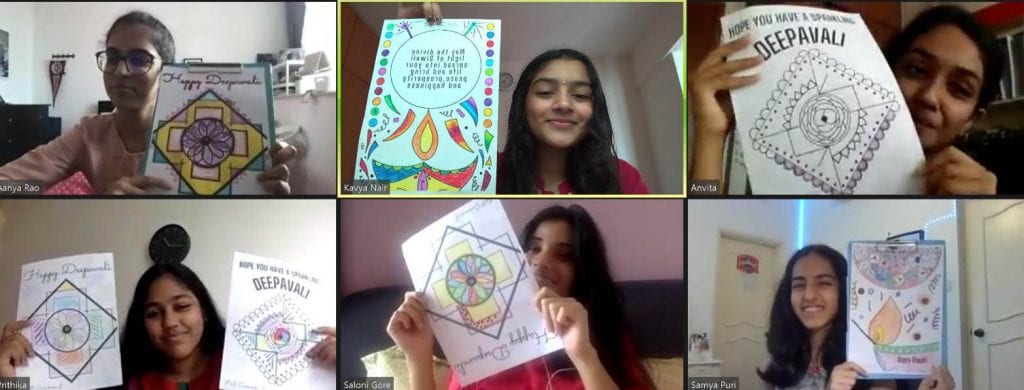
Art is Aanya’s safe space – an outlet for her emotions during difficult times of her life. In 2020, she started her initiative, Art:Connect, to connect youths with artistic talent to healthcare, providing a creative platform for youths to display their art in healthcare centres. 

Above: Aanya (top left) and fellow volunteers showcase their art. 
The 14-year-old hopes to integrate art in the process of healing while also creating a cheerful environment for patients, residents and staff in healthcare centres and nursing homes. Aanya believes that there is more to be done to make her dream into reality. “I may not be the first one to implement this, but I definitely shouldn’t be the last.”

2. Using creativity to inspire others

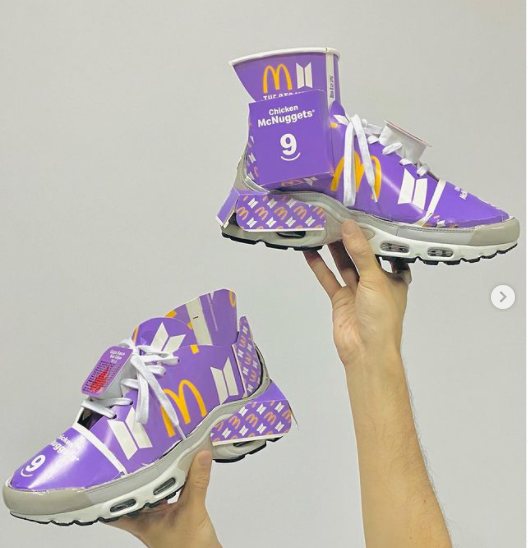
Upcycling BTS Meal packaging requires innovation, creativity and perseverance. Singaporean artist Josiah Chua created a pair of BTS meal sneakers with the packaging. Although this sneaker is neither durable nor comfortable enough to be used for walking, Chua has used his creativity to impressively transform what could have been merely regarded as trash.

Screenshots taken from: https://www.instagram.com/josiahchua/

Chua explained his creative process of designing the sneakers; from designing, cleaning the packaging, cutting out the design, to assembling the various parts of the sneaker. This is a remarkable effort and it can also be considered as ‘recycling’ or ‘reusing’! His work has certainly inspired a lot of others to do something creative with items or objects before throwing them away.

3. Being empathetic and kind

When you strive to be kind, you are thinking of what you can do and what resources you have, in order to impact other people positively.

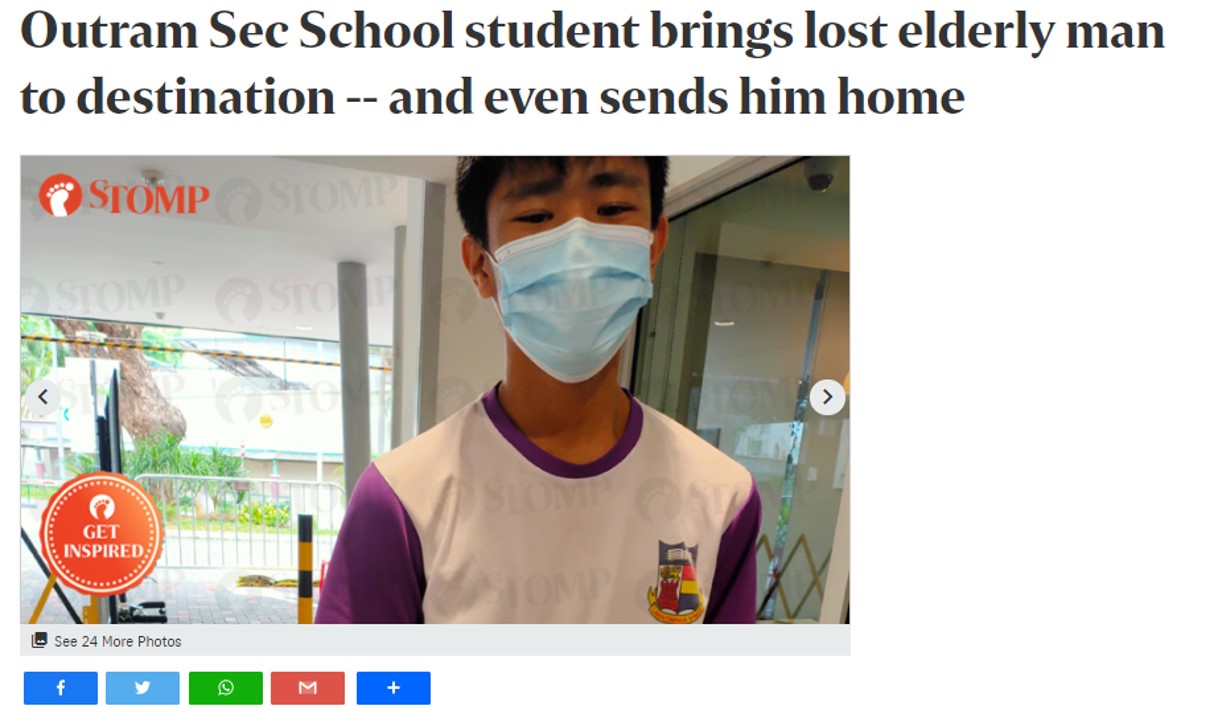
Screenshot taken from: https://stomp.straitstimes.com/singapore-seen/outram-sec-school-student-brings-lost-elderly-man-to-destination-and-even-sends-him

A passer-by was moved to tears upon witnessing how a 15-year-old boy went the extra mile to help a wheelchair-bound elderly man who had gotten lost.The boy, identified as Kean Koe from Outram Secondary School, treated the elderly man so kindly that Stomper Angela thought that Kean was the elderly man’s grandson. The elderly man was supposed to go to the community club to register and book a date for his Covid-19 vaccination but had earlier alighted at the wrong bus stop. Kean waited patiently with the uncle to have his appointment booked and even went the extra mile to send him home.

There are opportunities for you to be kind wherever you are, as long as you are willing to.

Here are some ideas if you need to get started: https://www.bestyoubestme.org/inspiration/100-ways-to-be-kind/

What are your character strengths?

How can you use your strengths to impact others?

Sources:

  1. https://positivepsychology.com/what-are-your-strengths/
  2. https://www.bandwagon.asia/articles/bts-meal-packaging-creations-upcycle-art-painting-shoes-bag-mcdonalds-army-fans-recycle-merch-2021
  3. https://www.instagram.com/p/CQf6E3PnAYR/
  4. https://cityofgood.sg/articles/singapore-youth-do-good/