Archives For Uncategorized

Success is a concept that means different things to different people. To some people, when they think of success, they imagine being wealthy and being able to afford everything that they want. Others regard success as being in power and authority while some just want to make a positive impact on the world and be happy. Though no matter what success means to you, it almost certainly isn’t something that will come easily. There will be trade-offs.

Success — and how we traditionally define it — is changing. Just because you’re wealthy doesn’t mean you’re a model of success, and just because you’re not raking in millions doesn’t mean you’re a failure. We have to stop this close-minded thinking.

In Singapore, the mark of a successful person is commonly known to be measured by the ‘5 Cs’, which are namely cash, car, credit cards, condominium and country club membership. These ‘Cs’ mainly reflect Singapore’s materialistic pursuit for wealth and status.  Bestselling author of The Happy Student, Daniel Wong proposed a new set of ‘5 Cs’ to redefine success below:

  1. Contribution

The Singapore culture emphasises the importance of achievement, whether it’s in school, business, or any other areas. We feel the pressure to work longer, harder and smarter, so that we can accomplish more.

However, enduring success is about contribution, not achievement. Achievement focuses on what we can do, while contribution focuses on what we can do for others. There’s a huge difference between the two.

If we serve others and add tremendous value to them, we’ll be on our way to building a meaningful life. We might be rewarded financially too, as a by-product of our contributions.


  1. Character

John Wooden once said: “Ability can get you to the top, but it takes character to keep you there.” In other words, competence leads to temporary success; character leads to permanent success. Character takes years to build, but it’s a key component of long-term success.

Acquiring traits like courage, perseverance, humility, generosity and kindness is what matters. These traits enable us to emerge stronger through the trials of life, and allow us to make a difference to the people around us.

We live in a world where social media and platforms broadcast not only what people think of you, but also how you treat others. You might make a ton of money, but if you treat people badly throughout your career, your success will be pretty shallow (and probably short-lived).

Successful people understand that legacy matters. When you look back at your career, you want to know that you’ve left a mark and that the people you’ve worked with hold you in the highest regard. With the world getting smaller, being respected in your career and for the way you treat others becomes more important to your success.


  1. Commitment

A committed person is someone who keeps to his or her word. When we are committed, we earn the respect of others and build our trustworthiness wherever we are. Commitment can be exhibited through being punctual, offering help when you have promised to and showing up for events even if you don’t feel like it.  If you have committed to a project or a task allocated to you, it is important that you dedicate your time and effort to complete it. Showing commitment through actions will make a good impression and helps build stronger relationships.


  1. Conviction

Take a moment and think about the two people you trust and respect most.

They’re probably people of conviction. They know what their values are, and they make deliberate choices to live out those values. This is reflected in the decisions they make with regard to family, career, finances and hobbies.

As discussed previously, Singaporeans are pragmatic and performance-driven. But real success isn’t just focused on pragmatism and performance. It’s focused on purpose, principles, and serving people. To attain this kind of success, we must first decide what’s most important to us, and what convictions we’ll live by.


  1. Community

To a large extent, the quality of our relationships determines the quality of our life. There are people who have sacrificed their relationships for personal gain. They missed their chance to form amazing, genuine relationships and enhance their lives and the lives of those around them.

Part of having a successful career is being able to share the journey with others. A quote by psychiatrist Robert Waldinger explains that, “Loneliness kills. It’s as powerful as smoking or alcoholism.” This is a nearly 80-year-old Harvard study about the relationship between your sense of community and your health. Surrounding yourself with people you admire, respect, and enjoy is so important to your life and your success.

Long-term success requires that we nurture our relationships. If we have the other 4 Cs of Contribution, Character, Commitment and Conviction, but if our lives are full of broken relationships, then we haven’t really experienced success.

We must make it a priority to live in community. This means that we invest in our family relationships, friendships, and in serving our neighbourhood. We’re independent people, but to grow as a nation we must learn to value interdependence and community too.

The bottom line

Materialism – that’s what the old ‘5 Cs’ are about. Material things matter, because they provide us with comfort and enjoyment. But there are other things that matter much more.

We must ask ourselves some hard questions. What do we want our lives to count for? What are our values? What do we want our legacy to be? What do we want Singapore’s legacy to be?

As we embrace these new ‘5 Cs’ of Singaporean success, the answers to those questions will become clearer. Then we’ll be headed down the path of building a better, brighter future for ourselves, our families, and our country.


Do you agree with the new ‘5 Cs’ proposed by the writer?

Can you think of other ‘Cs’ that would expand the definitions of success in Singapore?

Sources:

  1. https://www.lifehack.org/articles/lifestyle/how-to-be-successful-in-life.html
  2. https://sg.news.yahoo.com/blogs/singaporescene/new-5-cs-that-define-singaporean-success-023721747.html
  3. https://www.forbes.com/sites/johnhall/2018/09/09/the-trend-toward-a-new-definition-of-success-and-why-its-important-to-you/?sh=4969bb09e45c

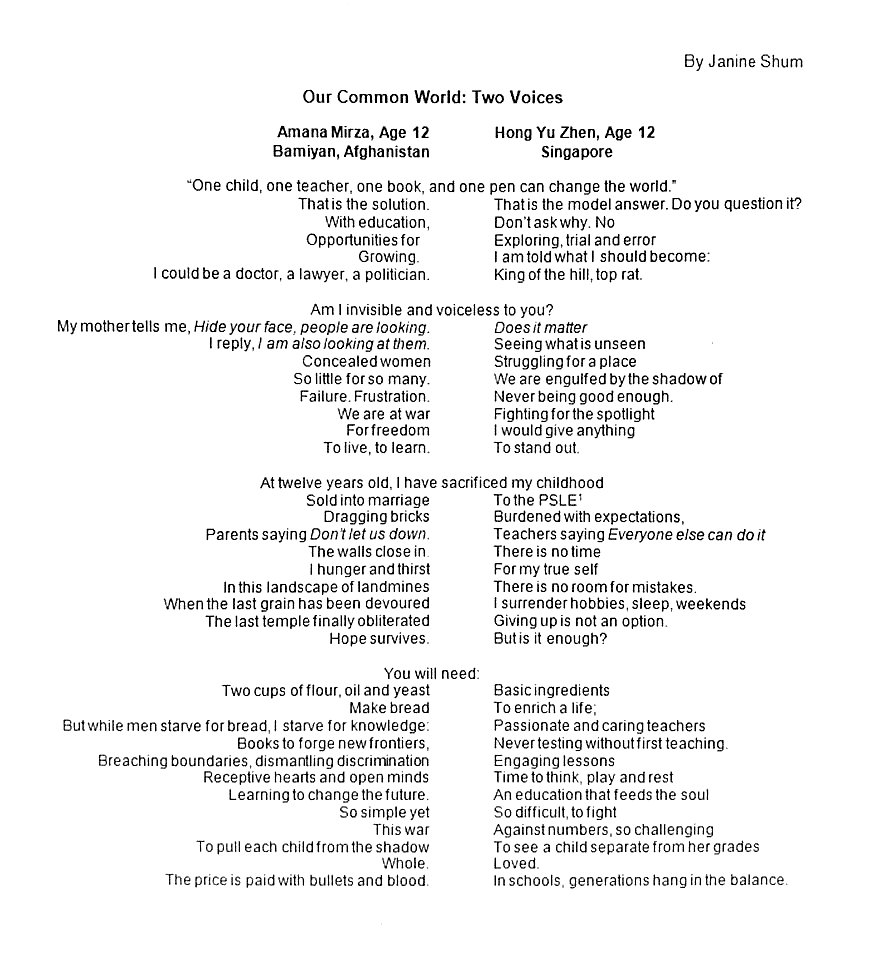
 

Twin Cinema

January 2, 2026 — Leave a comment

Poem taken from:

https://www.facebook.com/photo/?fbid=10205114253453224&set=a.10205159723109937

The poem by Shum is written in an interesting ‘twin cinema’ poetic form that could be read in three ways – two separate columns and once across horizontally. This poem truly makes readers reflect on the true purpose of education.

What is the real purpose of education?

The human race has made significant progress since their first existence. From being cave dwelling Neanderthals to now being jet-setting futurists, we have come a long way.  Today, as we gear up to become a planet of 9 billion people, are we better off than we were millenniums ago?

Of course, access to the bare necessities of life has never been easier. Shelter, electricity, food, and hygiene have considerably improved the quality of our lives. But the one essential element that separates us from the ‘uncivilised’, is education. Sadly, many people around the world are still deprived of access to education.

What is education?

The classic definition of education is “the process of receiving or giving systematic instruction, especially at a school or university”. Literacy and numeracy are basic skills taught in school. However, education is much more than just scoring well in examinations. It is a process of continuous learning which can be acquired anywhere at any time and any age.

Let us see how education can help enhance progress and make the world a better place.

  1. Education spreads awareness

Education leads to the growing awareness of how individual, societies and the world works, allowing humans to keep striving to become better versions of themselves. Education is about equipping individuals with knowledge that are based on truths and evidence. In school, teachers aim to teach critical thinking so that students are able to process the myriad of information from various sources and to ultimately discern truths from falsehoods. People who are misled by false beliefs and superstitions do more harm than good to society. An educated mind asks for logic and scientific reasoning behind all actions. For example, psychology provides information on how the human mind works after years of research and studies. With this knowledge, we understand human minds better and hence we can derive reliable solutions on how to improve mental health of individuals.

2. Education helps us stand up against wrong and for the right

Education makes us better citizens by providing us with a moral compass that teaches how to conduct ourselves appropriately in different situations.  There will be less crimes when people put to practise what they have learnt. For example, History teaches us how wars will create disastrous impacts on people and physical infrastructures, and the future generations to come. When we apply what we have learnt, it is crucial that politicians, leaders and people avoid wars by all means.

 3. Education helps us connect across borders

Learning and reading about the history, experiences and cultures of people from all over the world help us to be more understanding of people’s habits, behaviours and traditions. This insight develops global citizens who are confident in navigating the world independently and they also tend to be more empathetic and hence willing to work towards building a better world together. For example, learning about the ‘do and don’t’ from locals before travelling to certain countries will help travelers avoid unnecessary conflicts due to lack of awareness.  People from different countries can share their tips and experiences of solo-travelling and this can even lead to more travelling adventures with people of different nationalities!    

4. Education gives empowerment

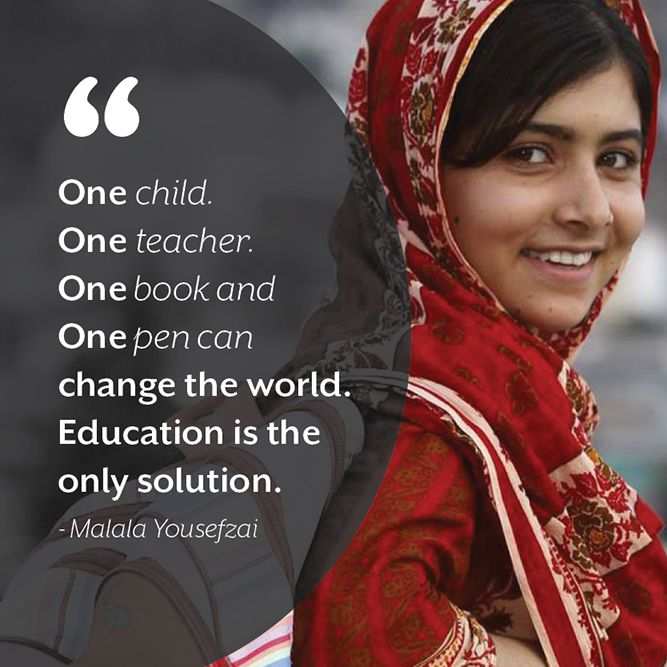
Education can help turn weakness into strength. Education gives us the confidence to stand for ourselves. It improves our decision-making capabilities and gives us access to social networks which help us to learn about basic human rights and true freedom all over the world. Many researchers have proven that in countries where women are subjected to gender bias, education helped them stand up against marital violence, improved their decision-making capabilities and helped them take charge of their own lives. One such example is Malala Yousefzai, who is an education activist, was shot by a masked gunman after she spoke publicly on behalf of girls and the right to learn in Pakistan. She survived the attack and continued to use her voice to empower girls all over the world. Read more about Malala Yousefzai’s inspiring story here: https://malala.org/malalas-story

Image credits: https://i.pinimg.com/originals/c7/da/98/c7da98ccccff9b6efcebb7fd8c24ed59.jpg

As we read stories of how education systems in other countries are evolving and improving, we should be inspired to make the world a better place.

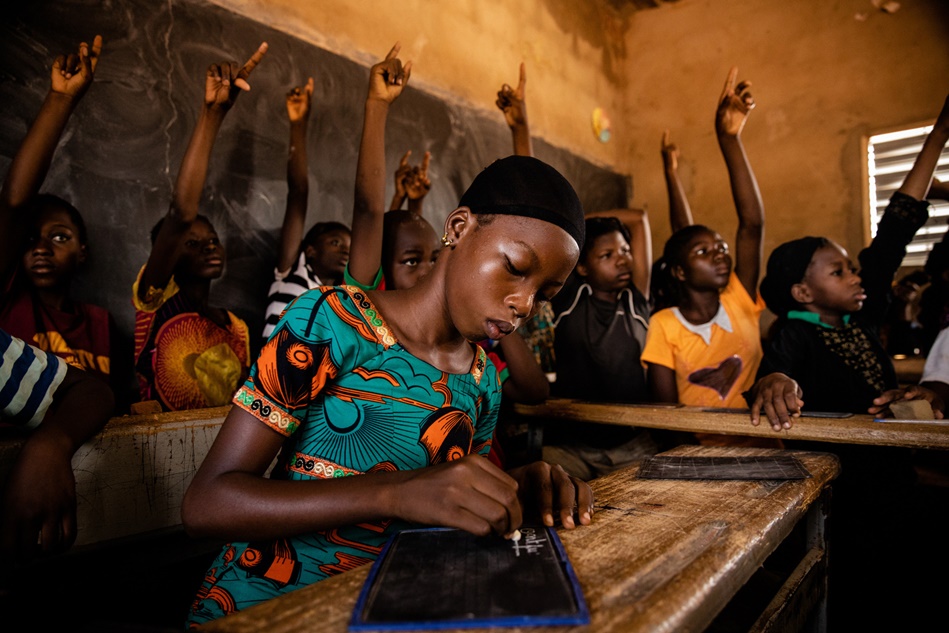
In West Africa, 11-year-old Rachidatou Sana concentrates on getting her answer exactly right.


Photo credit: Sophie Garcia

Already an outstanding pupil at Kua C school in Bobo-Dioulasso, she loves mathematical problem-solving but will have to find her own solution in the fight to keep on with her studies. Like many girls her age in Burkina Faso, Rachidatou was born to poor parents (her mother is illiterate) and is daily torn between home chores, earning a living and studying to better her situation. “I feel very lucky to go to school every day. My mother did not get that chance,” Rachidatou says. All she wants is an equal chance, the same as everyone else. She plans to go to college to train as a nurse so that she can help her family and others.

“I thought that teaching people would be giving them the gift of a lifetime”

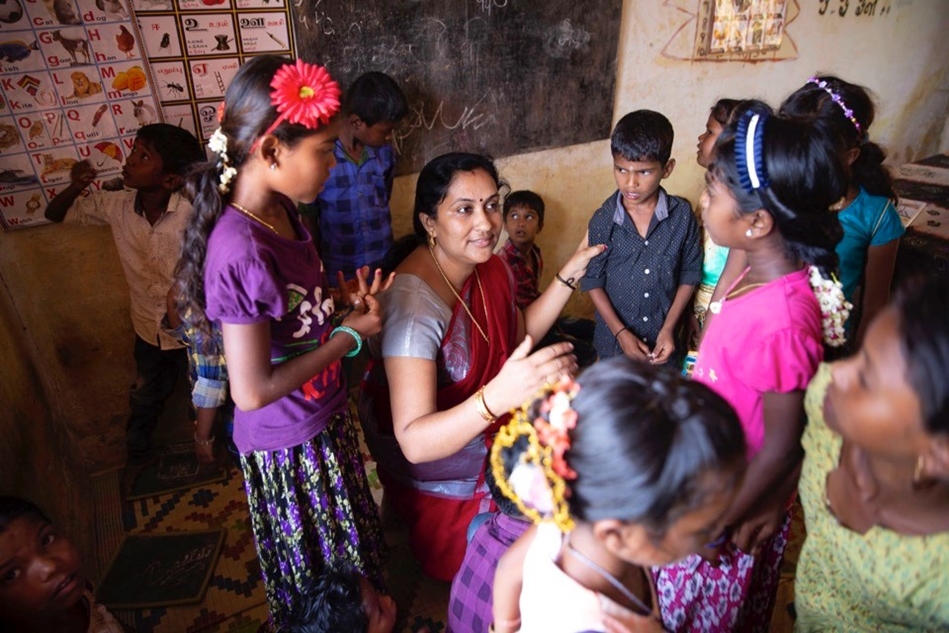
Photo credit : Jyothy Karat

Teacher Prathibha Balakrishnan, 38, came to the village of Kadichanokolli deep in the Nilgiris Biosphere Reserve in southern India in 2008 with a mission to teach the Betta Karumba mountain people. There was no electricity, no school and no healthcare. She joined hands with another extraordinary woman, namely Badichi, 44. Badichi, a tribal matriarch with seven children, has very little schooling but an innate understanding of the power of education. She worked hard as a housemaid to pay the tuition fees for all of her children and her grand-child Anitha who was abandoned by her parents. The Betta Kurumba, a secluded people who mostly work on tea and coffee plantations, have high levels of illiteracy. When Prathibha needed an ally to persuade them, Badichi went into action. Both women gained in confidence, gathering support to successfully petition the local government to install a primary school, roads and electricity. Along the way, Badichi’s daughters Seetha, 17, and Vasanthi, 19, who are pupils of Prathibha, returned the favour by teaching her the local language. Some villagers speak Prathibha’s native Tamil but are now taught in their own language. Seetha is now in 11th grade, Vasanthi has enrolled to become a nurse in a hospital nearby and both speak three languages, a leap forward for a village where most adults are illiterate.

These stories reveal that education is very much valued and regarded as the key to lead a better life. In Singapore, every child has the opportunity to learn in a safe and well-equipped school environment. Prime Minister Lee Hsien Loong states that, “Education is one of the most important things that Singaporeans have. And it is one of the most important things that the Government pays attention to because we believe that through education, we can help our citizens gain skills, learn knowledge, become productive and useful, become good people and make a living for themselves.” Singapore’s affordable and high-quality education is vital to Singapore’s future. A change in perspective will make us realise that we should strive to give our best in school and make the best out of the learning opportunity that we have in school.

What would you say to encourage someone who has lost interest in learning?

Sources:

  1. https://www.knowledgehut.com/blog/learning/education-powers-better-world
  2. https://malala.org/malalas-story
  3. https://en.unesco.org/news/power-education-inspiring-stories-four-continents
  4. https://www.straitstimes.com/singapore/education-system-designed-to-bring-out-best-in-every-student-pm


How can you show emotional support to someone?  

It can be difficult to know how to help someone you love and care for when they have gone through a distressing or frightening event.

It’s natural to want to make someone you love and care for feel better again, but it’s important to accept what has happened. There is nothing you can say or do to make the person’s pain disappear. That will happen with time, rest, and appropriate support. Explain to them that you are sorry about what they have had to experience and that you are there to help them in any way they need.

Offer support after a traumatic or distressing event

It’s always good to ask the person who has experienced a traumatic or distressing event what you can do to support them. Suggestions for supporting a friend or family member include:

  • Make time to be with the person and make it obvious that you are available. Sometimes, there can be a tendency to want to move someone on before they are ready, because the traumatic experience makes us feel uncomfortable. Try to avoid doing this. People who have had a traumatic experience can feel very reassured by human contact.
  • Don’t take their feelings to heart. They may be irritable, depressed, angry or frightened. Strong feelings and emotional outbursts are common – try not to take it personally. It is important to recognise that they have had a stressful experience and that their reactions are normal and will subside in time.
  • You can help by reassuring the person that their reactions are normal.
  • Offer practical support. You could do the housework or the grocery shopping for them, or pick up their children from school.
  • Encourage the person to take good care of themselves, for example, by eating well, avoiding alcohol, drugs or stimulants, and by attempting to maintain regular sleeping habits.
  • You may need to let the person have time by themselves.
  • Let them know you are there for them without judging.
  • Suggesting to a person that they maintain regular daily routines and habits can be helpful as well.

Talking about the trauma can be important

Suggestions include:

  • Allow the person to talk about what happened, even if they become upset. Just be calm yourself and listen carefully – getting upset too doesn’t help.
  • Don’t insist on talking if the person doesn’t want to. They may need time to be alone with their thoughts. Tell them you are there to listen whenever they feel ready.
  • Reassure them you care and want to understand as much as possible about what happened to them. They may say you can’t possibly understand what they went through and shut you out. If they take this approach, they risk becoming isolated from their support networks. Be patient and see what else you can do to help.
  • Try to make sure there is someone else they can talk to if they don’t want to talk to you about it.
  • If there are some difficult decisions to be made, talk about the situation with the person and help them to identify the different options. However, don’t make the decision for them. Also, if it is only a short time after the traumatic event, suggest that it might be a good idea to wait a little longer before making a decision.

What not to do or say

Some ways in which it can be unhelpful to respond include:

  • Don’t avoid talking about the event.
  • Don’t think you know how the person should think, feel or behave. Everyone’s response is different.
  • Don’t use general phrases such as ‘look on the bright side’ or ‘look for the silver lining’, but help them think about what they do have.
  • Don’t judge their thoughts or feelings – being accepted helps put things in context.
  • Don’t be impatient or expect them to ‘get over it’ in a certain time. It can take months or longer to recover from an event.
  • Don’t insist they need professional help. Not everyone who experiences a distressing event needs treatment. It will be more effective if they get it when they want it, even if that is later than is ideal.

Help them to relax and get involved in activities

Relaxation and fun are important recovery tools. Suggestions include:

  • Try to involve the person in physical activity, such as walking or swimming. Exercise burns off stress chemicals, reduces muscle tension and encourages better sleep.
  • While the person needs to spend some time alone, help them to strike a balance. Socialising – even low-key events such as sitting around with friends – can help to reduce stress levels.
  • Laughter is a wonderful antidote to stress. Find ways to help them to smile or laugh.

Source: https://www.betterhealth.vic.gov.au/health/ConditionsAndTreatments/trauma-helping-family-or-friends#bhc-content

The content feed that you ‘consume’ as you use your social media will affect your beliefs, thoughts and behaviours. Social media algorithms determine what you see on your social media based on your online behaviour. They aim to deliver what you want to see and weed out content that’s deemed irrelevant or low-quality. However, there are times that you view content that you do not prefer to see. Therefore, it is important to know how social media works and what you can actively do to control what you see on social media.

What controls the content that you see on Facebook, Instagram or other social media apps?

  1. Interest

Instagram looks at your past activity to gauge your potential interest. So, if there’s a certain genre of content that you engage with more frequently (e.g., food), Instagram might rank content in that genre (e.g., food, restaurants, etc.) higher on your feed.

  • Timeliness

Social media wants to show you posts that are recent and, consequently, more relevant .According to a talk from Instagram’s Thomas Dimson, the Instagram algorithm re-orders only the new posts between your current visit and your last visit. For example, if you scroll through your Instagram timeline at 11 pm and then check it again at 9 am the next morning, Instagram would only sort the posts created in between your check-ins.

  • Relationship

Content from your “best friends” likely rank higher on your feed. To determine who your best friends are, social media algorithm studies your past interactions to see which accounts you engage with most often.

  • Following

If you follow thousands of social media accounts, the algorithm must sort through more content in order to decide what to show you each time you open up the app. This means users who follow large numbers of people might see less from each individual account, whereas users who follow just a few select accounts are likely to see more from their closest friends.

Considering some of the above factors, here are some suggestions on how you can control what you see on my social media applications.

  1. Be selective with who you accept as a friend/follower and be careful in choosing the accounts that you follow.

It will be wise to only add friends whom you know personally (not a friend’s friend) and to only follow accounts after checking through the content feed thoroughly. If the content of any social media accounts promotes harmful and destructive behaviour (e.g. self-harming, eating disorder) and illegal activities (e.g. underage smoking, drinking and engaging in sexual activity), you should not continue to follow the account(s). Also report to your teachers if you have seen any images of your school mates engaging in illegal activities because such content would also likely be viewed by others of the same age group.

Remember that the algorithms of the social media show you what they think you are interested in but you have the choice to actively control and review what appears on your content feed by ‘unfollowing’ certain accounts or ‘hide posts’ that have a negative impact on you. In addition, know that you are not obligated in any way to follow an account that is ‘following’ you.  

  • Practise your ‘filtering’ skills when browsing

When browsing social media platforms, you are presented with content of various themes. Some may not be age-appropriate. There are all sorts of content shared by people and what you are browsing may conflict with your values or beliefs. ‘Filter’ what is negative and harmful to you. Aim to absorb useful information and knowledge and be inspired and encouraged with positive content.

  1. Follow social media accounts that are actually beneficial for you  

There are social media accounts that aim to provide content that benefit people as a whole. How about following some of these educational TikTok accounts that will improve your well-being?

Visit these websites to fill your social media feed with positive content:

  1. https://www.youth.gov.sg/Peek-Show/2020/10/TikTok-accounts-to-follow-for-useful-study-hacks
  2. https://www.youth.gov.sg/Peek-Show/2020/10/Five-Singapore-based-Instagram-accounts-that-will-improve-your-mental-well-being

What changes will you make to your social media accounts to impact others positively?

Sources:

  1. https://www.youth.gov.sg/Peek-Show/2020/10/TikTok-accounts-to-follow-for-useful-study-hacks
  2. https://www.youth.gov.sg/Peek-Show/2020/10/Five-Singapore-based-Instagram-accounts-that-will-improve-your-mental-well-being
  3. https://buffer.com/library/instagram-feed-algorithm/

What are food myths?

January 2, 2026 — Leave a comment

Cartoon credits: https://s3.amazonaws.com/lowres.cartoonstock.com/social-issues-baldo-five_second_rules-five_second_rules-children-lunch_break-hcc080715_low.jpg

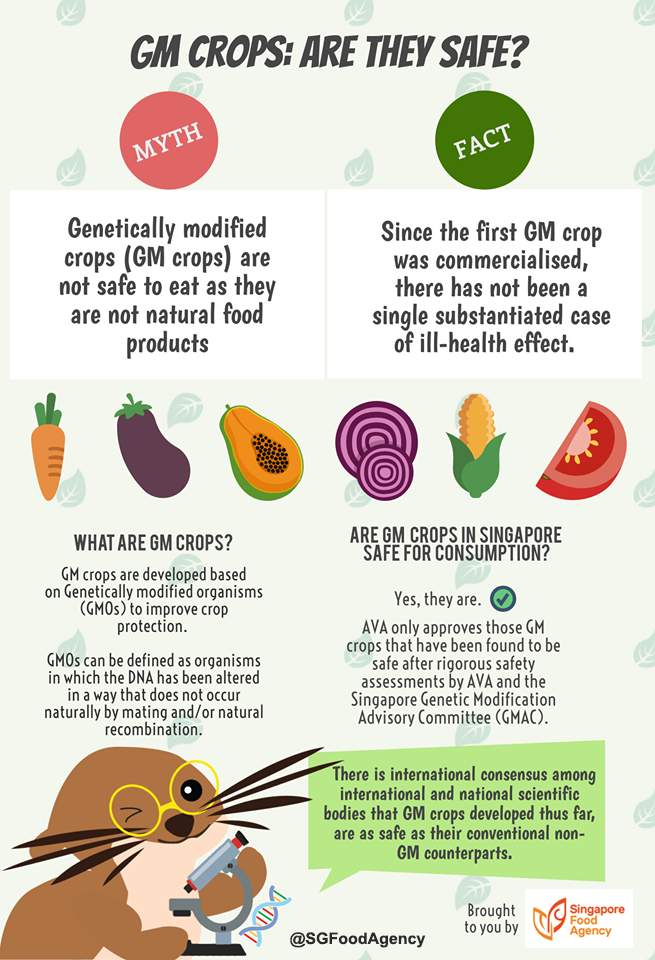
Food myths are commonly held misconceptions on food. Most of the food myths are not proven by evidence or studies. These myths might be old wives’ tale passed from generations to generations. In addition, the Internet and social media has also facilitated the spreading of all sorts of fake news.

In general, the spread of misinformation can generate fear and have social, economic and political impact. For example, in 2010, rumours on social media have circulated in China about plastic rice being manufactured and mixed in with the real rice supply in order to trick consumers. The rumours were originally prompted by “fake rice” scandals. This fake news spread to Africa in 2016 and Nigerian officials confiscated 2.5 tonnes of rice and food safety authorities in Africa had to intervene to address the rumours.

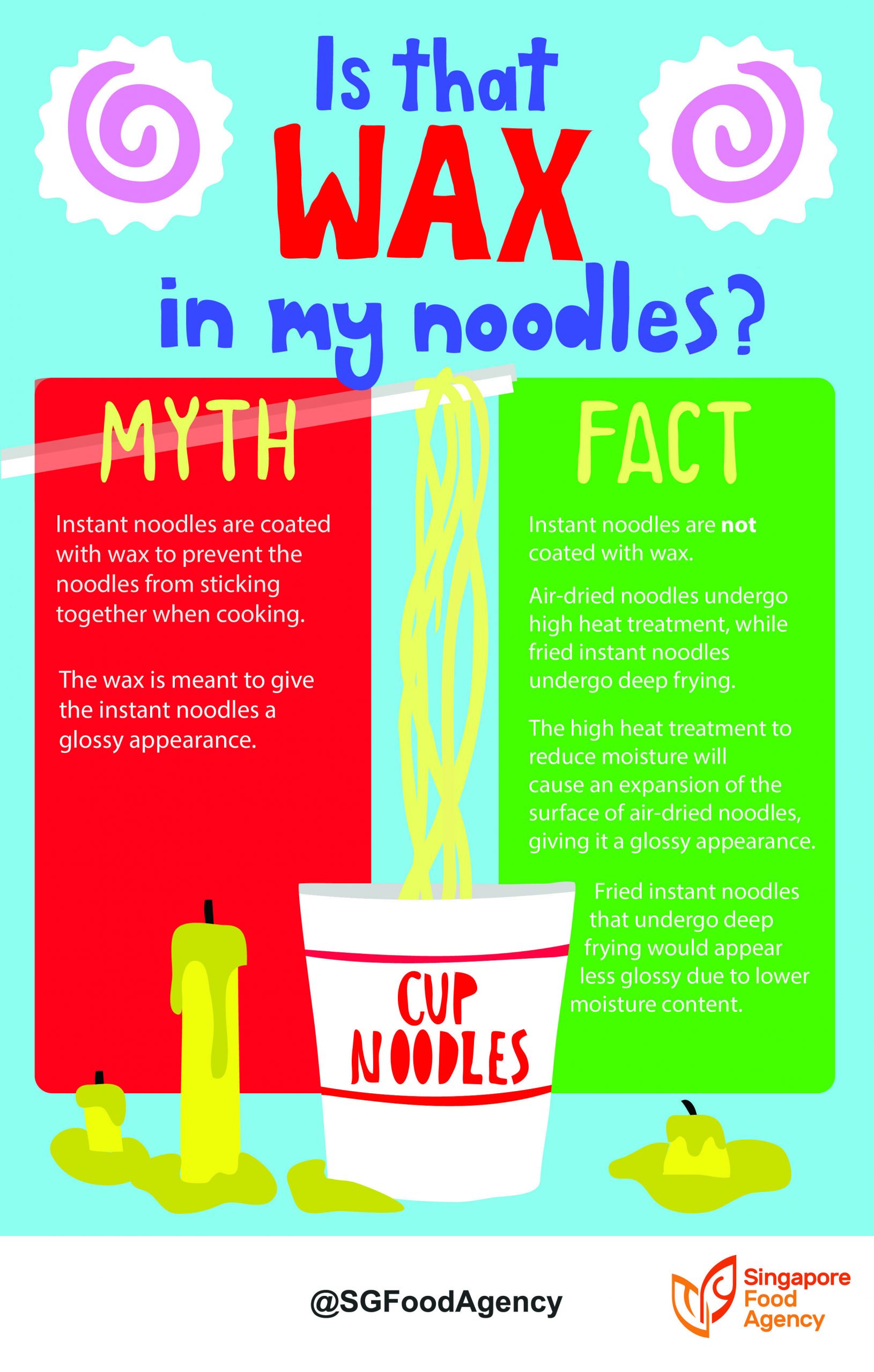
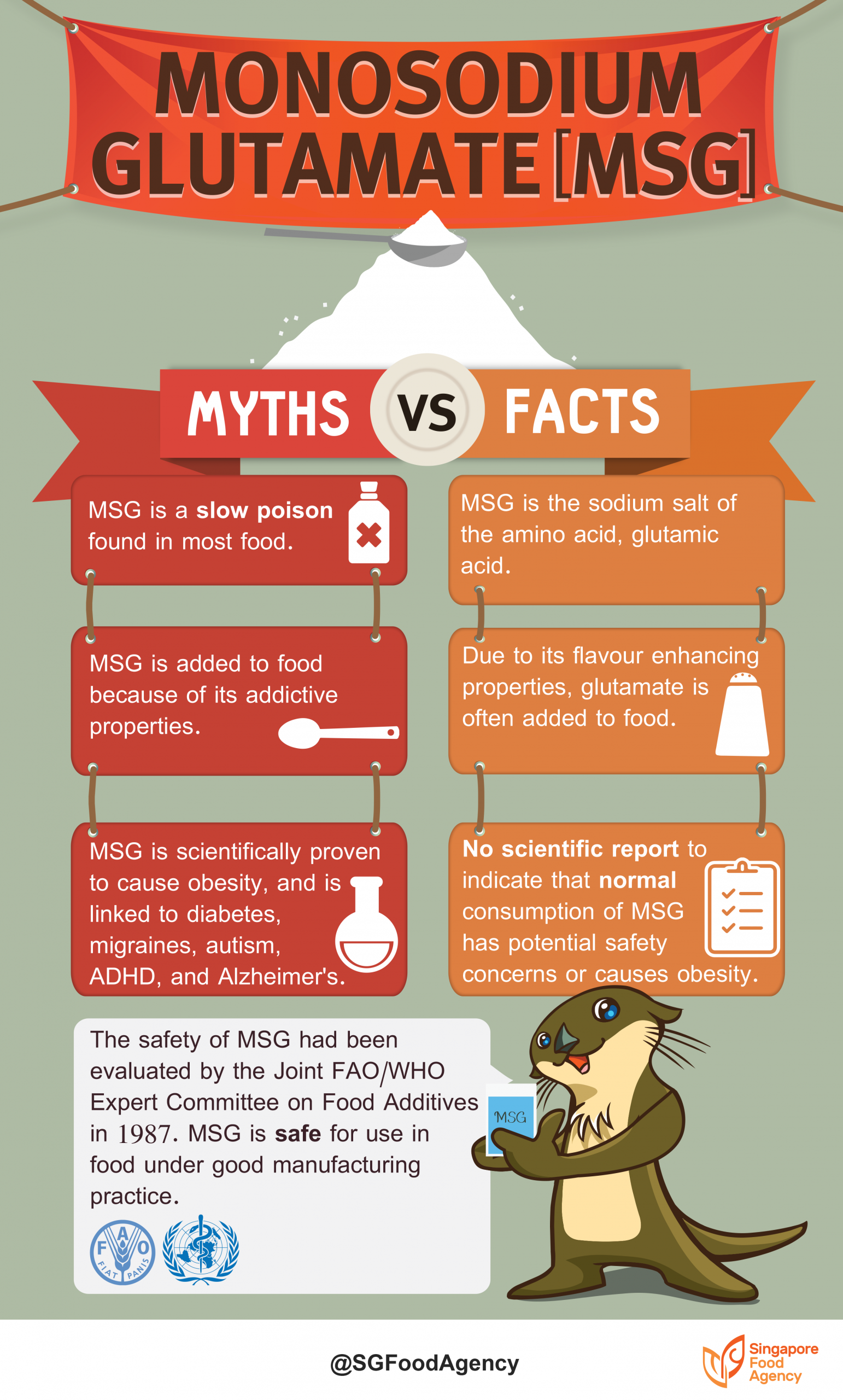
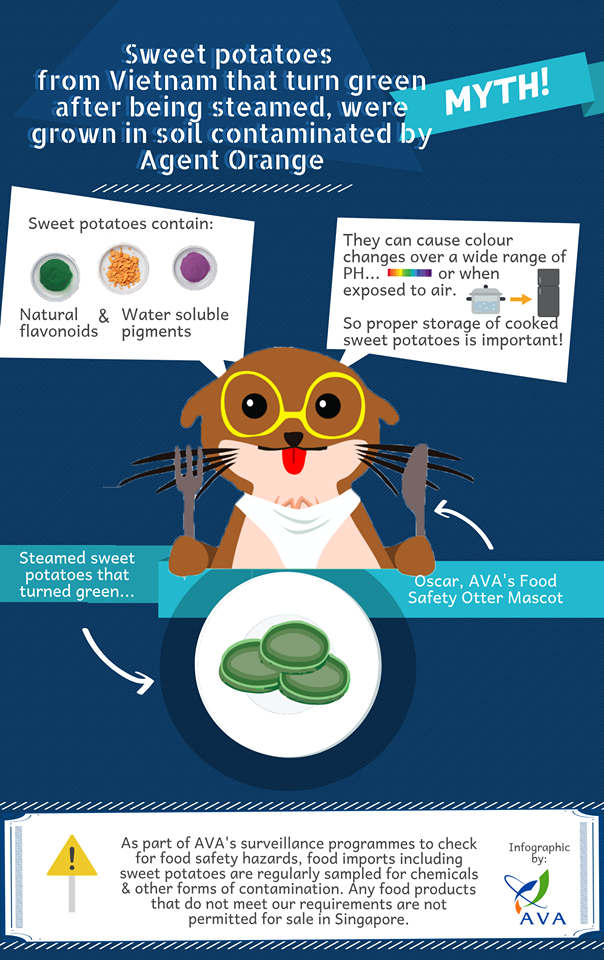
It is crucial to correct food myths or any fake news with reliable sources of evidence and information. Read on to bust food myths that you might have heard of!

Are you interested to learn more facts about food?

Read more here:

  1. https://www.straitstimes.com/singapore/health/50-food-myths-busted-setting-the-record-straight-on-popular-beliefs-about-food
  2. https://www.mountelizabeth.com.sg/healthplus/article/12-popular-health-myths-debunked

What are some new and interesting facts you have learnt about food that dispel common food myths?

Sources:

  1. https://www.sfa.gov.sg/food-for-thought/myth-busters
  2. https://www.bbc.com/news/blogs-trending-40484135