
Archives For Article

Global-Warming-affecting-our-food

From 1972 to 2014, the yearly average temperature in Singapore has increased from 26.6 to 27.7 degrees celcius. That’s an increase of 1.1 degrees. The Ministry of Environment and Water Resources reports that by the end of the century the daily average temperatures will increase by 1.4 to 4.6 degrees celcius.
While that might not seem very significant on its own, the effects of climate change, such as intense storms, flooding and prolonged droughts, are threatening global food security. In Singapore, we are particularly vulnerable to changes in global food supply and prices, because we import most of our food. In fact, less than 10% of our food is produced within Singapore. Even what seems like a small increase in global temperature can cause changes in weather patterns that will disrupt crops grown in other countries, and finally our food supply.

Climate shocks will affect food supply and prices for Singapore
A study undertaken at Nanyang Technological University (NTU) predicts more intense and frequent changes in food production around the world due to climate shocks like storms. For example, flooding and storm surges could affect rice production in north-eastern Thailand, and fishing in the waters of South-east Asia could reduce, as fish migrate away from the Equator to escape warmer oceans and increasingly acidic waters. These events and their effects are not imaginary. For example, during a dry spell in February 2014, high temperatures lowered the amount of oxygen in Singapore’s seawater and caused mass fish deaths in coastal farms.

Some farmers are already feeling the effects of climate change. The southern Mekong Delta in Vietnam, which is responsible for most of the country’s rice production, is suffering the worst drought to hit the country in nearly a century. This is expected to hit rice harvests hard.
But because Singapore’s food supply is sourced from around the world, Dr Cecilia Tortajada, a researcher at the National University of Singapore, says that we may not feel changes to supply as much as other countries that produce their own food. “If food from one source does not come, either due to climate change issues or other local problems, such as disruptions at the farm level, Singapore can source its food from other countries,” Dr Tortajada told The Straits Times.

We need to think about the future of our food source
More than 90 percent of Singapore’s produce is imported from countries such as Malaysia, Japan and even Brazil. But while our supply from countries like these is secure now, the NTU study suggests that we still need to think about the way that climate change can affect our food production in the future. This should include planning imports of produce from a range of locations, because when production is limited the exporting countries will see to their local markets and needs first. Other suggestions include investing in food processing and storage systems so that more food can be kept longer.

The Agri-Food and Veterinary Authority of Singapore (AVA) has also suggested that increasing the production of local farms could help with Singapore’s food supply.

Our families can support this by buying from local farms, and – as writer Michael Pollen suggests in the New York Times – increasing our independence by growing even some our own food.
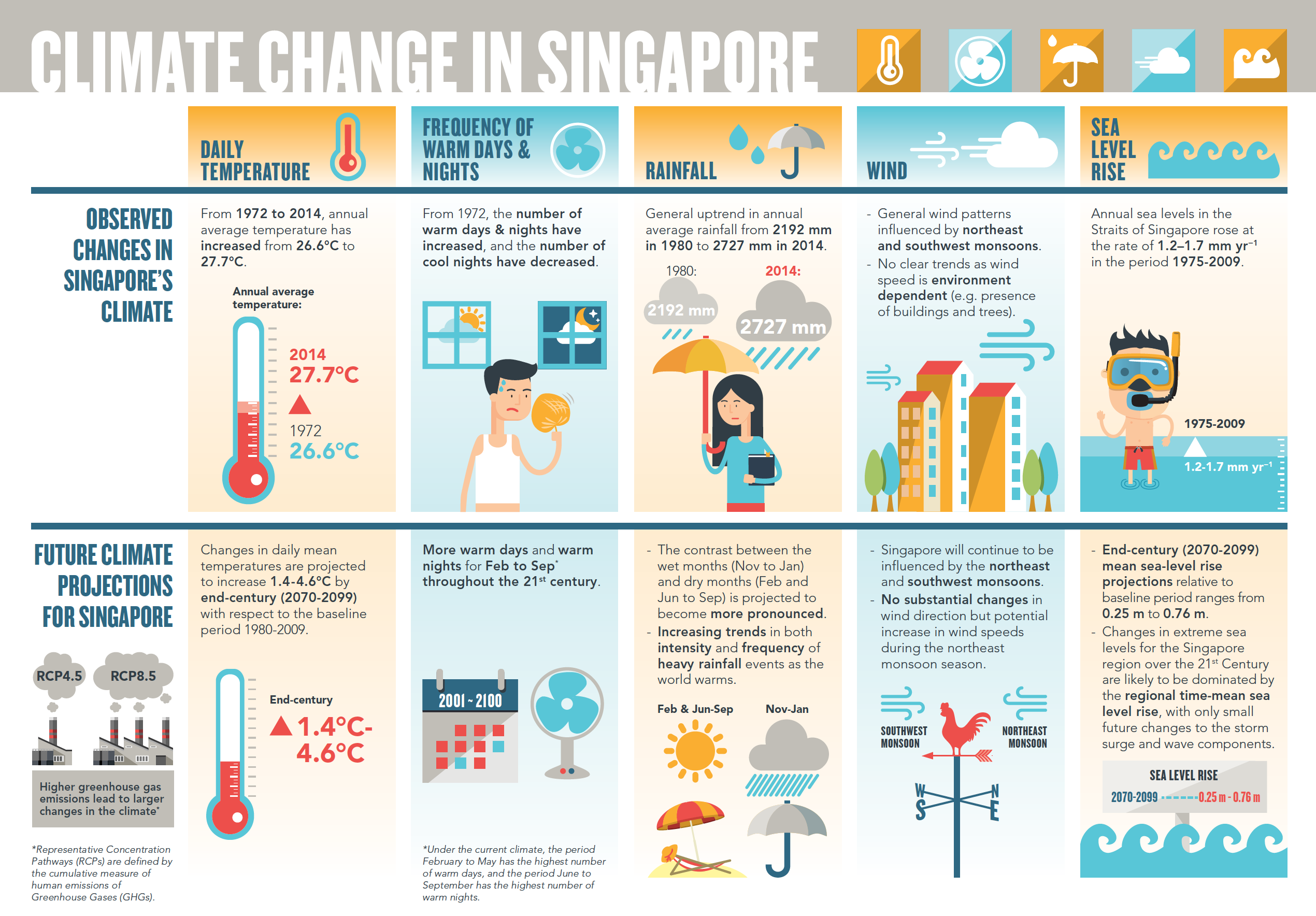
Infographic - Climate Change in Singapore

Source: Ministry of the Environment and Water Resources  https://www.nccs.gov.sg/climate-change-and-singapore/national-circumstances/impact-climate-change-singapore

image004


Sources: https://www.nccs.gov.sg/climate-change-and-singapore/national-circumstances/impact-climate-change-singapore and http://www.straitstimes.com/singapore/global-warming-hits-rice-bowls

zero-waste

Lauren Singer studied Environmental Studies at university in New York, USA, and worked as a Sustainability Manager at the New York City Department of Environmental Protection. Motivated by two key moments, she has been living a zero-waste lifestyle, producing little to no waste. The amount of trash that she has produced over the past three years can fit inside of a 453-gram jar.

Screenshot Lauren Singer and Generation Zero Waste

Screen shot from Seekers Stories: You Can Live Without Producing Trash


The first of these moments was during a presentation by a teacher at her university, Jeffrey Hollander from Seventh Generation, who emphasised the importance of ‘living your values’. This made Lauren think about her personal impact on the environment.

The second moment was when she realised that one of her classmates, who brought her lunch to university each day, used a plastic bag, disposable water bottle, and plastic takeaway container and cutlery every day. This woman would throw all of these items away at the end of her meal. Reflecting on these two moments, Lauren wondered how she could reduce her personal impact on the environment by making changes to her lifestyle, and walk the talk.

Inspired by a family from California, who call themselves the Zero Waste Home because they produce barely any rubbish, Lauren decided to stop buying packaged goods by using her own bags and jars to fill with bulk products at the supermarket. She only shopped in second-hand stores for clothes and reduced her possessions—selling, donating, or giving away unnecessary things in her life. She also tried to minimise potentially wasteful situations, saying ‘no’ to straws in her drinks, to plastic bags at stores and receipts. By minimising, reusing, recycling and composting her waste, Lauren was able to eliminate 80% of her waste

LAUREN SINGER

Image from http://www2.hm.com/es_es/life/culture/on-the-rise/zero-waste-for-lauren-singer.html


Lauren says the initial process required a lot of effort and but she was persistent; “If a family of four can live a zero-waste lifestyle, I, as a (then) 21-year-old single girl in NYC, certainly can. So I took the leap”. Lauren decided that if she was going to say that she loved the environment, she needed to actually live like she loved the environment.

Lauren created a blog, Trash is for Tossers, to document Zero Waste journey and show that leading a Zero Waste lifestyle is simple, cost-effective, timely, fun, and entirely possible for everyone and anyone.

Lauren suggests three things for someone looking to produce less waste:

  1. Evaluate your trash. Understand what goes into your garbage bin. Typically, this might include food packaging and organic waste. Once you identify the sources of your waste, come up with ways to eliminate them.
  2. Switch to easy, everyday waste-free alternatives,
  3. DIY. Do It Yourself where possible.

How can you go zero waste in Singapore? What needs to be changed to make this move more feasible?


Sources: http://www.trashisfortossers.com/p/about.html

http://www2.hm.com/en_cn/life/culture/on-the-rise/zero-waste-for-lauren-singer.html

http://tedxteen.com/talks/tedxteen-2015-nyc/295-lauren-singer-why-i-live-a-zero-waste-life


article02

Are your grades suffering, are you having difficulties remaining focused and making decisions? Do you often find yourself feeling groggy, tired or unmotivated in the afternoon? We may often turn to energy boosters such as sugary drinks and snacks to help us make it through the day. But, in reality, it could be because you’re not getting enough sleep. While it is well known that children need about 10 hours of sleep per night and adults need around seven or eight for maximum health benefits, many of us fail to make sleep important.  Comedian Carrie Snow once said, “No day is so bad it can’t be fixed with a nap.” In fact, many famous people have used naps to help themselves feel refreshed. Leonardo DaVinci is said to have had an extremely irregular sleep pattern, taking multiple naps a day and sleeping less at night. To alleviate stress on the job and break up his day, U.S. President John F. Kennedy took frequent naps. John D. Rockefeller, oil tycoon and philanthropist, napped every afternoon in his office. Actress and musician Emmy Rossum tries to prioritize her sleep. In an interview with HuffPost Live she said, “Sleep is important,” she said. “I’m a huge napper… I literally nap between interviews.” Maybe they’re all onto something. While we all know that we should be logging seven or eight hours of shut-eye each night for maximum health benefits, many of us fail to make sleep a priority. The truth is, taking a nap is perhaps the best way to rejuvenate your brain.   But, as David Dinges, a sleep scientist at the University of Pennsylvania’s Perelman School of Medicine, tells us, “Naps are actually more complicated than we realize,” said “You have to be deliberative about when you’re going to nap, how long you’re going to nap and if you’re trying to use the nap relative to work or what you have coming up.”  Sleep experts have break sleep down into several stages, which the brain runs through every 90 to 120 minutes. The first first two are relatively light sleep, while the third brings you into a deeper sleep. The fourth stage, known as rapid eye movement – or REM, is where most of your dreams begin.


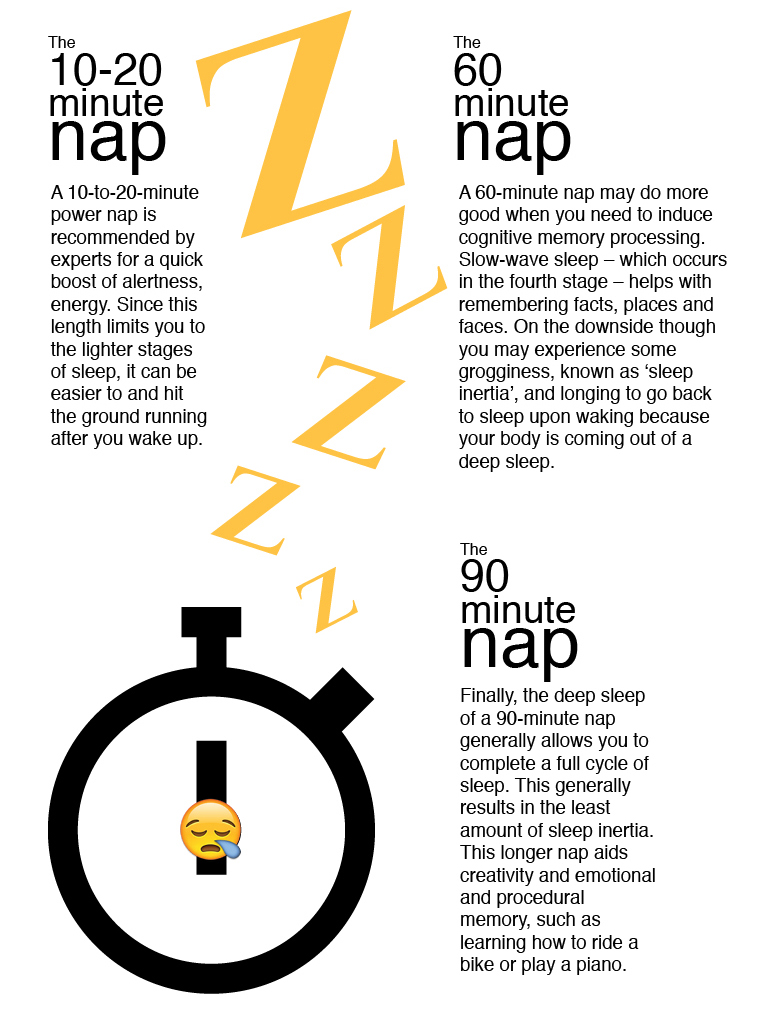
How Long to nap?

The benefits of napping are tied to the length of time in which you’re asleep.

(2)-Sleep-Deprived-Nation-infographics

Experts say the best time to nap is generally between the hours of 1 p.m. and 4 p.m. Napping later in the day could interfere with nighttime sleep.

There is a fine balance between the phases, and a nap’s timing and duration can have different effects on different people, depending on their age and possibly genetics. If you’ve ever taken a nap and felt worse when you woke up, it could be because you’re sleeping too long and you’re going into a stage of sleep that’s more difficult to get out of.

As the benefits of napping are becoming more well known, some work places and gyms are incorporating places to nap so people can have a brief afternoon nap on a daybed to increase alertness. We may need naps now more than ever.

Do you ever nap during the afternoon? Do you know how long your body needs to nap to feel refreshed?

Charitywateryellowline


Sources: http://www.huffingtonpost.com/2014/05/06/famous-people-who-nap_n_5248739.html and http://collectivelyconscious.net/articles/how-long-to-nap-for-the-biggest-brain-benefits/ and http://www.wsj.com/articles/SB10001424127887323932604579050990895301888

ARTICLE_01

Often, when people see someone achieve something great, they believe that the person had some huge talent that others don’t. Regardless of whether they are a concert pianist or computer guru, footballer or scientist, they usually have some talent. But what most people don’t like to admit is that ambition will win over talent most of the time. Here are a few reasons:

TALENT CAN BE WASTED

Talent alone does not guarantee success. Not every talented person will use their natural ability to its full potential. It is only when talent is combined with ambition that things begin to unfold. Ambition needs little added to go somewhere great. If you have an ambitious drive, you can create an opportunity for yourself, even though you may not feel as talented as others. We will rarely find an ambitious person who did not achieve anything, but finding unsuccessful people with huge talent is really quite easy.

TALENT CAN BE TAUGHT

While not everyone would agree, whatever comes naturally to some people can also be taught to others. As a result, we could say that the people with talent are not as ‘special’ or ‘unique’ as we thought, they only had a head start. If a person has plenty of ambition, and makes the effort to learn, they can become as ‘talented’ as those who had the natural ability. In other words, an ambitious person can learn talent, but we cannot say a talented one, on the other hand, may not be able to learn ambition.

TALENT CAN QUIT

Vince Lombardi, a famous American football coach, once said, “A quitter never wins and a winner never quits”. Despite having huge talent and a bright future ahead, a person without ambition may not have the motivation to keep going when faced with pressures, challenges and failures. Quitting is easy, but ambition, on the other hand, generally takes each disappointment and failure in stride, learning to overcome and move on. Scientists like Issac Newton and Albert Einstein continued pursuing their dreams and passions even though some of their experiments failed. They strived hard to reach their goals and only rested when they succeeded. In the game of life, a finisher without talent still went further than a genius who quit along the way.

While having a lot of talent and ambition is ideal, when it comes down to it when you have ambition in your life more things will seem achievable. So, when you see someone achieve something great, don’t just think it was because of talent, admit that hard work and determination were needed to attain it.


Charitywateryellowline

Source: http://wallstreetinsanity.com/4-reasons-ambition-is-more-important-than-talent/

http://elitedaily.com/life/motivation/remember-before-throwing-in-the-towel/886003/
http://www.mbarendezvous.com/essay/essay-topic-a-quitter-never-wins-and-a-winner-never-quits/

Carpe Diem

February 9, 2016 — Leave a comment

ARTICLE_15CAST2_05

What is ‘Carpe Diem’?

Continue Reading…