The importance of developing your critical thinking skills
There are all sorts of information flooding our social media, and amongst the sea of information, fake news lurks within. The full spectrum of fake news can range from truly absurd and unbelievable stories, which are clearly fake, to more subtle types of misinformation, which are more difficult to detect. There are also websites that perpetuate fake news and hoaxes without first verifying the veracity of the news.
Bearing in mind how much information we are consuming daily from the Internet and social media in this digital age we live in, all the more we must learn to discern truth from false information using critical skills and navigate the murky waters of social media carefully.
Here are some examples of fake news and ways we can ensure that we do not fall into the trap of circulating misinformation and generate unnecessary panic and alarm.
- Deceptive news can be made to look convincing and real.
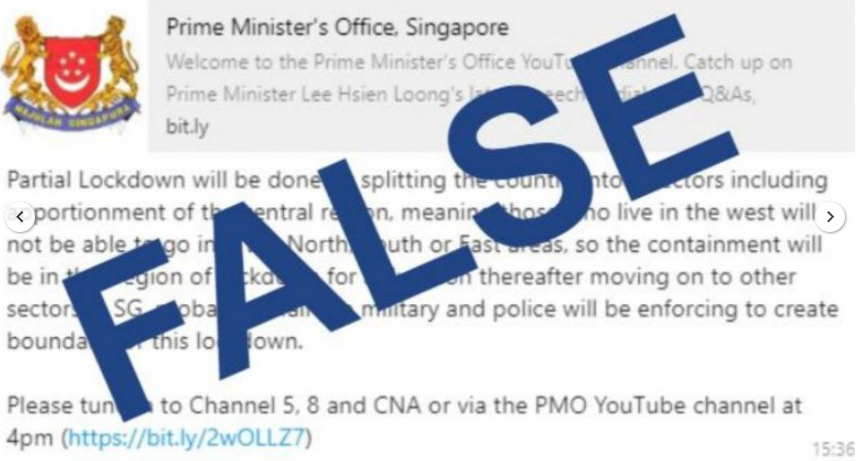
Image credits: https://www.straitstimes.com/singapore/coronavirus-pm-lee-announcement-that-sporeans-cant-travel-beyond-the-area-they-live-in-is
A message being circulated recently is similar to an old WhatsApp chain message that refers to a “partial lockdown” of Singapore, where the country is alleged to be split into four sectors – north, south, east and west. According to the fake message, boundaries of the sectors will be enforced by soldiers and the police to make sure that residents of one sector do not enter another.
In a message sent through Gov.sg’s messaging app channels, the Government said that people should refer to government sources or PM Lee’s official social media platforms for information on whether he was going to make a national address. There were no indications from official sources that he was going to make a national address on that day. The Gov.sg message urged people not to spread unverified information.
The Government invokes the Protection from Online Falsehoods and Manipulation Act (POFMA) to correct false statements. POFMA’s primary tools to counter online falsehoods are the correction directions – these directions do not require the online falsehood to be removed. In more serious cases, a stop communication or disabling direction may be used. However, there are concerns about the impact on freedom of expression in Singapore with the implementation of POFMA.
- Fake news and misinformation contradict facts
There are certain groups of people that challenge historical facts that have undoubtedly happened due to malicious intents and self-serving purposes.
One such example is the holocaust denial. The Holocaust was the genocide of the Jewish people that tragically happened under the totalitarian Adolf Hitler during World War II in Europe from the 1941 – 1945.
Read about the Holocaust here: https://www.britannica.com/summary/Holocaust
Despite reliable evidence that Holocaust has happened, there are people who deny that there was such an event. Holocaust deniers argue that Nazi Germany was the victim of a conspiracy, contrived by the Allies to brand Nazi Germany the villain of World War II. They maintain that the U.S. and Great Britain concocted wild atrocity stories about the Nazis to cover up their own war crimes. Jews, they claim, joined the conspiracy in order to prey upon the sympathies of the world and extort money from post-war Germany in order to establish the State of Israel. (Arab leaders have sometimes resorted to Holocaust denial in an attempt to delegitimize the existence of the State of Israel). To one degree or another, Holocaust revisionists claim the Holocaust is an exaggeration, if not an outright hoax.
Facebook is banning all content that “denies or distorts the Holocaust,” in a policy reversal that comes after increased pressure from critics.
Read why Mark Zuckerberg decided to remove Holocaust-denying posts after initially refusing to: https://www.npr.org/2020/10/12/923002012/facebook-bans-holocaust-denial-reversing-earlier-policy
How can we be more discerning and critical when reading from various sources?
A. Be careful of confirmation bias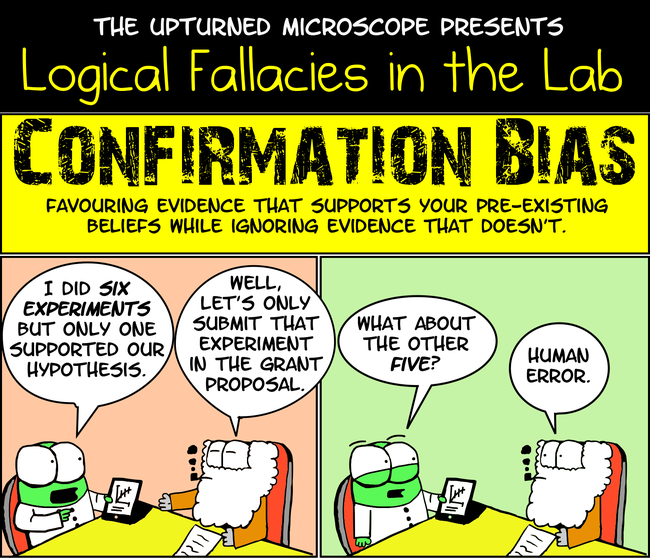
Image credits: https://onlinejournalismblog.files.wordpress.com/2020/04/lf16-confirmation-bias.png
A confirmation bias is a type of cognitive bias that involves favouring information that confirms your previously existing beliefs or biases.
For example, imagine that a person holds a belief that left-handed people are more creative than right-handed people. Whenever this person encounters a person that is both left-handed and creative, they place greater importance on this “evidence” that supports what they already believe. This individual might even seek proof that further backs up this belief while discounting examples that don’t support the idea.
Confirmation biases impact how we gather information, but they also influence how we interpret and recall information. For example, people who support or oppose a particular issue will not only seek information to support it, they will also interpret news stories in a way that upholds their existing ideas. They will also remember details in a way that reinforces these attitudes.
Unfortunately, we all have confirmation bias. Even if you believe you are very open-minded and only observe the facts before coming to conclusions, it’s very likely that some bias will shape your opinion in the end. It’s very difficult to combat this natural tendency.
That said, if we know about confirmation bias and accept the fact that it does exist, we can make an effort to recognize it by working to be curious about opposing views and really listening to what others have to say and why. This can help us better see issues and beliefs from another perspective, though we still need to be very conscious of wading past our confirmation bias.
B. Evaluate the sources using critical skills
This is the time to put all the skills that you have learnt from your history lessons to use! Test the reliability of the source by asking yourself questions:
- Who created the source? Whose perspective is presented?
- Look at the author. To check if they are real, reliable and “trustworthy”, look for other pieces they have written and what outlets they have written for. If they haven’t written anything else, or if they write for websites that look unreliable, think twice about believing what they say.
- Find out more about the source. Look at the website where the story comes from to see if the story is well-presented, if the images are clear, and if the text is written well and without any spelling errors or exaggerated language. If you’re not sure, try clicking on the “about us” section, and check that there’s a clear outline explaining the work of the organisation and its history.
- What is the purpose of the source?
- Who is the target audience of the source?
- What is the intended impact of the source?
- Is this a form of propaganda to influence certain ideologies and actions of some groups of people? Check that the article contains references and links to other news stories, articles and authors. Click on the links and check if they seem reliable and trustworthy.
C. Do a Google Reverse Image Search
This is an excellent tool, which allows you to search Google by images, rather than words. It’s simple; all you have to do is upload a picture onto the Google Reverse Image Search site and you will see all the other web pages that have similar images. This then tells you the other sites where the images have been used – and if they’ve been used out of context.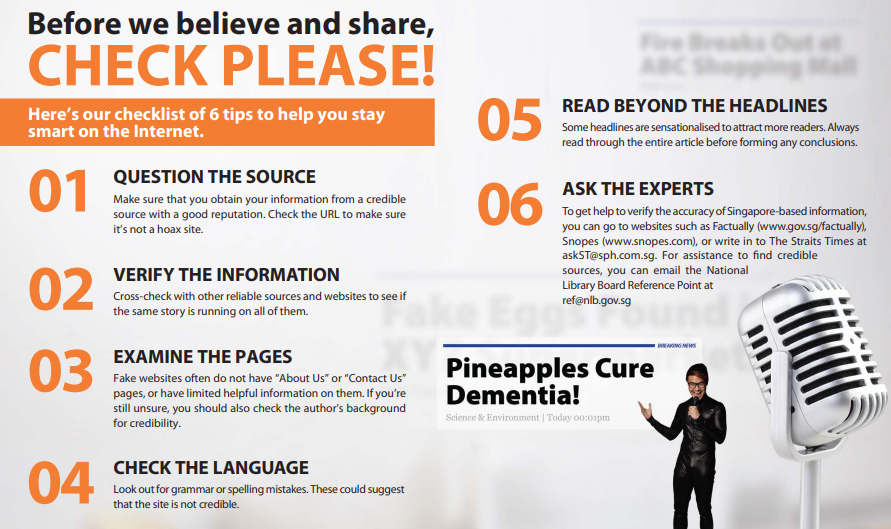
Image credits: https://www.betterinternet.sg/-/media/MLC/Files/SID-2018/Quick-Tips/1_How-to-spot-Fake News_Tipsheet.pdf
Do remember that trending news or news that is widely shared may not be accurate or true! It’s really important to avoid sharing stories that you are unsure about. If you are in any doubt about whether the news is real or fake, discuss it with a knowledgeable friend or a family member to find out what they think about the story.
How confident are you in identifying fake news?
Have you been duped by fake news that you first believed to be real?
Sources:
- https://www.pofmaoffice.gov.sg/regulations/protection-from-online-falsehoods-and-manipulation-act/
- https://www.straitstimes.com/singapore/coronavirus-pm-lee-announcement-that-sporeans-cant-travel-beyond-the-area-they-live-in-is
- https://www.museumoftolerance.com/education/teacher-resources/holocaust-resources/what-is-holocaust-denial.html#2
- https://www.npr.org/2020/10/12/923002012/facebook-bans-holocaust-denial-reversing-earlier-policy
- https://www.verywellmind.com/what-is-a-confirmation-bias-2795024
- https://www.betterinternet.sg/SID-Campaign-2018/Tipsheets/Online-Discernment
- https://theconversation.com/how-to-spot-fake-news-an-experts-guide-for-young-people-88887