The idea of autonomous sensory meridian response (ASMR) has been around a long time, though it was not always described as such.
History of ASMR
Even before the term ASMR was coined, people were already experiencing “weird sensations” from observing people carry out simple tasks like filling out a form, reading a story etc. People in an online forum began discussing their experiences and tried hard to explain the sensation.
It wasn’t until 2010 when YouTuber Jennifer Allen coined the term ASMR, and the whole thing really took off. In 2011, a subreddit forum called “ASMR: Sounds that feel good” was created that continued to draw more fans of the genre.
Fast forward to 2016, WhisperingLife, the first whisper YouTube channel had well over half a million subscribers and 15 million video views. More channels had popped up during this time and moved well beyond whispering to whole buffets of audiovisual stimuli intended to give people the tingles. ASMR has continued to build in popularity ever since.
Health benefits of ASMR
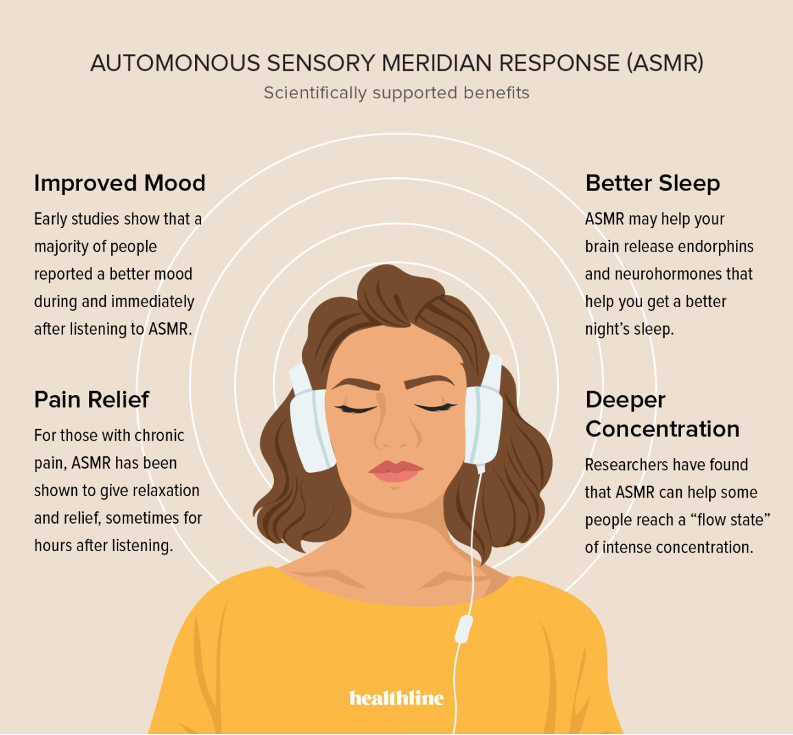
Image source: https://www.healthline.com/health/autonomous-sensory-meridian-response#benefits
- ASMR has reportedly helped in Immediate pleasure. For people who experience the ASMR shivers and tingles, it can be a very pleasurable and relaxing feeling that happens almost immediately with exposure to the stimuli.
- Improved mood. An early study revealed that 80 percent of participants had improved mood after exposure to ASMR. The benefits declined faster in people with higher levels of depression.
- Pain relief. The same study showed that a portion of people who deal with chronic pain found relief that lasted for up to 3 hours after exposure.
- Deeper concentration. A “flow state” refers to when you lose yourself or your sense of time because you are so deeply concentrated on something. Researchers have found similarities between ASMR and the type of focus you would experience in flow.
- Better sleep. Early research has shown that ASMR may help get you and your brain into the right state for deep, healthy sleep by promoting relaxation and theta brainwaves.
- Other benefits. People who enjoy ASMR often report reduced anxiety, fewer headaches, lower blood pressure, and more.
While these are in line with what has been proven, more research is needed to back up these claims. ASMR is accessible to almost anyone. So, if these benefits sound promising to you, you can try it for free online and without a prescription.
Question and Answer about ASMR
- Can you be addicted to ASMR?
You can get too much of a good thing, but watching too many ASMR videos won’t necessarily harm you. If it starts to interfere with your everyday life or you feel dependent on ASMR to function, you may want to contact your doctor or therapist to see if there are other issues at play. It is worth mentioning again that people who watch too much ASMR or who have developed a problem with their relationship to ASMR may be more likely to become desensitized and develop “ASMR immunity.”
- How can I start my own ASMR channel?
Visit this website for more information: https://asmruniversity.com/be-asmr-artist/
- Why do some people cringe at ASMR?
Some people may cringe at ASMR because they have misophonia, which means “hatred of sound” and can be triggered by the same sounds that elicit pleasure in others. Whereas ASMR makes some people feel warm and fuzzy, misophonia may produce an unsettling fight, flight, or freeze response in others.
Experiencing ASMR for yourself
Now that you know about the unique benefits of what is termed as ‘stimulating relaxation’, ASMR can seem like something you may want to experience for yourself. Unfortunately, it is not the kind of thing you can teach, practice, or learn. It is an involuntary physical reaction and it’s not as common as you might expect despite the popularity of ASMR videos. It’s difficult to say just how many people have the ASMR response, but an article in The Guardian from 2018 indicated that anywhere between 20% and 70% of adults might experience it.
In the end, if you experience ASMR, it might be good for you, in that you can probably use it to help you relax at bedtime… but if you don’t, it’s probably nothing to lose sleep over. Overall, in your everyday life it is still important to be mindful of using your senses to be present in the moment.
What are your responses and feelings as you watch ASMR content videos?
Sources:
- https://www.healthline.com/health/autonomous-sensory-meridian-response#benefits
- https://www.healthline.com/health/autonomous-sensory-meridian-response#asmr-uses
- https://asmruniversity.com/about-asmr/what-is-asmr/
- https://www.psychologytoday.com/sg/blog/i-hear-you/202201/what-is-asmr-all-about
[ASMR]: Everything Science Knows So Far
https://www.youtube.com/watch?v=-WpAphhsBgs (4.23 mins)
Meet The ASMR Creators Behind The Spine-Tingling Videos Taking Over YouTube
https://www.youtube.com/watch?v=nyQ56-GxM5k (5.37 mins)