Some students regard history as boring, uninteresting and irrelevant. They find studying History as a subject challenging because they are unable to memorise large chunks of information. However, the main goal of studying History is not to improve our memorising and regurgitation skills, nor is it a test of who can write the most pages of essays. Although admittedly, sometimes it can seem like it.
The History syllabus in Singapore states that the aims of History education in Singapore are to develop in students:
- an appreciation of past human experiences
- critical awareness of the nature of historical knowledge
- the ability to make connections between the past and present
Through the teaching and learning of historical content, concepts and skills in school, qualities of a history learner can be manifested.
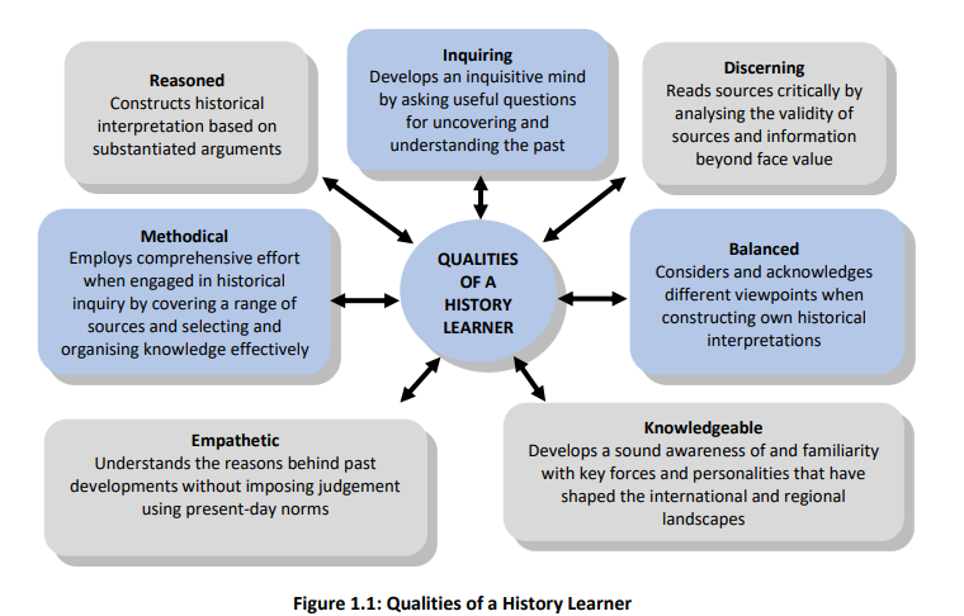
Image credits: https://www.moe.gov.sg/-/media/files/secondary/syllabuses/humanities/2021-history-lower-secondary-syllabus.pdf
Here are some reasons why people study history (in general) and History (as a subject):
- Everything has a history
Everything we do, everything we use, everything else we study is the product of a complex set of causes, ideas, and practices. Even the material we learn in other subjects has important historical elements – whether because our understanding of a topic changed over time or because the discipline takes a historical perspective. There is nothing that cannot become grist for the historian’s mill (PS: please check the meaning of the idiom ‘grist for the mill’).
- “Doing” History is like completing a puzzle or solving a mystery
Imagine asking a question about the past, assembling a set of clues through documents, artifacts, or other sources, and then piecing those clues together to tell a story that answers your question and tells you something unexpected about a different time and place. That’s doing history. People can have different perspectives about historical figures, decisions made or an event in the past because people of different ages, ethnic groups, social status, occupations etc, their lives are impacted by forces of history differently. Often, the people with power and authority or the ‘winners’ are the ones who manage to tell their stories. Other stories are deemed as ‘less important’ or unimportant and hence untold. When you study history, see yourself as a detective trying to find out the truth and then as you write your essays, imagine yourself as a journalist helping readers to understand the topic at hand.
There are many branches of history and we study history to better understand the modern world we are living in.
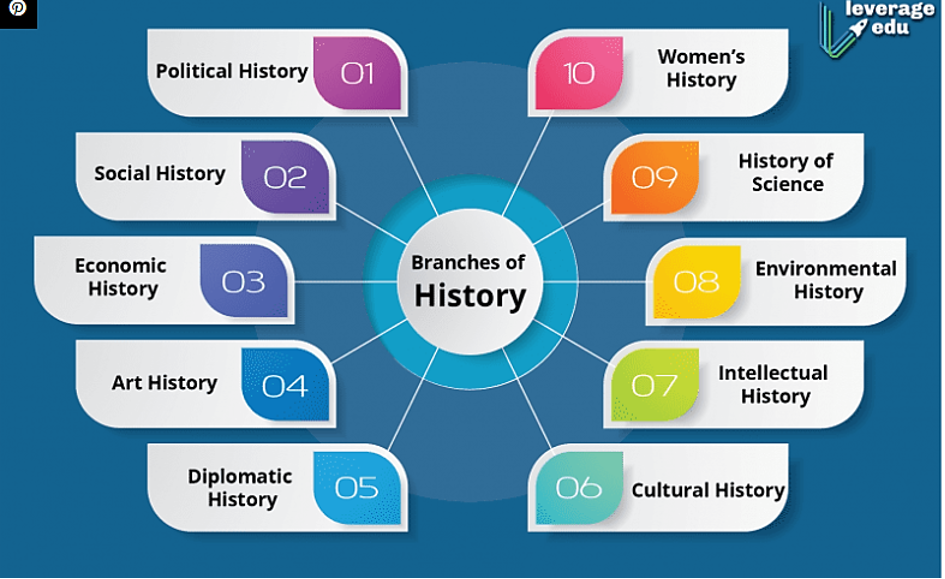
Image credits: https://leverageedu.com/blog/branches-of-history/
- The past teaches us about the present
History gives us the tools to analyze and explain problems in the past, it positions us to see patterns that might otherwise be invisible in the present – thus providing a crucial perspective for understanding (and solving!) current and future problems. For example, a course on the history of public health might emphasize how environmental pollution disproportionately affects less affluent communities – a major factor in the Flint water crisis. Understanding immigration patterns may provide crucial background for addressing ongoing racial or cultural tensions. In many ways, history interprets the events and causes that have shaped our current world.
- History can be intensely personal
Why do people want to participate in DNA Ancestry tests? Each individual is born with a personal variant of an inherited genetic template, known as the genome, which has evolved during the entire life-span of the human species. Studying history and finding out about our heritage help people make sense of their own identities. In fact, we are all living histories. Communities speak languages that are inherited from the past. They live in societies with complex cultures, traditions and religions that have not been created on the spur of the moment
In learning about the past, we often discover how our own lives fit into the human experience. In October 2015, a UW alumnus named Michael Stern contacted Professor Amos Bitzan for help translating letters from his grandmother, Sara Spira, to his parents. Bitzan was able to integrate some of the letters into his class on the Holocaust to bring to life for his students the day-to-day realities of being Jewish in Nazi-occupied Poland. As Bitzan explained, “I realized that Sara Spira’s postcards could be a way for my students to integrate two facets of the study of the Holocaust: an analysis of victims and perpetrators.” And if you have ever seen an episode of “Who Do You Think You Are?”, you’ve seen the ways in which historical research can tell us amazing stories about our ancestors – stories we might not ever know otherwise.
Therefore, understanding the linkages between past and present is absolutely basic for a good understanding of the condition of being human. That, in a nutshell, is why History matters. It is not just ‘useful’, it is essential.
- History builds empathy
Developing historical empathy is perhaps the most difficult, but one of the most important, skills you will learn as a student of History. When we study History, we are also studying the lives and struggles of others. You will encounter a vast array of people who thought, spoke and acted in ways that are foreign to you. You will wonder, “Why did this person make this decision during that time? Can’t they just do this instead?”
However, bear in mind that the world and culture people in the past were in would have influenced how they thought and responded. By simply judging another’s thoughts, words and actions based upon your own cultural norms shows a lack of empathy for their way of life. We can judge and condemn people who are not like us too quickly. If we do this, we will make the mistake of being unable to really understand people and cultures that are different from our own.
To begin to empathise with the people of past, you must first work out what motivated them. We need to ignore our own personal opinions and try to understand that they were motivated by different things. Overcoming our own judgement and appreciating their motives is called ‘Historical Empathy’. Empathy is the ability to see and understand events from the point of view of those experienced the events firsthand. It allows us to appreciate the feelings, thoughts or attitudes of another person.
- To study history is to study change and hopefully serve to promote change for a better world
Historians are experts in examining and interpreting human identities and transformations of societies and civilizations over time. They use a range of methods and analytical tools to answer questions about the past and to reconstruct the diversity of past human experience: how profoundly people have differed in their ideas, institutions, and cultural practices; how widely their experiences have varied by time and place, and the ways they have struggled while inhabiting a shared world.
Historians use a wide range of sources to weave individual lives and collective actions into narratives that bring critical perspectives on both our past and our present. Studying history helps us understand and grapple with complex questions and dilemmas by examining how the past has shaped (and continues to shape) global, national, and local relationships between societies and people. There are lessons to be learnt from the past and if there are negative patterns, it is the current generation to promote change for a better world.
Skills taught in the humanities classroom in Singapore (for example, Social Studies, Geography, History, the Arts (Theatre Studies, Film studies, Music and Art), or Literature in English, Malay or Tamil) also help students to understand the human condition with critical and analytical minds.
What is your favourite Humanities subject? Why?
Sources:
- https://www.moe.gov.sg/-/media/files/secondary/syllabuses/humanities/2021-history-lower-secondary-syllabus.pdf
- https://archives.history.ac.uk/makinghistory/resources/articles/why_history_matters.html
- https://history.wisc.edu/undergraduate-program/history-careers/why-history/#:~:text=The%20Past%20Teaches%20Us%20About,current%20and%20future%20problems.
- https://www.historyskills.com/historical-knowledge/motives-and-historical-empathy/