You might have heard that some people survive on less than 4 hours of sleep. There are also some who feel that they are nocturnal creatures; people who are more alert and active at night and therefore decide to only study at night (hmm… or is that merely procrastination?). However, this decision can lead to them feel extremely fatigued in the day, and they will mostly likely find themselves nodding off unwittingly in the day or desiring more caffeine-fix to stay awake.
Can I ‘borrow’ one hour of sleep on the weekday as I need to study for an exam, and then ‘pay it back’ during the weekend? How does ‘sleep debt’ work?
Here is how science explains sleep. Losing even an hour puts you in sleep debt. Many people think of sleep like a bank account: Withdraw an hour on Monday, then deposit an extra one on Saturday to break even. But the equation is more complicated than that, says Dr. Cathy Goldstein, an associate professor of neurology at the University of Michigan Sleep Disorders Center. “You might be getting some alertness benefits by sleeping longer on the weekends, but as far as truly making up for the lost sleep during the week, you really can’t make up for it hour by hour,” she says.
Research has suggested that a person would actually need four days of adequate rest to make up for even one hour of sleep debt. Since many people get less sleep than they need just about every weeknight, Dr. Goldstein says it’s almost mathematically impossible to close that gap over only two weekend nights. “The sleep debt is just accumulating over time,” she says.
Your circadian clock is more sensitive than you think
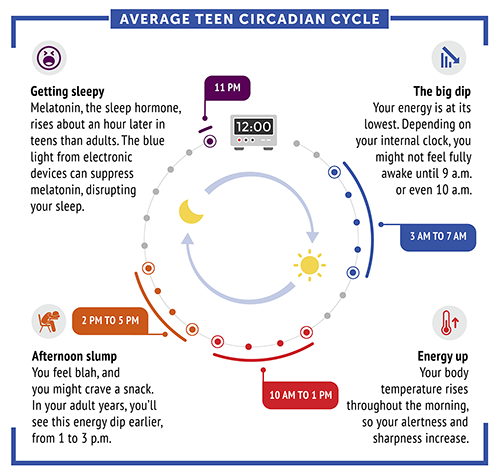
Pulling an occasional all-nighter or extra-early morning may not seem like a big deal. But Dr Goldstein says fatigue isn’t the only consequence of an erratic sleep schedule; it also disrupts your circadian clock, an internal system that regulates hormone levels to promote sleep at night and alertness during the day.
Your circadian clock naturally starts secreting sleep-promoting melatonin around 9 p.m., and levels stay elevated throughout the night before dropping off in the morning, according to the National Sleep Foundation. Light exposure influences circadian rhythms somewhat — which is why you may have trouble sleeping after using screens at night — but if you maintain stable sleep and wake times, your internal clock should be similarly reliable.
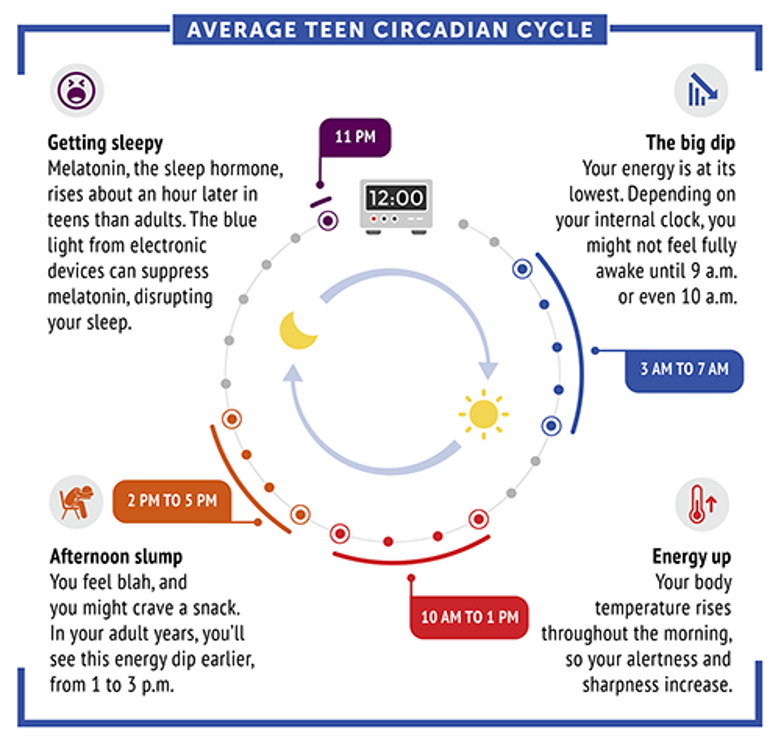
Image credits: https://www.nigms.nih.gov/education/fact-sheets/PublishingImages/circadian-rhythms/circadian-cycle.png
Here, Dr Goldstein explains the consequences to circadian disruption (of any degree):
- Higher chances of suffering cancer, cognitive decline and early death
- Obesity issues. Research linked losing just an hour of sleep to eating about 200 extra calories the next day. The new Current Biology study found that sleep-deprived people snacked more after dinner and experienced negative metabolic changes compared to people who got enough sleep for 10 days in a row, and those changes could not be fully corrected through weekend sleep.
- Worsens productivity
There is lower efficiency displayed at school and workouts the next day, creating a ripple effect that can’t be easily corrected by sleeping more during the weekend.
Therefore, it is important to maintain your body’s natural circadian cycle/rhythm. So, what are the recommended activities that you can be involved in throughout the day?