Archives For Books & People

Can we make Singapore a finer city?

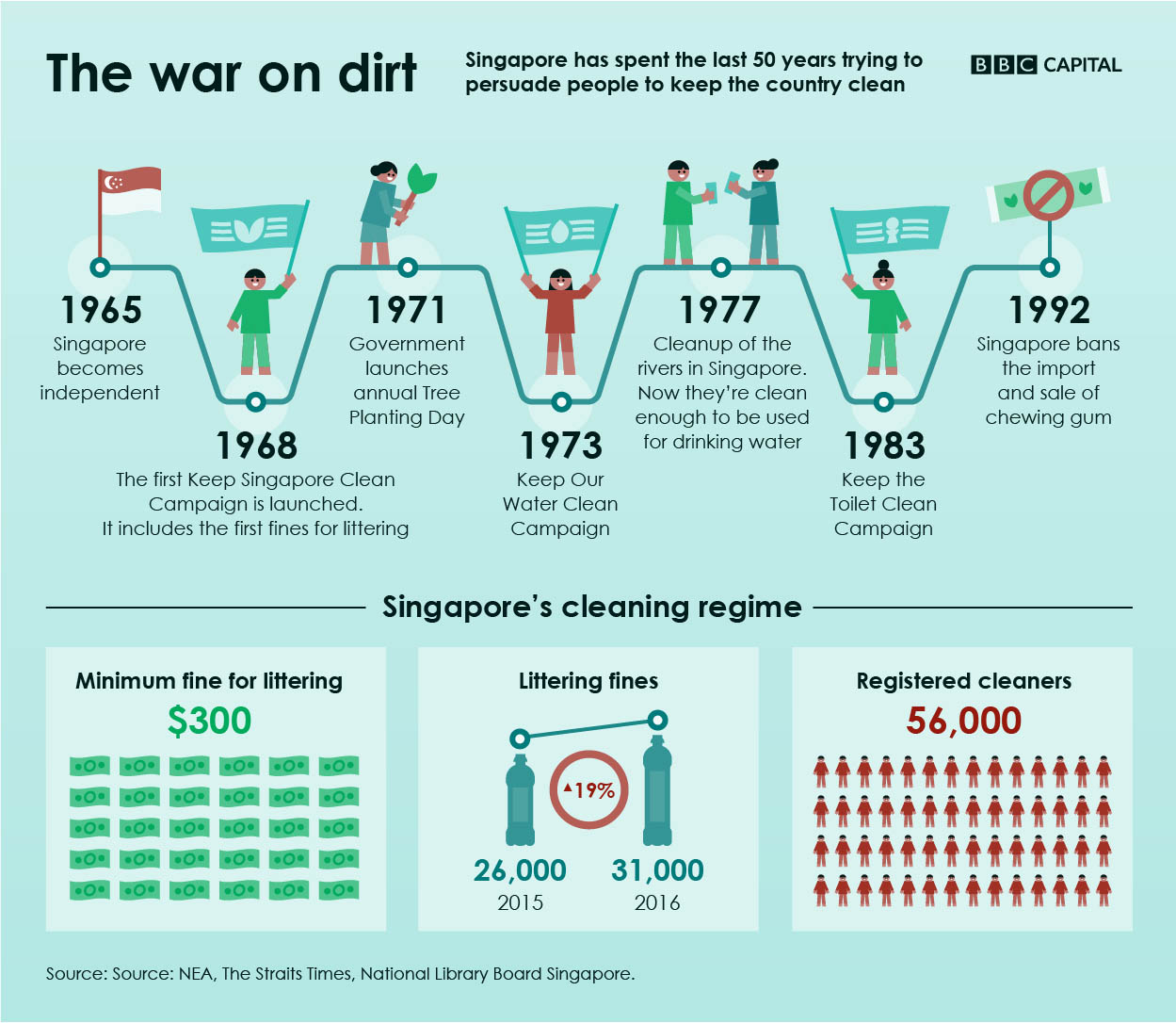
Singapore is known for being a clean country. In 1968 when the ‘Keep Singapore Clean Campaign’ was first introduced, the government believed that “improved environmental conditions would not only enhance the quality of life for Singaporeans and cultivate national pride, but also attract foreign investors and tourists to Singapore”.
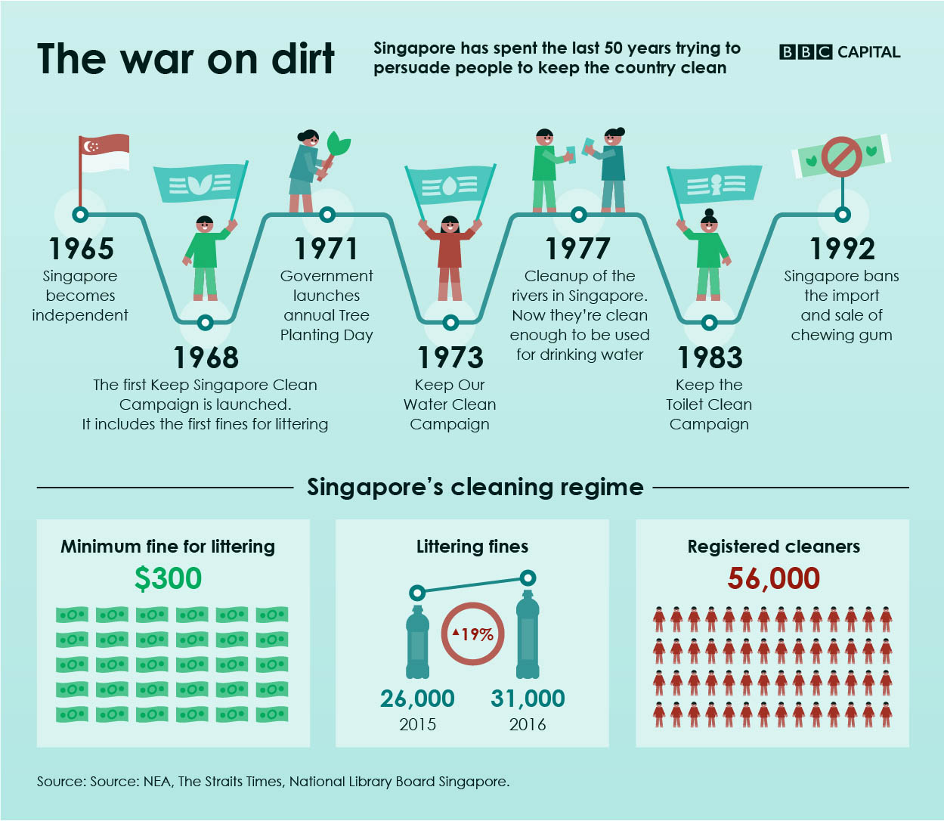
Image taken from: http://ichef.bbci.co.uk/images/ic/raw/p06q5m6z.jpg

However, efforts to keep Singapore clean seem to be mainly a ‘top-down’ approach. Litterbugs may be fined up to $2000 for the first court conviction and sentenced to Corrective Work Order so that they would be more aware of the impact of littering and the difficulties faced by the cleaners.

In 2018, the National Environment Agency (NEA) issued about 39,000 tickets for littering offences as a deterrent. A man was fined $300 by an NEA officer for shooting 2 rubber bands onto the public road.

Image taken from: https://www.facebook.com/roadssg/photos/a.861427330556338/2531812036851184/?type=3

These punitive measures can be effective only to a certain extent because it is a shift in mindset and behaviours of residents of Singapore that will make a long-term impact.

“Singapore is not a clean city. It’s a cleaned city,” Liak Teng Lit, chairman of the National Environment Agency declares.

Singapore spends at least SGD $120 million a year on cleaning public spaces. There are 56,000 cleaners registered with the National Environment Agency and likely thousands of independent contractors who aren’t registered. Mostly they’re low-paid foreign workers or elderly workers. Taipei, by contrast, has maybe 5,000 cleaners.

Edward D’Silva, chairman of the Public Hygiene Council, thinks that “Singaporeans have had it too easy for too long, and they need to change”.

“If you are able to instill and cultivate a habit whereby people don’t throw their litter anywhere and anyhow, then the money you would have otherwise spent to employ those cleaners, well, millions of dollars could have been better spent on health and education,” he said.

Sometimes you might feel that an individual’s efforts in cleaning up the environment are negligible and hence you do not take the initiative to pick up a litter. What happens if every person thinks the same way?

How can we make Singapore really clean?

A shift in mindset and behavior are necessary.

Everyone has a part to play in upholding high standards of cleanliness and public health in Singapore. Do not underestimate the power of your actions and the impact they can have on others. You can influence someone positively or negatively through your actions.

Observe your school environment (school corridors, classrooms, canteens, halls, toilets, field etc…) and answer these questions:

  • Do you know who are the people who help to maintain a clean and hygienic school environment?
  • How old are the cleaners in your school?
  • How much do you think they earn a month?
  • Describe what would happen if there were no cleaners in your school.
  • What can you do to recognise the efforts of the cleaners in your school?
  • How can you play your part in ensuring that the school is clean?

Sources:

https://www.nea.gov.sg/media/news/news/index/enforcement-for-littering-offences-increased-by-almost-22-per-cent-in-2018

https://www.bbc.com/worklife/article/20181025-the-cost-of-keeping-singapore-squeaky-clean

http://eresources.nlb.gov.sg/infopedia/articles/SIP_1160_2008-12-05.html


Be Inclusive

June 6, 2025 — Leave a comment

Leave your judgmental thoughts behind and make the world an inclusive place for people with disabilities

You may have limited interactions with people who have special needs and hence you may feel clueless on how to assist or interact with them. You may also feel that people with disabilities are pitiful. Hopefully as you read the article about persons with disabilities and after finding out more about the types of disabilities, you will develop a more understanding stance towards people who have special needs.

Understanding Persons with Disabilities – Removing Barriers

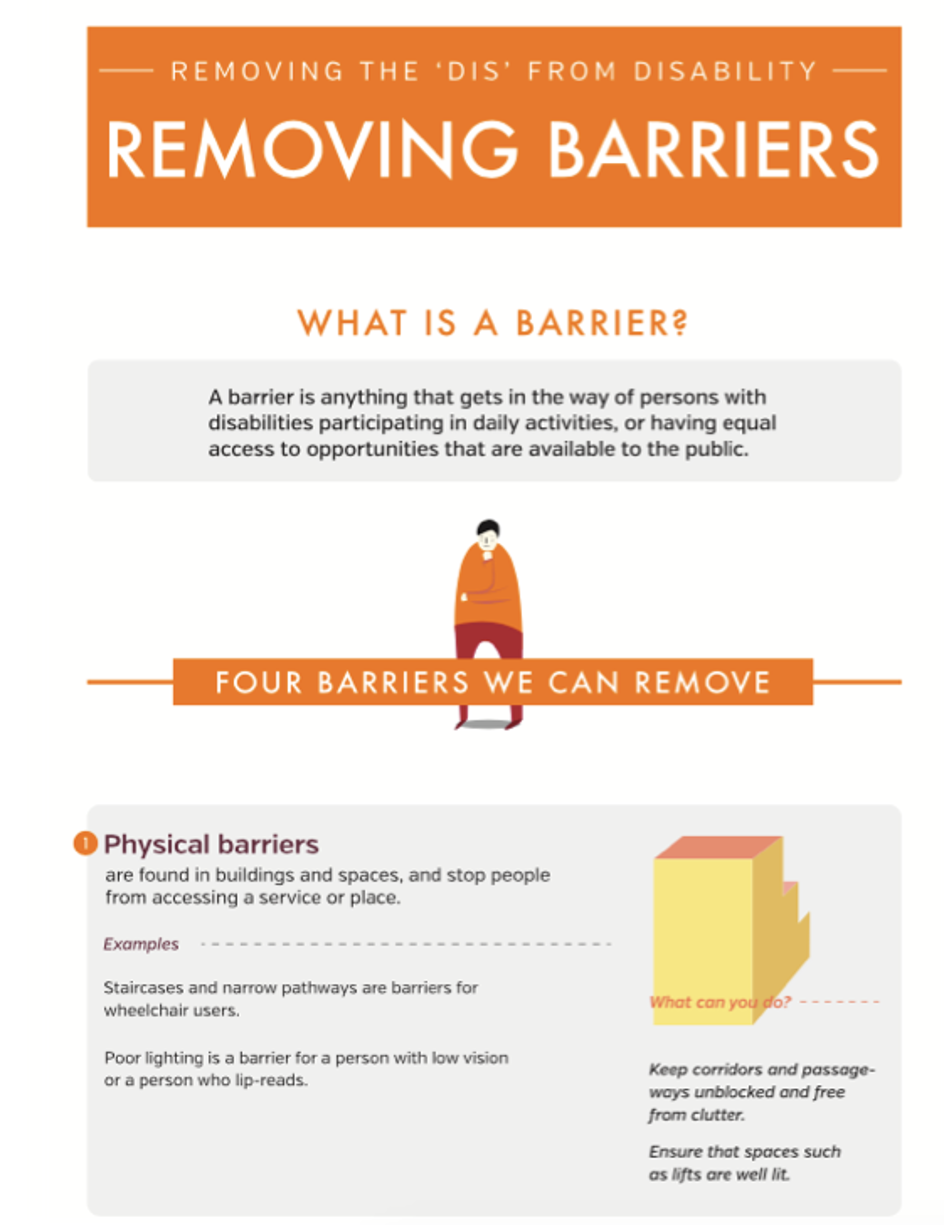
As individuals in a society, we should strive to remove barriers so that society can be more inclusive. What are these barriers and how can you remove them for persons with disabilities?

Physical Barriers

Physical barriers are found in buildings and spaces, and they prevent people from accessing a service or place conveniently. For example, staircases and narrow pathways are barriers for wheelchair users.

Think: Observe your surroundings as you travel, is the physical environment friendly for wheelchair users? Do any of your actions hinder their mobility? For example, blocking entrances and exits of ramps? Is your school physically friendly to students with disabilities?

Attitudinal Barriers

Attitudinal barriers are when people have incorrect understanding and mindsets about disability. For example, people tend to avoid interacting with persons with disabilities for the fear of saying or doing the wrong thing.

Think: What are your preconceived notions about persons with disabilities? What can you do to have a deeper understanding about them? How can we engage them meaningfully?

Information and Communication Barriers

Information and communication barriers stop persons with disabilities from getting information. There are print or digital materials that are not available in Braille or are not suitable for viewing on screen readers. These are barriers for the visually impaired. Audio announcements without visual cues and videos without subtitles are barriers for the deaf.

Think: What can we do to ensure that persons with disabilities can access information easily?

Systemic Barriers

Systemic barriers are policies and practices that discriminate against persons with disabilities. Some examples of systemic barriers are policies that do not allow persons with disabilities to take certain courses in universities.

Think: What principles should policy-makers take into consideration when devising policies? What should you do if you feel that some practices discriminate against persons with disabilities?

How can the school be more inclusive for persons with disabilities?

You may write a formal email to the school leaders to propose some suggestions to your school.

You can also design an infographic to raise awareness on people with special needs.

Source: https://www.ncss.gov.sg/Press-Room/Publications/Detail-Page?id=Understanding-Persons-with-Disabilities

Suggested Videos:

Kathy Buckley – Deaf Comedian Misjudges Quadriplegic
Watch on Facebook: https://www.facebook.com/goalcast/videos/2503107733107713/UzpfSTU2NDYxODQ3MDoxMDE1Njk3Nzg1NzkzMzQ3MQ/

The lure of gaming can be hard to resist. Games certainly provide a respite from the stress in life. However, if you do not prioritise your time wisely, you can easily get sucked into a trap where your time is controlled by different levels and stages of the game, or worst, on endless mode. When your gaming experience is characterized by rapid mouse-clicking and when your eyes are perpetually glued to the screen, ignoring what is really going on in reality, you might have become addicted to games. Game addiction might be more serious than you think it is.

How Using Video Games As Escapism Helped (And Damaged) My Mental Health

I, along with many others, have suffered from depression and anxiety. And as a gamer, my relationship with video games has both positively and negatively impacted my struggles with my mental health.

Perhaps the biggest way that video games have helped me cope is by offering a form of escapism. It doesn’t have to be a high-fantasy title — or even a game that focuses heavily on narrative. Even a simple puzzle game that doesn’t depict a world in any traditional sense can offer a much-needed break from the stresses of everyday life. By fully investing ourselves in a video game, it becomes all we think about — at least, for a short amount of time.

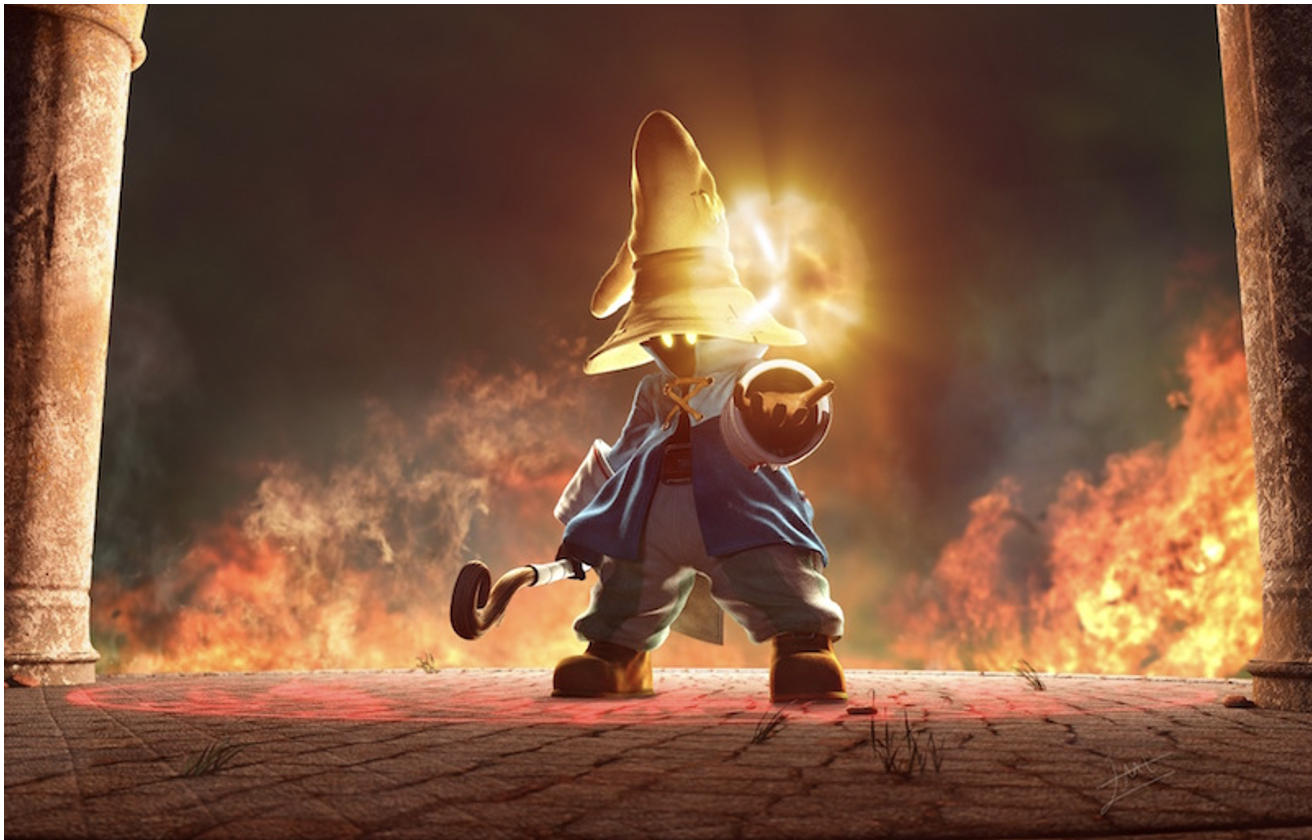
For me, the type of games I first felt could help me escape were high-fantasy Role Playing Games (RPGs). It makes sense; RPGs by their very nature require you to invest in their worlds and believe in their fantastical narrative. It’s kind of the point: you are taking up a new role that requires some form of investment and suspension of disbelief in order to make it a truly enjoyable experience. It was Final Fantasy for me. Those games made me invest in each and every one of their worlds and I was hooked from a young age. In my early years, I played Final Fantasy VII, IX and X almost religiously to take away the worries of school. Taking on the challenge of toppling evil organisations and gods that would have us dead was much less stressful.

When I first started to suffer from depression as a young adult, these games also gave me a place I was able to relax in. Final Fantasy provided a world where Robert Gammon’s real-world problems didn’t exist; only the challenges of the characters within these new worlds did. Playing also allowed me an external outlet to understand certain issues — narratives, especially in RPGs, often explore themes that we can relate to in real life, therefore giving me a safe platform to explore my problems with no consequences of making anything worse in the real world.

The opportunity to escape reality that video games provide can be a much-needed respite, and in turn, this break from the world can give us the energy we need to face our demons. However, like all good tools, it must be used appropriately.

Escapism is all very well when it takes us away from our problems for a short while — but it can become all-consuming, making us unable to face our real life when we most need to. This was my problem. I often let gaming be the answer to my issues instead of tackling them appropriately.

Even with the most difficult level, there is always a solution to the problems that appear in video games. Even when bad things happen, and even when the solution might not seem like a solution, there’s still always some form of progression — either the plot moves forward, or you get to try again. If not, watching a walk-through of the game can easily assist you in overcoming the challenge in games. Sad to say, this isn’t always true of real life.

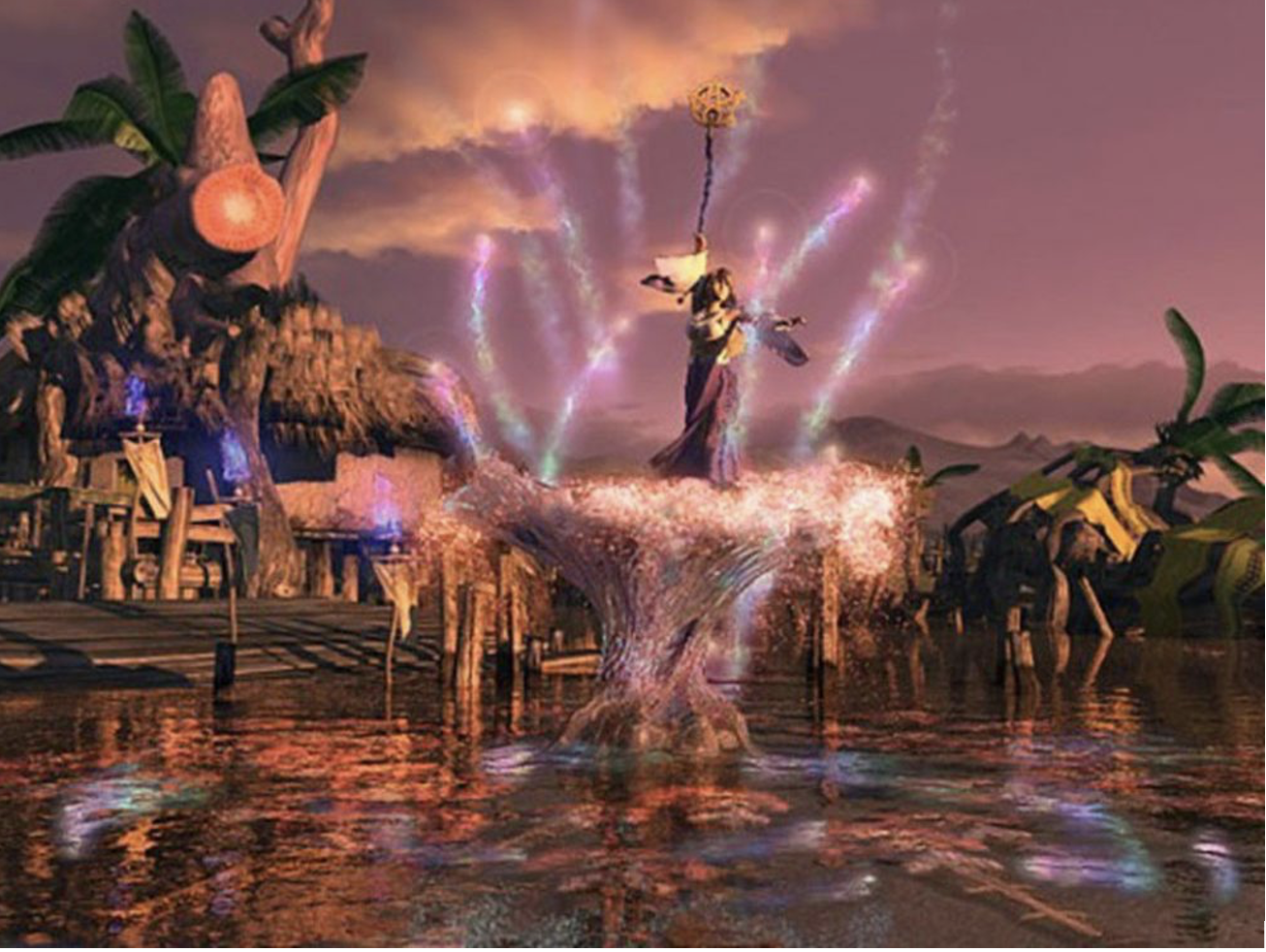
I remember desperately wanting to be in the world of Spira from Final Fantasy X, as I felt that there is meaning in the game. The game gave me clearly set goals that I could achieve; everything was mapped out for me and I knew exactly what I needed to do at any given moment. I couldn’t say the same for real life.

I was becoming dependent on a fictional world, which caused me to neglect the complicated personal issues that were currently going on in my life as well as my depression. The escapism that videos games offered to me had itself become a problem; it exacerbated my issues as I ignored those pressing real life issues that I had to solve. Accepting that the life I needed to focus on wasn’t part of a fantastical video game world was upsetting — but it was a realisation that I needed to make.

Sure, games are fun, and part of their purpose is to offer an escape from the real world. The opportunity to exist in a new world that has no consequence on our day-to-day lives is a great tool for us to be able to relax without the worrying that our actions may impact on our real life. Video games provide a safe playground to enjoy ourselves, learn new personal skills and rid us of our overactive minds.

However, being too involved in the fantasy world can lead us to neglect important problems in our real lives, thereby worsening them. We must make sure that when we escape to ‘new worlds’ we keep rooted to the real world and not be in denial.

Do you empathise with Robert Gammon’s experience with gaming? What would you say to someone who might be addicted to gaming?

If you suspect that you have a game addiction, please do not hesitate to seek help.

You can send an email to: help@wecare.org.sg , or call 6547 5459. One of the professional counsellors from WE CARE Community Services will answer your call. Your email and call will remain confidential.

Source: https://www.gamespew.com/2018/01/escapism-my-mental-health-gaming-experiences/

Reason For Being

January 7, 2025 — Leave a comment

Screenshot 2025-01-07 at 6.44.53 AM

Below are some people who have found their ikigai at different points of their lives. Hopefully after reading the article, you will be inspired to undergo your own journey of self-discovery.

Example 1: Xiuhtezcatl Martinez, Youth Director of Earth Guardians


Xiuhtezcatl Martinez is a prime example of one who has found his ikigai at a young age. At the early age of six, Xiuhtezcatl began speaking around the world, from the Rio+20 United Nations Summit in Rio de Janeiro, to addressing the General Assembly at the United Nations in New York city. He aims to educate his generation about the state of the Earth they are inheriting and to inspire youths into action to protect the Earth.


Xiuhtezcatl and his sister, Isa, are conscious hip-hop artists and activists who write and produce music to tell the stories of the movements and issues facing the world from the perspective of young ambitious musicians. Their music brings movements to the masses, written to inspire people to pursue their passions and use art as a form of resistance to create change, battle oppression, bring people together, and tell their stories. They have spoken and performed in the United Nations and at events, colleges, conferences, and music festivals worldwide.

Hip-Hop Environmental Activism: Xiuhtezcatl Martinez at TEDxYouth@MileHigh: https://www.youtube.com/watch?v=o2V2yVkedtM

Information taken from: https://www.earthguardians.org/xiuhtezcatl

Example 2: Poet/rapper/Facebook sensation Prince Ea


Prince Ea has woven his love and concern for humanity and Earth with a gift for capturing profound messages into powerfully creative 3-5 minute videos – an expression of ikigai which galvanises the energy and support of millions of people online each week.

Over a decade ago, he was making music with grand ambitions of gaining respect, being named the best rapper of all time and performing in front of thousands of fans. This egoic pursuit caused a lot of suffering. He began to compare himself with other musicians who were “further along” than he was and this caused much internal pain. The suffering and unhappiness were so overwhelming that he stopped making music and decided that he simply wanted to be happy.

This was when he began to read ancient and modern texts on spirituality. Through literature and introspection, he realized that “doing” will never make him happy, it is only in “being” where happiness and peace arises. Also, the realization of the brevity of life was what led him to create the content he produces now. He feels grateful for every moment, every unrepeatable miracle, and he wants to reach every single heart on the planet to show people that at our core, “We are love, we are free, and we are one”.

Before you go to school, Watch this – What is school for? https://www.youtube.com/watch?v=_PsLRgEYf9E

Information taken from: https://princeea.com/about/

 Example 3: Founder of Voices For Animals


Derrick Tan was a hooligan in his younger days. He failed his studies, joined various gangs, sniffed glue, did drugs, was arrested for rioting and had other unsavoury habits. Now, Derrick is a well-known animal activist in Singapore.

How did he find his ikigai? A turning point in his life was when he started National Service and was assigned to the Police Dog Unit. He discovered his strengths in managing and training canines and even won a few awards for dog handling in the force. His passion took him places. He was sent to Britain where he learnt how to train dogs to sniff out explosives. Derrick spent nine years with the police force. When he was 29, he decided he needed to explore other options. “I wanted to find out what I could do,” says Mr Tan, who continued working as a volunteer with various animal welfare groups. There were stints as a marketing executive in the marine industry and as an interior designer but he did not like the jobs.

“I used to volunteer at a dog shelter next to a breeding farm. I’d seen the conditions. The animals were always housed in small cages, and were often neglected. I just felt very sad for them.” He decided to take seven months off and his passion led him to set up Voices For Animals, a shelter for abused and abandoned breeding dogs. Derrick has definitely found a purpose in life – being the voice for voiceless animals. Now he aims to create more awareness about responsible pet ownership and to educate people on treating animals humanely. Derrick’s experience showed that discovering one’s ikigai can take a significant amount of time and effort but ultimately, that will lead to a greater sense of purpose in life.

The Good Word Project: Derrick

https://www.youtube.com/watch?time_continue=45&v=vshi1cCitww

Read more about Derrick’s story on:  https://www.straitstimes.com/opinion/it-changed-my-life-glue-sniffer-turned-animal-activist


When is the last time you did absolutely nothing for 10 whole minutes? Not texting, talking or even thinking? Mindfulness expert Andy Puddicombe describes the transformative power of doing just that: Refreshing your mind for 10 minutes a day, simply by being mindful and experiencing the present moment.


Simon & Garfunkel – The Sound of Silence – Madison Square Garden, NYC – 2009/10/29&30

Watch Simon and Garfunkel perform 44 years after the song was first released in 1965


Sound of Silence lyrics

Hello darkness, my old friend
I’ve come to talk with you again
Because a vision softly creeping
Left its seeds while I was sleeping
And the vision that was planted in my brain
Still remains
Within the sound of silence

In restless dreams I walked alone
Narrow streets of cobblestone
‘Neath the halo of a street lamp
I turned my collar to the cold and damp
When my eyes were stabbed by the flash of a neon light
That split the night
And touched the sound of silence

And in the naked light I saw
Ten thousand people, maybe more
People talking without speaking
People hearing without listening
People writing songs that voices never share
And no one dared
Disturb the sound of silence

Fools, said I, you do not know
Silence like a cancer grows
Hear my words that I might teach you
Take my arms that I might reach you
But my words, like silent raindrops fell
And echoed in the wells of silence

And the people bowed and prayed
To the neon god they made
And the sign flashed out its warning
In the words that it was forming
And the sign said, the words of the prophets are written on the subway walls
And tenement halls
And whispered in the sound of silence

Songwriters: Paul Simon

The Sound of Silence lyrics © Universal Music Publishing Group


By Kori Morgan

Millions of music fans have been moved by Paul Simon’s lyrics since his career began in the 1960s. In particular, the 1966 Simon and Garfunkel hit “The Sound of Silence” has left an indelible mark on pop culture. Told from the perspective of a speaker who dreams of a more spiritually conscious world, the lyrics paint a disturbing picture of a society wrought with materialism and self-absorption. “The Sound of Silence” contains numerous poetic elements, including figurative language devices, rhyme scheme and tone.

Personification

In poetry, personification gives human characteristics to an object or idea. To emphasize the speaker’s isolation, Simon uses personification by having him speak directly to “darkness, my old friend.” The speaker desires to encourage people to find meaning in their lives beyond commercial culture, but no one will listen, except for the darkness he awakens to after dreaming of a chance to address them. The second line, “I’ve come to talk with you again,” tells readers that these nighttime conversations are habitual, further emphasizing the speaker’s status as an outcast.

Simile

A simile is a poetic device where the author describes something through a comparison, using the words “like” or “as.” In “The Sound of Silence,” the speaker uses a simile when he states that “silence like a cancer grows.” The people in his dream worship material culture at the expense of relationships with others, and the comparison of their silence to cancer emphasizes the destructiveness of this lifestyle. The speaker uses another simile when he says that although he pleads with them to listen, “my words like silent raindrops fell.” Like rain, his pleas fall quietly and unnoticed.

Rhyme

Rhyme is the use of similar sounds to create unity within a poem or song. In “The Sound of Silence,” Simon uses end rhyme, a type of rhyme that occurs when lines end with the same sound. For example, the first verse contains end rhyme through the words “friend” and “again,” “creeping” and “sleeping” and “brain” and “remains.” The final line of the verse ends with the word “silence,” but no corresponding rhyming line, creating a beat of actual silence in its absence.

Paradox

The University of California Stanislaus defines paradox as “an apparent contradiction that is nonetheless true.” It might seem impossible that the people in the song can be “talking without speaking” or “hearing without listening,” since on the surface, these words appear to be synonyms. However, Simon uses these paradoxes to imply that the people’s relationships and conversations are so superficial and limited that they fail to have any connection or deeper interaction. In this case, paradox makes us think about the level of alienation these subjects experience.

Tone

Tone is the speaker’s attitude toward the subject of a poem. In “The Sound of Silence,” the speaker feels he has an important message to deliver to the people entrenched in materialism, but they are too busy worshiping “the neon god” of culture to care. The speaker’s tone can therefore be described as solemn and disappointed. From the fact that only darkness will listen to his message to the people’s ultimate rejection, it is clear that he is saddened by the narrowness of their lives and that they are unable to look for something deeper.